Loading...
Done
Revellers enjoy a night out in central Liverpool, northwest England, on December 30, 2020 before hightened Tier 3 restrictions closing hospitality venues, and bars indoor and outdoor socialising between households are imposed in the city amid surging cases of the novel coronavirus. Tighter coronavirus restrictions will be extended across England from on December 30 the British government announced, with a new Covid-19 variant blamed for a rapid surge in cases. Liverpool enters Tier 3, which closes hospitality venues, and bars indoor and outdoor socialising between households with the highest Tier 4 rules, which require all non-essential shops, hairdressers as well as leisure and entertainment venues to close, will now apply to more than 44 million people. (Photo by Oli Scarff/AFP Photo)

Revellers enjoy a night out in central Liverpool, northwest England, on December 30, 2020 before hightened Tier 3 restrictions closing hospitality venues, and bars indoor and outdoor socialising between households are imposed in the city amid surging cases of the novel coronavirus. (Photo by Oli Scarff/AFP Photo)
Details
01 Mar 2021 08:47:00
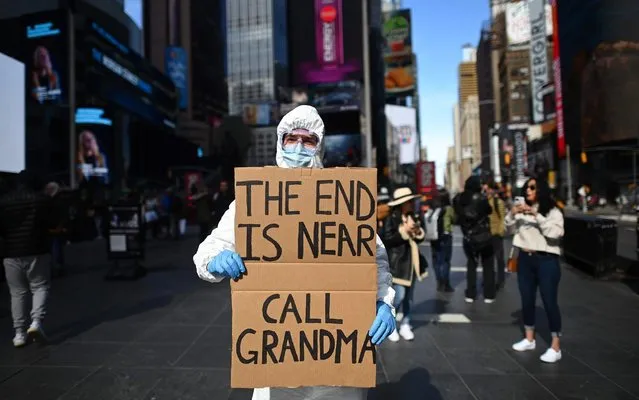
A man wearing a hazmat suit and a mask holds a sign reading “The end is near – call grandma” at Times Square on March 14, 2020 in New York City. The World Health Organization said March 13, 2020 it was not yet possible to say when the COVID-19 pandemic, which has killed more than 5,000 people worldwide, will peak. “It's impossible for us to say when this will peak globally”, Maria Van Kerkhove, who heads the WHO's emerging diseases unit, told a virtual press conference, adding that “we hope that it is sooner rather than later”. (Photo by Johannes Eisele/AFP Photo)

A man wearing a hazmat suit and a mask holds a sign reading “The end is near – call grandma” at Times Square on March 14, 2020 in New York City. The World Health Organization said March 13, 2020 it was not yet possible to say when the COVID-19 pandemic, which has killed more than 5,000 people worldwide, will peak. “It's impossible for us to say when this will peak globally”, Maria Van Kerkhove, who heads the WHO's emerging diseases unit, told a virtual press conference, adding that “we hope that it is sooner rather than later”. (Photo by Johannes Eisele/AFP Photo)
Details
16 Mar 2020 00:07:00
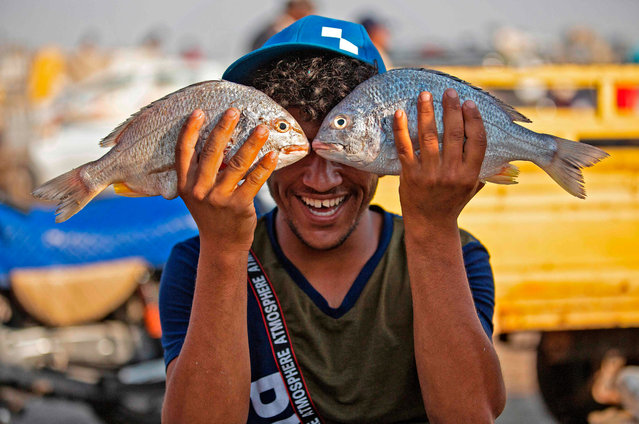
A youth poses while holding two fishes before his face in Iraq's southern port city of al-Faw, 90 kilometres south of Basra near the Shatt al-Arab and the Gulf, on May 18, 2020. In Iraq, a national lockdown to halt the COVID-19 coronavirus pandemic has found some unexpected fans: local businesses who no longer have to compete with Turkish, Iranian or Chinese imports. Those countries, as well as Saudi Arabia, Jordan and Kuwait, typically flood Iraqi markets with inexpensive products at prices local producers can't compete with. (Photo by Hussein Faleh/AFP Photo)

A youth poses while holding two fishes before his face in Iraq's southern port city of al-Faw, 90 kilometres south of Basra near the Shatt al-Arab and the Gulf, on May 18, 2020. In Iraq, a national lockdown to halt the COVID-19 coronavirus pandemic has found some unexpected fans: local businesses who no longer have to compete with Turkish, Iranian or Chinese imports. Those countries, as well as Saudi Arabia, Jordan and Kuwait, typically flood Iraqi markets with inexpensive products at prices local producers can't compete with. (Photo by Hussein Faleh/AFP Photo)
Details
02 Jul 2020 00:01:00
A picture taken on April 27, 2021, shows the electrical wires running between homes in the capital Baghdad's Murabaa neighbourhood. Between January and March alone, the interior ministry recorded 7,000 fires, the deadliest of which erupted on Sunday in a Covid-19 hospital in Baghdad. Eighty-two people died and 100 others were injured in the inferno, which sparked shock and outrage in the country. Baghdad, a sprawling metropolis of 10 million people, has the tragic distinction of being the Iraqi city hit by the most fires every year. (Photo by Sabah Arar/AFP Photo)

A picture taken on April 27, 2021, shows the electrical wires running between homes in the capital Baghdad's Murabaa neighbourhood. Between January and March alone, the interior ministry recorded 7,000 fires, the deadliest of which erupted on Sunday in a Covid-19 hospital in Baghdad. Eighty-two people died and 100 others were injured in the inferno, which sparked shock and outrage in the country. Baghdad, a sprawling metropolis of 10 million people, has the tragic distinction of being the Iraqi city hit by the most fires every year. (Photo by Sabah Arar/AFP Photo)
Details
06 May 2021 08:26:00
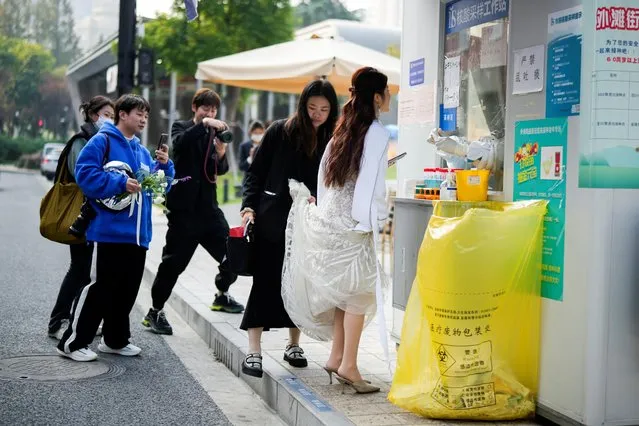
A bride gets tested for the coronavirus disease (COVID-19) at a nucleic acid testing site, following the coronavirus disease (COVID-19) outbreak in Shanghai, China on November 15, 2022. (Photo by Aly Song/Reuters)

A bride gets tested for the coronavirus disease (COVID-19) at a nucleic acid testing site, following the coronavirus disease (COVID-19) outbreak in Shanghai, China on November 15, 2022. (Photo by Aly Song/Reuters)
Details
23 Nov 2022 04:11:00
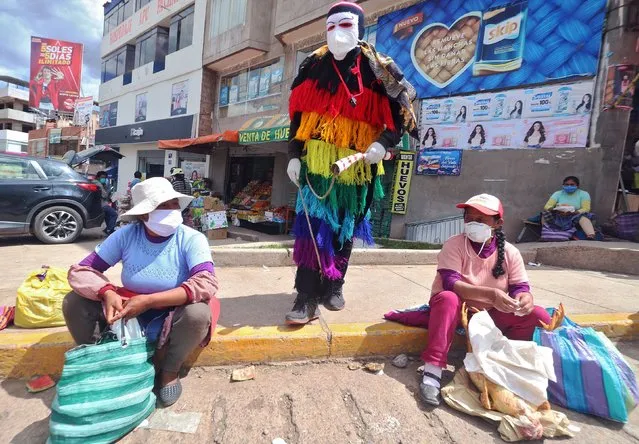
A man dressed in Andean attire as “Ukukus” or “Pabluchas”, a traditional character that acts as a vigilante imposing social order, uses a whip as a threat to force people to maintain their distance and remind them to wear face masks and gloves as a preventive measure against the novel coronavirus COVID-19, in the Vinocanchon market area in San Jeronimo district, close to the Peruvian Andean city of Cusco, on May 2, 2020. The government has identified public markets as major hotspots of the new coronavirus in Peru, where 40,459 confirmed cases and 1,124 deaths were reported on May 1. (Photo by Jose Carlos Angulo/AFP Photo)

A man dressed in Andean attire as “Ukukus” or “Pabluchas”, a traditional character that acts as a vigilante imposing social order, uses a whip as a threat to force people to maintain their distance and remind them to wear face masks and gloves as a preventive measure against the novel coronavirus COVID-19, in the Vinocanchon market area in San Jeronimo district, close to the Peruvian Andean city of Cusco, on May 2, 2020. The government has identified public markets as major hotspots of the new coronavirus in Peru, where 40,459 confirmed cases and 1,124 deaths were reported on May 1. (Photo by Jose Carlos Angulo/AFP Photo)
Details
04 May 2020 00:07:00
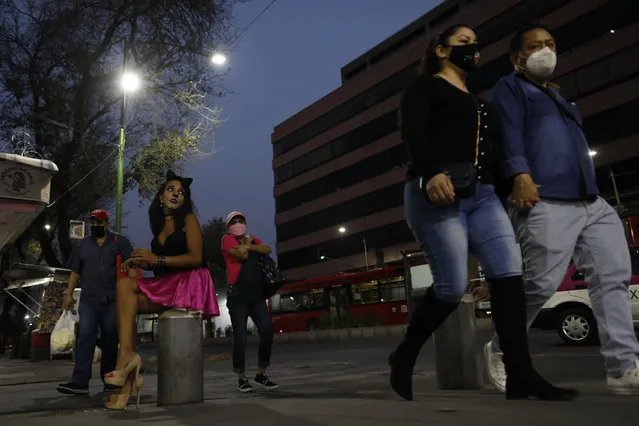
Sеx worker Geraldine wearing cat make-up sits on her usual corner as she waits for clients outside the Revolution subway station, in Mexico City, Saturday, March 13, 2021. Geraldine, 30, a sеx worker since age 15, says many of her regular clients have stopped coming amid the coronavirus pandemic and that seeing new clients presents new health and security risks. She is most concerned about the risk of bringing COVID-19 home to her partner, who has diabetes. (Photo by Rebecca Blackwell/AP Photo)

Sеx worker Geraldine wearing cat make-up sits on her usual corner as she waits for clients outside the Revolution subway station, in Mexico City, Saturday, March 13, 2021. Geraldine, 30, a sеx worker since age 15, says many of her regular clients have stopped coming amid the coronavirus pandemic and that seeing new clients presents new health and security risks. She is most concerned about the risk of bringing COVID-19 home to her partner, who has diabetes. (Photo by Rebecca Blackwell/AP Photo)
Details
24 Jan 2022 05:17:00
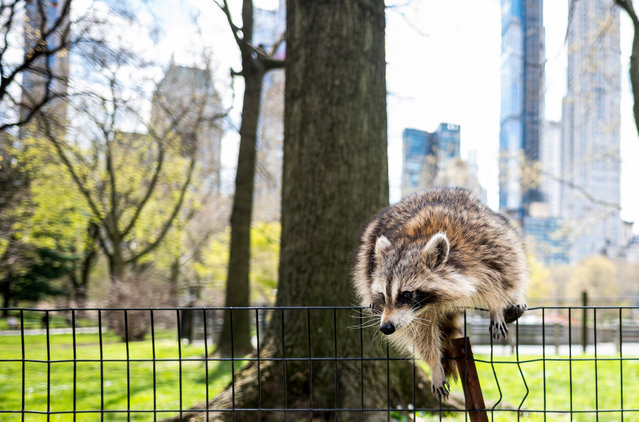
A racoon jumps over a fence in almost deserted Central Park in Manhattan on April 16, 2020 in New York City. Gone are the softball games, horse-drawn carriages and hordes of tourists. In their place, pronounced birdsong, solitary walks and renewed appreciation for Central Park's beauty during New York's coronavirus lockdown. The 843-acre (341-hectare) park – arguably the world's most famous urban green space – normally bustles with human activity as winter turns to spring, but this year due to Covid-19 it's the wildlife that is coming out to play. (Photo by Johannes Eisele/AFP Photo)

A racoon jumps over a fence in almost deserted Central Park in Manhattan on April 16, 2020 in New York City. Gone are the softball games, horse-drawn carriages and hordes of tourists. In their place, pronounced birdsong, solitary walks and renewed appreciation for Central Park's beauty during New York's coronavirus lockdown. The 843-acre (341-hectare) park – arguably the world's most famous urban green space – normally bustles with human activity as winter turns to spring, but this year due to Covid-19 it's the wildlife that is coming out to play. (Photo by Johannes Eisele/AFP Photo)
Details
14 Dec 2025 07:04:00