Loading...
Done
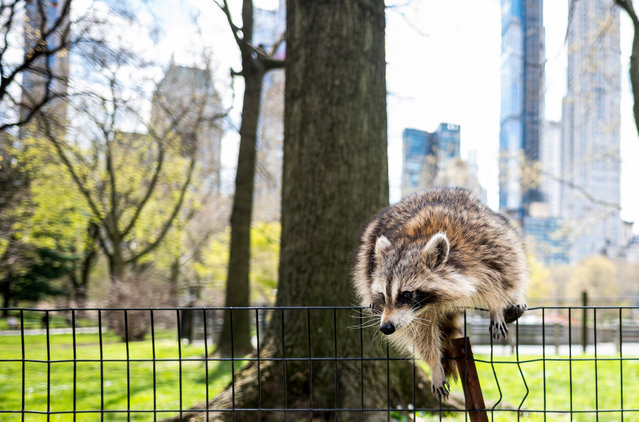
A racoon jumps over a fence in almost deserted Central Park in Manhattan on April 16, 2020 in New York City. Gone are the softball games, horse-drawn carriages and hordes of tourists. In their place, pronounced birdsong, solitary walks and renewed appreciation for Central Park's beauty during New York's coronavirus lockdown. The 843-acre (341-hectare) park – arguably the world's most famous urban green space – normally bustles with human activity as winter turns to spring, but this year due to Covid-19 it's the wildlife that is coming out to play. (Photo by Johannes Eisele/AFP Photo)

A racoon jumps over a fence in almost deserted Central Park in Manhattan on April 16, 2020 in New York City. Gone are the softball games, horse-drawn carriages and hordes of tourists. In their place, pronounced birdsong, solitary walks and renewed appreciation for Central Park's beauty during New York's coronavirus lockdown. The 843-acre (341-hectare) park – arguably the world's most famous urban green space – normally bustles with human activity as winter turns to spring, but this year due to Covid-19 it's the wildlife that is coming out to play. (Photo by Johannes Eisele/AFP Photo)
Details
14 Dec 2025 07:04:00
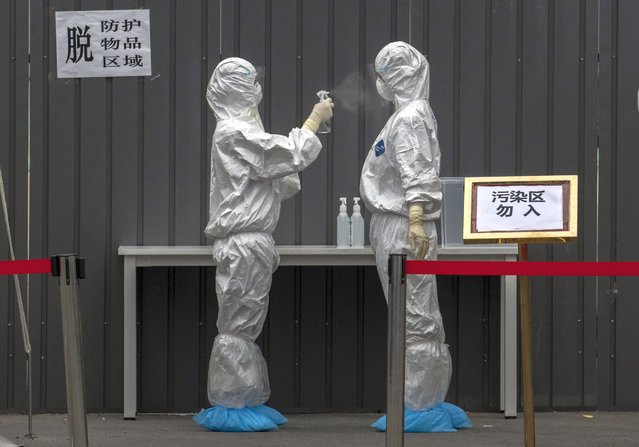
Chinese epidemic control workers wear protective suits as they disinfect each other after performing nucleic acid swab test for COVID-19 on citizens at a government testing site in Xicheng District during an organized tour on June 24, 2020 in Beijing, China. While Chinese government medical officials have said they believe they have controlled the spread, authorities are trying to contain the outbreak linked to the Xinfadi wholesale food market, Beijing's biggest supplier of produce and meat. More than 2.5 million people have undergone nucleic acid tests for COVID-19 at dozens of sites across the city in recent days, with officials using contact tracing to target high and middle risk areas and people who may have had contact with the market or food that came from there. Several neighborhoods have been locked down and a number of other food markets have been closed, The outbreak has triggered fears of a second wave of infection after 56 straight days with no domestically transmitted cases in the capital. (Photo by Kevin Frayer/Getty Images)

Chinese epidemic control workers wear protective suits as they disinfect each other after performing nucleic acid swab test for COVID-19 on citizens at a government testing site in Xicheng District during an organized tour on June 24, 2020 in Beijing, China. While Chinese government medical officials have said they believe they have controlled the spread, authorities are trying to contain the outbreak linked to the Xinfadi wholesale food market, Beijing's biggest supplier of produce and meat. (Photo by Kevin Frayer/Getty Images)
Details
26 Jun 2020 00:01:00
Revellers enjoy a night out in central Liverpool, northwest England, on December 30, 2020 before hightened Tier 3 restrictions closing hospitality venues, and bars indoor and outdoor socialising between households are imposed in the city amid surging cases of the novel coronavirus. Tighter coronavirus restrictions will be extended across England from on December 30 the British government announced, with a new Covid-19 variant blamed for a rapid surge in cases. Liverpool enters Tier 3, which closes hospitality venues, and bars indoor and outdoor socialising between households with the highest Tier 4 rules, which require all non-essential shops, hairdressers as well as leisure and entertainment venues to close, will now apply to more than 44 million people. (Photo by Oli Scarff/AFP Photo)

Revellers enjoy a night out in central Liverpool, northwest England, on December 30, 2020 before hightened Tier 3 restrictions closing hospitality venues, and bars indoor and outdoor socialising between households are imposed in the city amid surging cases of the novel coronavirus. (Photo by Oli Scarff/AFP Photo)
Details
01 Mar 2021 08:47:00
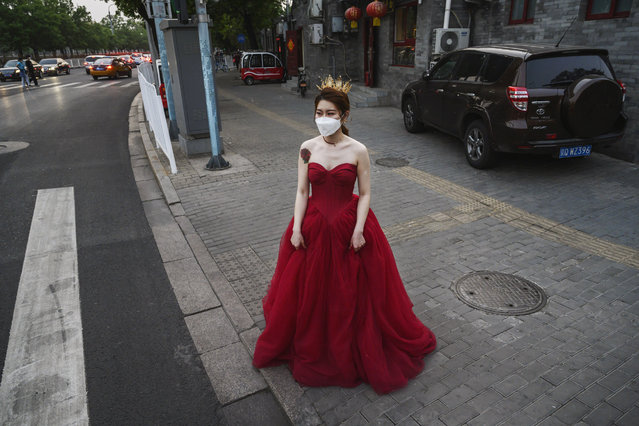
A Chinese woman wears her dress and a protective mask as she waits to change after taking pictures in advance of her wedding near the Forbidden City, on April 30, 2020 in Beijing, China. Beijing lowered its risk level after more than three months Thursday in advance of the May holiday, allowing most domestic travellers arriving in the city to do so without having to do 14 days of quarantine. The Forbidden City will open to a limited number of visitors as of Thursday morning. After decades of growth, officials said China's economy had shrunk in the latest quarter due to the impact of the coronavirus epidemic. The slump in the world's second largest economy is regarded as a sign of difficult times ahead for the global economy. While industrial sectors in China are showing signs of reviving production, a majority of private companies are operating at only 50% capacity, according to analysts. With the pandemic hitting hard across the world, officially the number of coronavirus cases in China is dwindling, ever since the government imposed sweeping measures to keep the disease from spreading. Officials believe the worst appears to be over in China, though there are concerns of another wave of infections as the government attempts to reboot the world's second largest economy. Since January, China has recorded more than 81,000 cases of COVID-19 and at least 3,200 deaths, mostly in and around the city of Wuhan, in central Hubei province, where the outbreak first started. (Photo by Kevin Frayer/Getty Images)

A Chinese woman wears her dress and a protective mask as she waits to change after taking pictures in advance of her wedding near the Forbidden City, on April 30, 2020 in Beijing, China. Beijing lowered its risk level after more than three months Thursday in advance of the May holiday, allowing most domestic travellers arriving in the city to do so without having to do 14 days of quarantine. (Photo by Kevin Frayer/Getty Images)
Details
03 May 2020 00:07:00
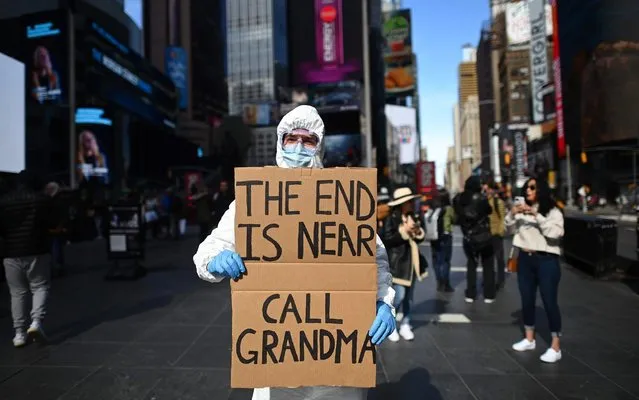
A man wearing a hazmat suit and a mask holds a sign reading “The end is near – call grandma” at Times Square on March 14, 2020 in New York City. The World Health Organization said March 13, 2020 it was not yet possible to say when the COVID-19 pandemic, which has killed more than 5,000 people worldwide, will peak. “It's impossible for us to say when this will peak globally”, Maria Van Kerkhove, who heads the WHO's emerging diseases unit, told a virtual press conference, adding that “we hope that it is sooner rather than later”. (Photo by Johannes Eisele/AFP Photo)

A man wearing a hazmat suit and a mask holds a sign reading “The end is near – call grandma” at Times Square on March 14, 2020 in New York City. The World Health Organization said March 13, 2020 it was not yet possible to say when the COVID-19 pandemic, which has killed more than 5,000 people worldwide, will peak. “It's impossible for us to say when this will peak globally”, Maria Van Kerkhove, who heads the WHO's emerging diseases unit, told a virtual press conference, adding that “we hope that it is sooner rather than later”. (Photo by Johannes Eisele/AFP Photo)
Details
16 Mar 2020 00:07:00
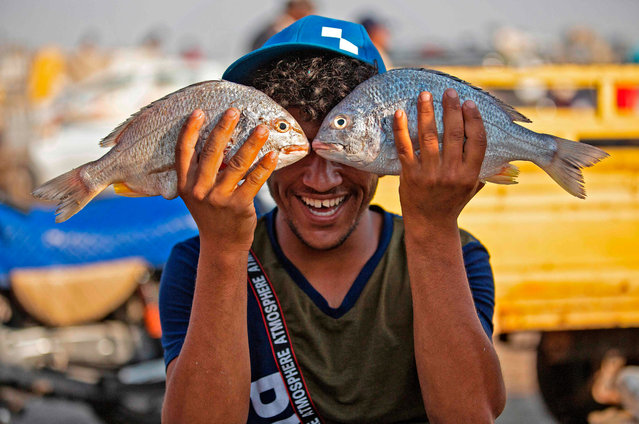
A youth poses while holding two fishes before his face in Iraq's southern port city of al-Faw, 90 kilometres south of Basra near the Shatt al-Arab and the Gulf, on May 18, 2020. In Iraq, a national lockdown to halt the COVID-19 coronavirus pandemic has found some unexpected fans: local businesses who no longer have to compete with Turkish, Iranian or Chinese imports. Those countries, as well as Saudi Arabia, Jordan and Kuwait, typically flood Iraqi markets with inexpensive products at prices local producers can't compete with. (Photo by Hussein Faleh/AFP Photo)

A youth poses while holding two fishes before his face in Iraq's southern port city of al-Faw, 90 kilometres south of Basra near the Shatt al-Arab and the Gulf, on May 18, 2020. In Iraq, a national lockdown to halt the COVID-19 coronavirus pandemic has found some unexpected fans: local businesses who no longer have to compete with Turkish, Iranian or Chinese imports. Those countries, as well as Saudi Arabia, Jordan and Kuwait, typically flood Iraqi markets with inexpensive products at prices local producers can't compete with. (Photo by Hussein Faleh/AFP Photo)
Details
02 Jul 2020 00:01:00
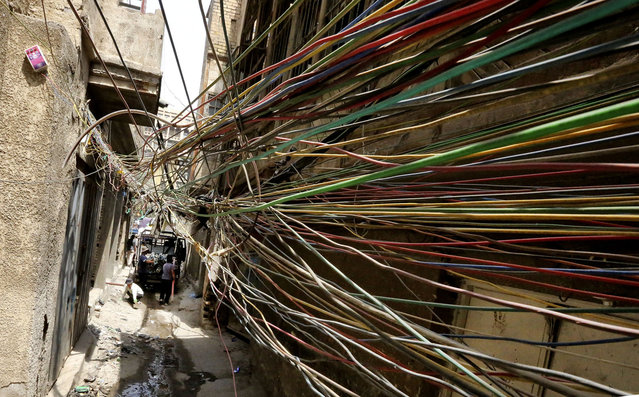
A picture taken on April 27, 2021, shows the electrical wires running between homes in the capital Baghdad's Murabaa neighbourhood. Between January and March alone, the interior ministry recorded 7,000 fires, the deadliest of which erupted on Sunday in a Covid-19 hospital in Baghdad. Eighty-two people died and 100 others were injured in the inferno, which sparked shock and outrage in the country. Baghdad, a sprawling metropolis of 10 million people, has the tragic distinction of being the Iraqi city hit by the most fires every year. (Photo by Sabah Arar/AFP Photo)

A picture taken on April 27, 2021, shows the electrical wires running between homes in the capital Baghdad's Murabaa neighbourhood. Between January and March alone, the interior ministry recorded 7,000 fires, the deadliest of which erupted on Sunday in a Covid-19 hospital in Baghdad. Eighty-two people died and 100 others were injured in the inferno, which sparked shock and outrage in the country. Baghdad, a sprawling metropolis of 10 million people, has the tragic distinction of being the Iraqi city hit by the most fires every year. (Photo by Sabah Arar/AFP Photo)
Details
06 May 2021 08:26:00
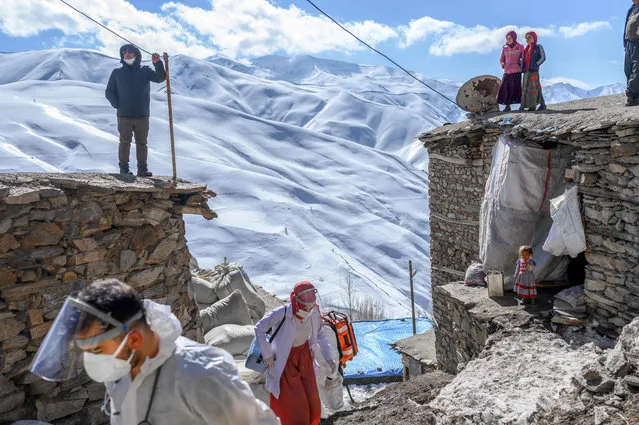
In this photograph taken on February 15, 2021, doctor Sergen Saracoglu (L) and nurse Yilzdiz Ayten (C) from the Bahcesaray public hospital vaccination team, arrive at the village of Guneyyamac in eastern Turkey, as part of an expedition to vaccinate residents of 65 years old or above with Sinovac's CoronaVac Covid-19 vaccine. Turkey's population of more than 83 million is spread out across Europe and Asia and covers some seemingly impregnable terrain. The vaccination effort with China's CoronaVac jab kicked off with a bang in mid-January when Turkey inoculated more than half a million people in the first few days. But it slowed down considerably when doctors left the big cities and tried to reach remote places such as Imamli and Ozbeyli – two ethnically Kurdish hamlets of a few hundred herders and farmers each. (Photo by Bulent Kilic/AFP Photo)

In this photograph taken on February 15, 2021, doctor Sergen Saracoglu (L) and nurse Yilzdiz Ayten (C) from the Bahcesaray public hospital vaccination team, arrive at the village of Guneyyamac in eastern Turkey, as part of an expedition to vaccinate residents of 65 years old or above with Sinovac's CoronaVac Covid-19 vaccine. (Photo by Bulent Kilic/AFP Photo)
Details
18 Mar 2021 09:32:00