Loading...
Done
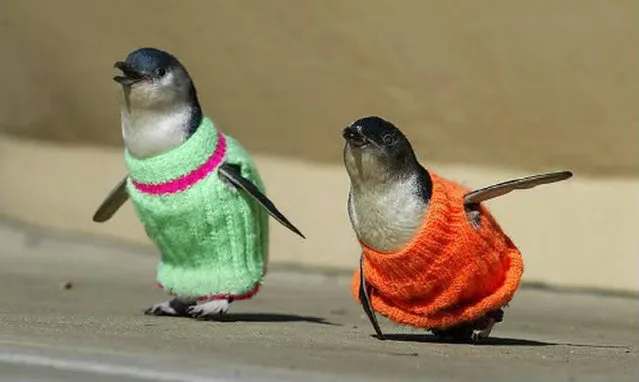
New Zealand Penguins in Need of Sweaters

Penguin sweaters, also known as penguin jumpers, are sweaters which are knitted for penguins that have been caught in oil slicks. When an oil spill affects penguins, they are dressed in knitted sweaters to stop them preening their feathers and to keep them warm, since the spilled oil destroys their natural oils. This also prevents them from poisoning themselves by ingesting the oil. The sweaters are removed and discarded as soon as the penguins can be washed. The original project has been completed, but the knitting pattern is still available on-line, as subsequent oil spills make it necessary. The extra sweaters are kept on behalf of the Wildlife Rescue Team.
Details
31 Oct 2012 13:06:00
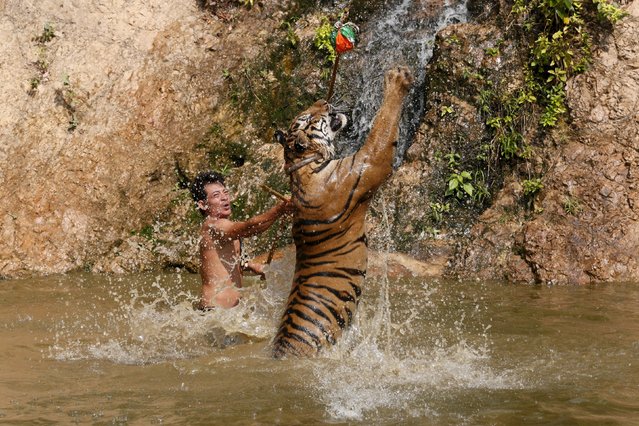
A tiger jumps while being trained at the Tiger Temple in Kanchanaburi province, west of Bangkok, Thailand, February 25, 2016. Thailand's controversial Tiger Temple, dogged for years by talk that it supplies the black market and mistreats its animals, is fighting to keep the big cats after wildlife authorities rejected a bid to extend a zoo licence that expired in 2013. (Photo by Chaiwat Subprasom/Reuters)

A tiger jumps while being trained at the Tiger Temple in Kanchanaburi province, west of Bangkok, Thailand, February 25, 2016. Thailand's controversial Tiger Temple, dogged for years by talk that it supplies the black market and mistreats its animals, is fighting to keep the big cats after wildlife authorities rejected a bid to extend a zoo licence that expired in 2013. The Buddhist temple, home to more than 100 tigers, has been investigated for suspected links to wildlife trafficking and wildlife activists have accused it of illegal breeding of the animals. Thai wildlife authorities have sent ten of the temple's tigers to a wildlife sanctuary. But the temple, which bills itself as a wildlife sanctuary, has denied links to illegal trafficking, and wants to hold on to its tigers. (Photo by Chaiwat Subprasom/Reuters)
Details
29 Feb 2016 11:56:00
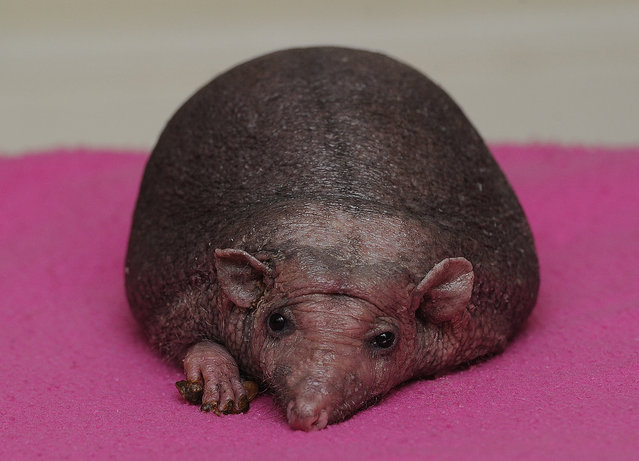
Meet the world's smoothest cuddliest hedgehog. Names after brave hero, but Nelson is completely bald so when curled up he looks like an egg. Doesn't have a single prickle or strand of hair. Thought to be suffering a stress related alopecia following a trauma in the wild. Volunteers have been massaging him for half an hour a day for the last year to encourage spikes to grow. Now given up but he still gets daily massages because he enjoys them so much and to keep his cuddle skin soft and smooth. Unlike his namesake Nelson could not defend himself so will live out his days at the Foxy Lodge Wildlife Rescue in Hemsby, England. (Photo by Jeremy Durkin)

Meet the world's smoothest cuddliest hedgehog. Names after brave hero, but Nelson is completely bald so when curled up he looks like an egg. Doesn't have a single prickle or strand of hair. Thought to be suffering a stress related alopecia following a trauma in the wild. Volunteers have been massaging him for half an hour a day for the last year to encourage spikes to grow. Now given up but he still gets daily massages because he enjoys them so much and to keep his cuddle skin soft and smooth. Unlike his namesake Nelson could not defend himself so will live out his days at the Foxy Lodge Wildlife Rescue in Hemsby, England. (Photo by Jeremy Durkin)
Details
23 Oct 2016 11:33:00
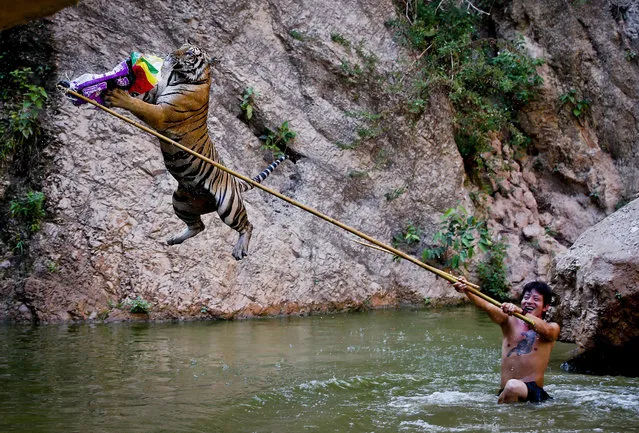
A picture made available 26 April 2016 shows a tiger playing in the water with a trainer nicknamed “Super Tiger Man” at the Tiger Temple in Kanchanaburi province, Thailand, 24 April 2016. The site known in Thai as “Wat Pa Luangta Maha Bua Yannasampanno” has been the focus of a dispute with the Department of National Parks, Wildlife and Plant Conservation (DNP) after the DNP asked in 2015 that the temple hands over its 147 tigers since it was not licensed to keep them. The temple has requested for a zoo license according to its managing director. (Photo by Diego Azubel/EPA)

A picture made available 26 April 2016 shows a tiger playing in the water with a trainer nicknamed “Super Tiger Man” at the Tiger Temple in Kanchanaburi province, Thailand, 24 April 2016. The site known in Thai as “Wat Pa Luangta Maha Bua Yannasampanno” has been the focus of a dispute with the Department of National Parks, Wildlife and Plant Conservation (DNP) after the DNP asked in 2015 that the temple hands over its 147 tigers since it was not licensed to keep them. The temple has requested for a zoo license according to its managing director. (Photo by Diego Azubel/EPA)
Details
01 Jun 2016 12:44:00
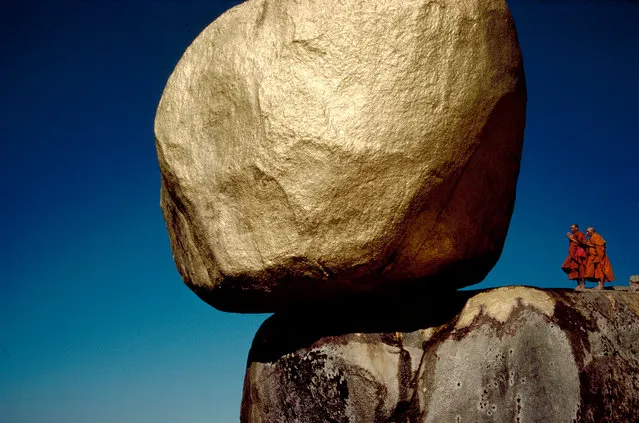
Kyaiktiyo, Burma, 1978. The Golden Rock at Shwe Pyi Daw (the Golden Country), the Buddhist holy place. Hiroji Kubota writes: “I was desperate to keep a distance from America for a while; luckily, I found Burma and its gentle and compassionate people. In the spring of 1978, on the top of the hill where I took this photo, I had two Leica bodies: the one with Tri-X and the other with Kodachrome 64. Soon after, I realised that the colour one looked very colourful and was more powerful. That was my decisive moment, to become a colour photographer”. (Photo by Hiroji Kubota/Magnum Photos)

Kyaiktiyo, Burma, 1978. The Golden Rock at Shwe Pyi Daw (the Golden Country), the Buddhist holy place. Hiroji Kubota writes: “I was desperate to keep a distance from America for a while; luckily, I found Burma and its gentle and compassionate people. In the spring of 1978, on the top of the hill where I took this photo, I had two Leica bodies: the one with Tri-X and the other with Kodachrome 64. Soon after, I realised that the colour one looked very colourful and was more powerful. That was my decisive moment, to become a colour photographer”. (Photo by Hiroji Kubota/Magnum Photos)
Details
10 Jun 2016 13:30:00
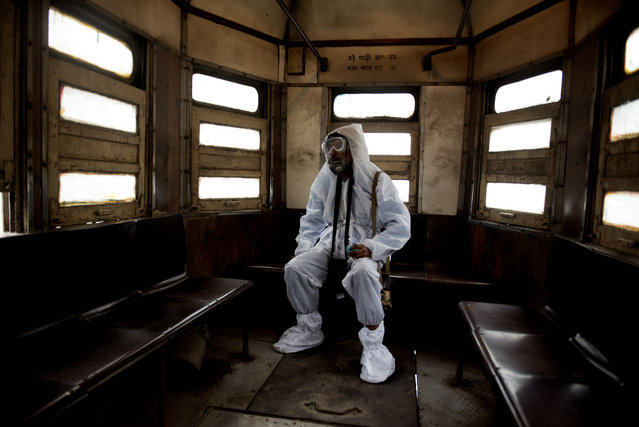
Fighting Infections (single image) | Fighting Pandemic by Sudipto Das. “It’s exhausting. A tram conductor in Kolkata, India, wears protective clothing from head to toe even in the heat of a summer afternoon. This was when restrictions were easing after India’s first Covid-19 lockdown – public transport was running, but staff were advised to suit up like this. We’ve all grown used to saluting the efforts of healthcare workers, but plenty of other people in public-facing jobs have performed gruelling duties too to keep people safe”. (Photo by Sudipto Das/Wellcome Photography Prize 2021)

Fighting Infections (single image) | Fighting Pandemic by Sudipto Das. “It’s exhausting. A tram conductor in Kolkata, India, wears protective clothing from head to toe even in the heat of a summer afternoon. This was when restrictions were easing after India’s first Covid-19 lockdown – public transport was running, but staff were advised to suit up like this. We’ve all grown used to saluting the efforts of healthcare workers, but plenty of other people in public-facing jobs have performed gruelling duties too to keep people safe”. (Photo by Sudipto Das/Wellcome Photography Prize 2021)
Details
29 Jun 2021 09:49:00
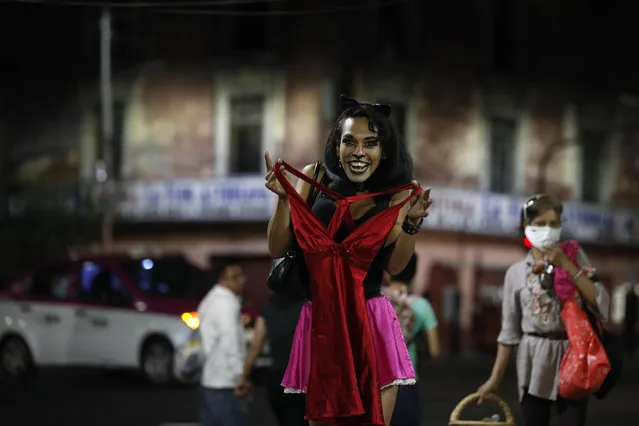
Sеx worker Geraldine, wearing cat make-up, excitedly holds up a dress she is thinking of buying from a street vendor, so that her partner, sitting nearby to keep her company, can see it, as she waits for clients outside the Revolution subway station, in Mexico City, Saturday, March 13, 2021. According to Geraldine, 30, the pandemic has cut clients and increased risks to the sеx workers but has also brought out more assistance for them too, both from dedicated organizations such as the activist group Brigada Callejera or “The Street Brigade” and from individuals who have donated food or clothing. (Photo by Rebecca Blackwell/AP Photo)

Sеx worker Geraldine, wearing cat make-up, excitedly holds up a dress she is thinking of buying from a street vendor, so that her partner, sitting nearby to keep her company, can see it, as she waits for clients outside the Revolution subway station, in Mexico City, Saturday, March 13, 2021. According to Geraldine, 30, the pandemic has cut clients and increased risks to the sеx workers but has also brought out more assistance for them too, both from dedicated organizations such as the activist group Brigada Callejera or “The Street Brigade” and from individuals who have donated food or clothing. (Photo by Rebecca Blackwell/AP Photo)
Details
25 Apr 2021 07:38:00
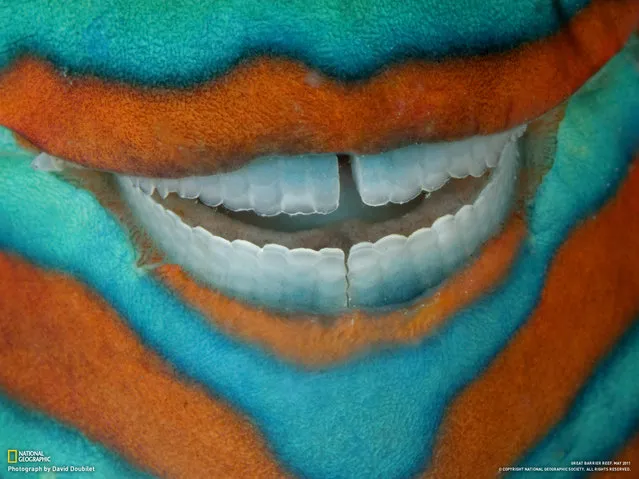
Photographers: David Doubilet

“David Doubilet (born 28 November 1946) is a well known underwater photographer known primarily for his work published in National Geographic Magazine. He was born in New York and started taking photos underwater at the young age of 12. He started with a Brownie Hawkeye in a rubber anesthesiologist's bag to keep the water out of the camera. During his summer holidays, he spent his time along the New Jersey coast. He later worked as a diver and photographer for the Sandy Hook Marine Laboratories in New Jersey. He also spent much time in the Caribbean. While a dive instructor in the Bahamas he found his motivation to capture the beauty of the sea and everything in it”. – Wikipedia. (Photo by David Doubilet/National Geographic)
Details
16 May 2012 12:21:00