Loading...
Done
Giant Crystal Cave in Naica, Mexico

Cave of the Crystals or Giant Crystal Cave is a cave connected to the Naica Mine 300 metres (980 ft) below the surface in Naica, Chihuahua, Mexico. The main chamber contains giant selenite crystals (gypsum, CaSO4·2 H2O), some of the largest natural crystals ever found. The cave's largest crystal found to date is 12 m (39 ft) in length, 4 m (13 ft) in diameter and 55 tons in weight. The cave is extremely hot with air temperatures reaching up to 58 °C (136 °F) with 90 to 99 percent humidity. The cave is relatively unexplored due to these factors. Without proper protection people can only endure approximately ten minutes of exposure at a time.
Details
20 May 2014 07:56:00
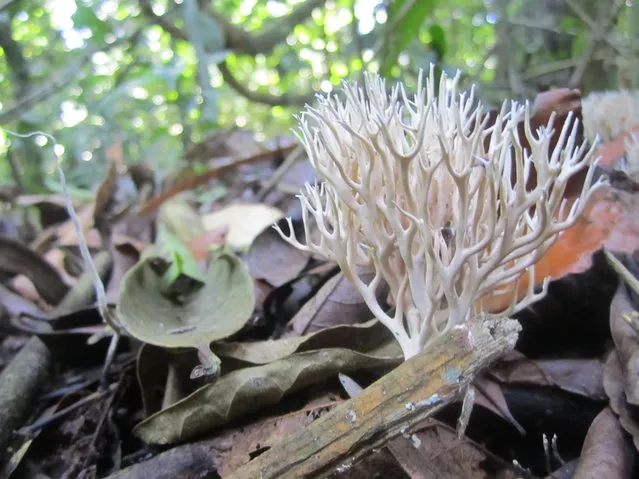
This strange coral-looking specimen is actually a mushroom. The photo, “Beautiful Destroyer”, was taken in the Panamanian tropical rainforest where the mushroom produces nitrogen, an element vital to soil health. (Photo by Sarah A. Batterman)

This strange coral-looking specimen is actually a mushroom. The photo, “Beautiful Destroyer”, was taken in the Panamanian tropical rainforest where the mushroom produces nitrogen, an element vital to soil health. (Photo by Sarah A. Batterman)
Details
13 Aug 2014 09:49:00
Tourists sit around a bonfire on the Makgadikgadi salt pan in Botswana. (Photo by Yang Mengxi/Xinhua News Agency/Barcroft Media)

Tourists sit around a bonfire on the Makgadikgadi salt pan in Botswana. (Photo by Yang Mengxi/Xinhua News Agency/Barcroft Media)
Details
27 Feb 2020 00:05:00
Marines of the Baltic Fleet forces of the Russian Navy train in the zone of obstacles during military exercises at the Khmelevka firing ground in the Kaliningrad region, Russia on November 24, 2021. (Photo by Vitaly Nevar/Reuters)

Marines of the Baltic Fleet forces of the Russian Navy train in the zone of obstacles during military exercises at the Khmelevka firing ground in the Kaliningrad region, Russia on November 24, 2021. (Photo by Vitaly Nevar/Reuters)
Details
20 Dec 2021 07:30:00
A fan cheers during the African Cup of Nations Group F soccer match between DR Congo and Zambia in San Pedro, Ivory Coast, Wednesday, January 17, 2024. (Photo by Themba Hadebe/AP Photo)

A fan cheers during the African Cup of Nations Group F soccer match between DR Congo and Zambia in San Pedro, Ivory Coast, Wednesday, January 17, 2024. (Photo by Themba Hadebe/AP Photo)
Details
31 Mar 2025 04:11:00
Centre of the Heart Nebula by Ivan Eder (Hungary). Situated 7500 light years away in the ‘W’-shaped constellation of Cassiopeia, the Heart Nebula is a vast region of glowing gas, energized by a cluster of young stars at its centre. The image depicts the central region, where dust clouds are being eroded and moulded into rugged shapes by the searing cosmic radiation. (Photo by Ivan Eder)

The competition, which is run by the Royal Observatory Greenwich in association with BBC Sky at Night Magazine, is now in its sixth year and has received over 2,500 entries. Photo: Centre of the Heart Nebula by Ivan Eder (Hungary). Situated 7500 light years away in the “W”-shaped constellation of Cassiopeia, the Heart Nebula is a vast region of glowing gas, energized by a cluster of young stars at its centre. The image depicts the central region, where dust clouds are being eroded and moulded into rugged shapes by the searing cosmic radiation. (Photo by Ivan Eder)
Details
03 Jul 2014 11:59:00
The fairy chimneys are seen with light illuminations created with different techniques in Cappadocia, Nevsehir, Turkiye on August 01, 2024. Fairy chimneys are formed by volcanic eruptions and erosions over millions of years and are considered as one of the unique characteristics of the geography. (Photo by Harun Ozalp/Anadolu via Getty Images)

The fairy chimneys are seen with light illuminations created with different techniques in Cappadocia, Nevsehir, Turkiye on August 01, 2024. Fairy chimneys are formed by volcanic eruptions and erosions over millions of years and are considered as one of the unique characteristics of the geography. (Photo by Harun Ozalp/Anadolu via Getty Images)
Details
27 Aug 2024 02:58:00
Astronomy Photographer Of The Year 2013 Part2

The Royal Observatory just announced its Astronomy Photographer Of The Year 2013 winners. Australian photographer Mark Gee was chosen among a thousand amateur and professional photographers around the globe to win the top title. His work is part of an exhibition of the winning photographers, which opened on Sept. 19 at the Royal Observatory Greenwich. The Royal Observatory shared with us the winners and notable mentions of the competition. Their descriptions of the prizewinners can be found below the images.
Details
05 Oct 2013 12:23:00