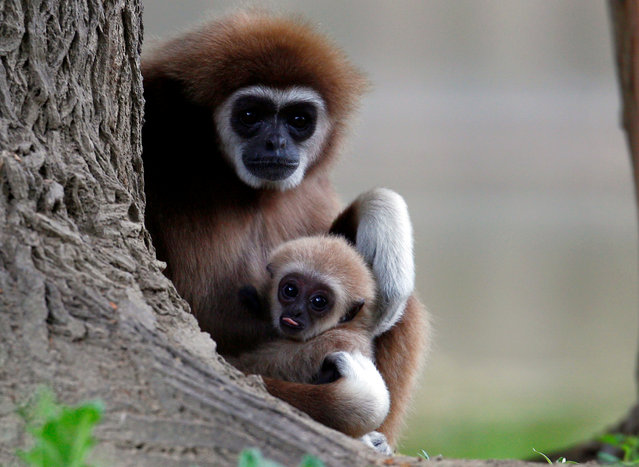
A first white-handed gibbon infant born at the Skopje Zoo is seen with his mother in Skopje, North Macedonia on May 9, 2019. (Photo by Ognen Teofilovski/Reuters)
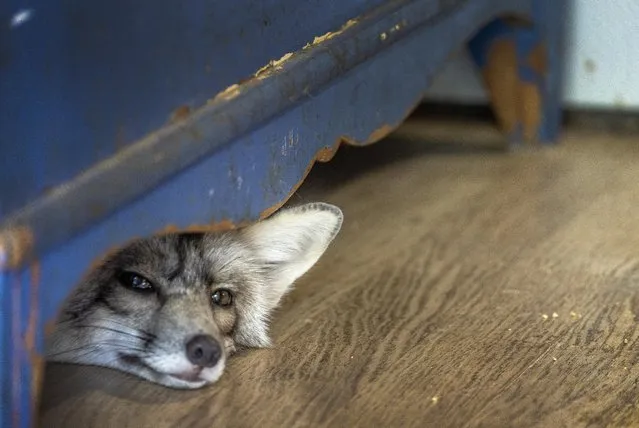
A rescued red fox rests under a closet at “Pawsitive Beginnings” fox rescue sanctuary in Key Largo, Florida, USA on August 1, 2023. Pawsitive Beginnings is a nonprofit group that works closely with organizations in parts of the USA where fur farming takes place to find permanent placement for foxes when needed. According to Pawsitive Beginnings, about 300 fur farms operate in the United States and there are very few federal laws to regulate the treatment of these animals born in captivity, raised for one year, and then killed for their coats. (Photo by Cristobal Herrera-Ulashkevich/EPA/EFE)
A 6-month old female giant panda cub, an offspring of Xing Xing, formerly known as Fu Wa and Liang Liang, formerly known as Feng Yi, plays at the Giant Panda Conservation Center at the National Zoo in Kuala Lumpur, Malaysia, Thursday, February 18, 2016. (Photo by Joshua Paul/AP Photo)
The Sphinx breed of cat “Adam vom Feisastern” of the German breeder Sabine Braeuer waits on a jury table during an annual International Pedigree Dog and Cat Show in Erfurt, Germany on June 10, 2012. (Photo by Jens Meyer/Associated Press)
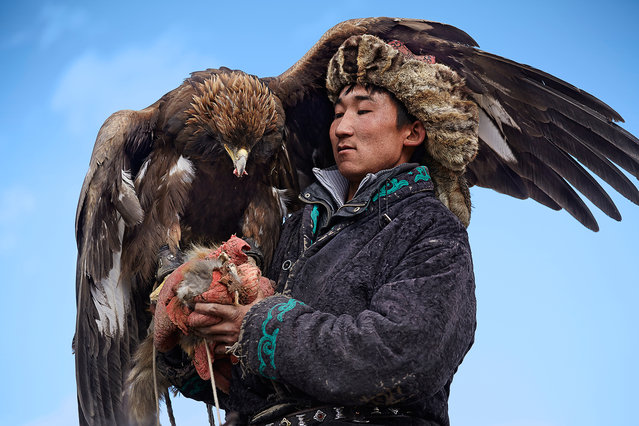
In one of the planet’s most desolate and harsh terrains, the Altai Mountains which run from Siberia in Russia down to Mongolia’s Gobi Desert, hunting with eagles is currently only practiced by a handful of Kyrgyz and Kazakhs. This form of falconry, the practice of hunting with the aid of birds of prey, can be traced back as far as 4,000 years in Central Asia. Here: after a successful hunt, a proud hunter rewards his eagle by feeding it the lungs of the prey, which is considered the most highly prized part of the animal. (Photo by Tariq Zaidi/The Washington Post)