Loading...
Done
A golden huddle by Minqiang Lu, China. Two females and a male golden snub-nosed monkey huddle together to keep warm in the extreme cold. Threatened by forest loss and fragmentation, this endangered species is confined to central China. Restricted to living high up in the temperate forests, these monkeys – here in the Qinling mountains in Shaanxi province – feed mostly in the trees, on leaves, bark, buds and lichen. In heavy wind and snow, Minqiang walked up the mountain carrying his equipment. He stayed for half an hour in temperatures of –10C opposite the tree where the group was huddled before achieving this eye-level composition. (Photo by Minqiang Lu/Wildlife Photographer of the Year)

A golden huddle by Minqiang Lu, China. Two females and a male golden snub-nosed monkey huddle together to keep warm in the extreme cold. Threatened by forest loss and fragmentation, this endangered species is confined to central China. Restricted to living high up in the temperate forests, these monkeys – here in the Qinling mountains in Shaanxi province – feed mostly in the trees, on leaves, bark, buds and lichen. In heavy wind and snow, Minqiang walked up the mountain carrying his equipment. He stayed for half an hour in temperatures of –10C opposite the tree where the group was huddled before achieving this eye-level composition. (Photo by Minqiang Lu/Wildlife Photographer of the Year)
Details
12 Jan 2023 01:19:00
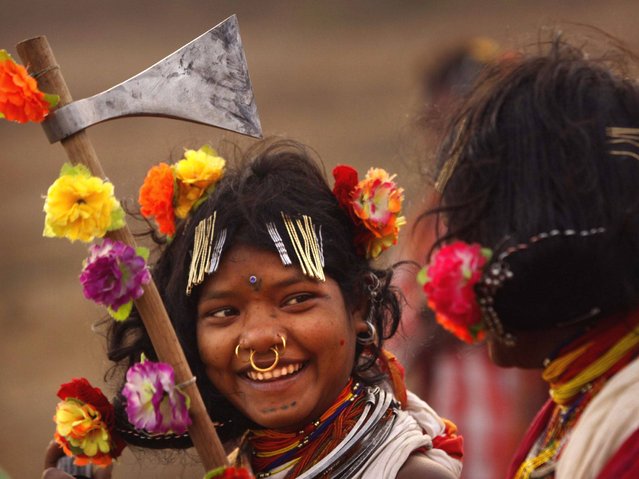
A Dongria tribe girl holds her traditional weapon and dance on the last day of their two days long Niyamraja Festival atop of the Niyamgiri hills near Lanjigarh in Kalahandi district, Orissa state. (Photo by Biswaranjan Rout/AP Photo)

A Dongria tribe girl holds her traditional weapon and dance on the last day of their two days long Niyamraja Festival atop of the Niyamgiri hills near Lanjigarh in Kalahandi district, Orissa state. (Photo by Biswaranjan Rout/AP Photo)
Details
25 Feb 2014 12:41:00
21 year-old Chanel Tapper, with the amazing tongue and 35 year-old Aevin Dugas, with the beautiful hair was certified as world record breakers for the world’s longest tongue and the world’s biggest afro in the Guinness Book of World Records. (Photo by Guinness World Records)

21 year-old Chanel Tapper, with the amazing tongue and 35 year-old Aevin Dugas, with the beautiful hair was certified as world record breakers for the world’s longest tongue and the world’s biggest afro in the Guinness Book of World Records. (Photo by Guinness World Records)
Details
10 Jan 2013 14:45:00
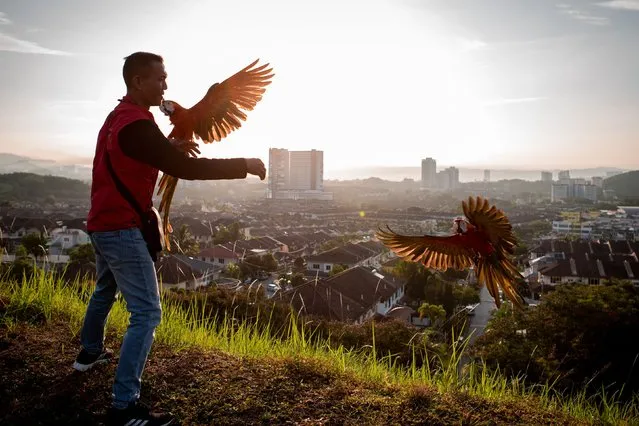
A parrot breeder and his parrots are seen at the Damai Perdana hill in the Cheras region ahead of the May 31 World Parrot Day in Kuala Lumpur, Malaysia on May 29, 2022. A group of parrot breeders in the capital Kuala Lumpur performed a “free flight” performance with different species of parrots. (Photo by Syaiful Redzuan/Anadolu Agency via Getty Images)

A parrot breeder and his parrots are seen at the Damai Perdana hill in the Cheras region ahead of the May 31 World Parrot Day in Kuala Lumpur, Malaysia on May 29, 2022. A group of parrot breeders in the capital Kuala Lumpur performed a “free flight” performance with different species of parrots. (Photo by Syaiful Redzuan/Anadolu Agency via Getty Images)
Details
23 Jul 2022 05:01:00
A child looks at a reveller dressed as devil on the eve of Saint Nicholas Day in Prague, Czech Republic on December 5, 2022. (Photo by David W. Cerny/Reuters)

A child looks at a reveller dressed as devil on the eve of Saint Nicholas Day in Prague, Czech Republic on December 5, 2022. (Photo by David W. Cerny/Reuters)
Details
01 Feb 2024 07:49:00
Fuzzbucket. “Not only did we keep our jobs, but because of the pictures, all the kittens were adopted within hours!”. (Photo by  Seth Casteel/Hachette Australia)

California-based photographer Seth Casteel made his name taking photographs of dogs underwater, but before that, he was snapping cats on land. In fact, they were his first animal subjects. Casteel’s new book, Pounce – a follow-up to his bestselling Underwater Dogs and Underwater Puppies – features more than 80 photographs of playful cats doing what they do best. Here: Fuzzbucket. (Photo by Seth Casteel/Hachette Australia)
Details
18 Nov 2016 11:21:00
Kawakanih Yawalapiti, 9, Upper Xingu region of Mato Grosso, Brazil, 2018: Kawakanih lives with her tribe, the Yawalapiti, in Xingu national park, a preserve in the Amazon basin of Brazil. The Yawalapiti collect seeds to preserve species unique to their ecosystem, which lies between the rain forest and savannah. Kawakanih’s diet is simple, consisting mainly of fish, cassava, porridge, fruit and nuts. “It takes five minutes to catch dinner”, says Kawakanih. “When you’re hungry, you just go to the river with your net”. (Photo by Gregg Segal/The Guardian)

Photographer Gregg Segal travelled the world to document children and the food they eat in a week. Partly inspired by the increasing problems of childhood obesity, he tracked traditional regional diets as yet unaffected by globalisation, and ironically, found that the healthiest diets were often eaten by the least well off. (Photo by Gregg Segal/The Guardian)
Details
03 Jul 2019 00:03:00
Faruk, 17, a Rohingya refugee trader holds betel leaves which are on sale at a stall in Palong Khali refugee camp near Cox's Bazar, Bangladesh, November 3, 2017. He left his village in Myanmar when the military opened fire towards the Rohingya. “I buy this betel leaf from Palong Khali market, in one bundle there are 160 pieces, I buy it for 80 taka and I sell it for 100 taka. Bangladeshi's and I sell for the same rate in the camp. Outside in the local market it is 80 taka per bundle. My problem is that I don't have money so I can't buy anything to eat, I can't buy fish to eat”, he said. (Photo by Hannah McKay/Reuters)

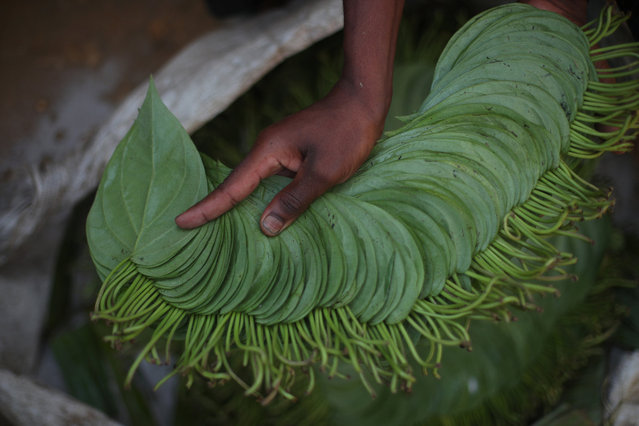
Faruk, 17, a Rohingya refugee trader holds betel leaves which are on sale at a stall in Palong Khali refugee camp near Cox's Bazar, Bangladesh, November 3, 2017. He left his village in Myanmar when the military opened fire towards the Rohingya. “I buy this betel leaf from Palong Khali market, in one bundle there are 160 pieces, I buy it for 80 taka and I sell it for 100 taka (1 Bangladeshi Taka = 0.012 US Dollar). Bangladeshi's and I sell for the same rate in the camp. Outside in the local market it is 80 taka per bundle. My problem is that I don't have money so I can't buy anything to eat, I can't buy fish to eat”, he said. (Photo by Hannah McKay/Reuters)
Details
27 Nov 2017 08:54:00