Loading...
Done
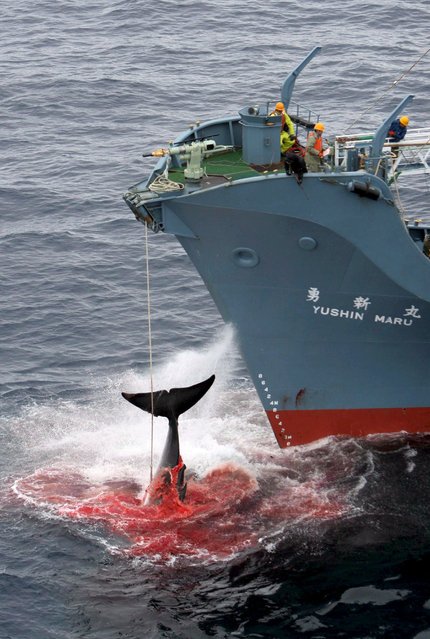
A file photograph dated 07 January 2006 and released by Greenpeace, showing the Yushin Maru, a factory ship in a Japanese whaling fleet, injuring a whale with it's first harpoon attempt. A UN court in The Hague on 31 March 2014 halted Japan's much-criticized whaling programme, ruling that it contravenes a 1986 moratorium on whale hunting. Japan must end its 'research whaling' programme, the International Court of Justice (ICJ) said. (Photo by Kate Davison/EPA)

A file photograph dated 07 January 2006 and released by Greenpeace, showing the Yushin Maru, a factory ship in a Japanese whaling fleet, injuring a whale with it's first harpoon attempt. A UN court in The Hague on 31 March 2014 halted Japan's much-criticized whaling programme, ruling that it contravenes a 1986 moratorium on whale hunting. Japan must end its 'research whaling' programme, the International Court of Justice (ICJ) said. Japan said the programme was for scientific research and permitted under international conventions. Australia had brought the case to the ICJ in 2010, charging that Japan was breaching international law by killing hundreds of whales every year for commercial purposes. Japan was “deeply disappointed” by the ruling, an unnamed government official was quoted by the Kyodo News agency as saying. But the official said Japan would stand by the ruling. (Photo by Kate Davison/EPA)
Details
01 Apr 2014 08:38:00
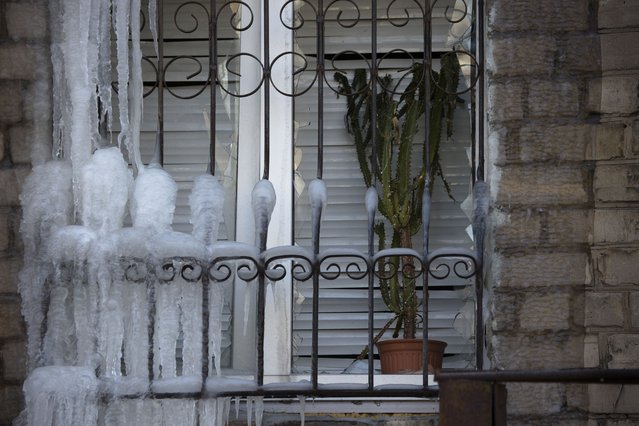
In this photo taken on Monday, October 27, 2014, a cactus stands at a broken window in a damaged house after shelling not far from Donetsk airport in the town of Donetsk, eastern Ukraine. (Photo by Dmitry Lovetsky/AP Photo)

In this photo taken on Monday, October 27, 2014, a cactus stands at a broken window in a damaged house after shelling not far from Donetsk airport in the town of Donetsk, eastern Ukraine. Donetsk, which has lost about 400,000 of its 1 million pre-war population, is bracing to a winter ahead. In a climate like eastern Ukraine's, where temperatures typically stay below zero all winter, the damage to the critical infrastructure and lack of effort to provide adequate shelter to people whose homes were destroyed could literally mean a death from the cold. (Photo by Dmitry Lovetsky/AP Photo)
Details
06 Nov 2014 09:06:00
A man walks into a room in the Ice hotel in Jukkasjarvi, Sweden, December 16, 2015. (Photo by Ints Kalnins/Reuters)

In Jukkasjärvi, a village a few miles east of Kiruna, the proprietors of one hotel begin planning for a winter ice festival in March. That’s when they begin collecting some 5,000 tons of ice from the River Torne in order to prepare the Icehotel, the world’s coolest place to stay. Options for overnight stay include snow rooms, ice rooms, art suites, and the Northern Lights room, all of which range from about $300 to $900 per night. But the deluxe suite’s the only way to go. These rooms come with a critical amenity: heated ensuite bathrooms and saunas. Here: A man walks into a room in the Ice hotel in Jukkasjarvi, Sweden, December 16, 2015. (Photo by Ints Kalnins/Reuters)
Details
18 Dec 2015 08:02:00
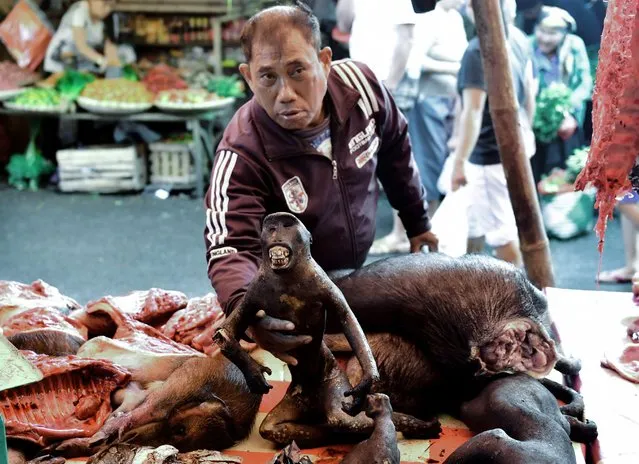
This picture taken on February 18, 2017 shows a customer holding a crested black macaque in Tomohon market in northern Sulawesi, Indonesia. (Photo by Bay Ismoyo/AFP Photo)

This picture taken on February 18, 2017 shows a customer holding a crested black macaque in Tomohon market in northern Sulawesi, Indonesia. Authorities and activists are stepping up efforts to persuade villagers on Sulawesi island to stop consuming the critically endangered crested black macaques, one of many exotic creatures that form part of the local indigenous community' s diet. The macaque' s meat is prized by the ethnic Minahasan people, a largely Christian group in the world' s most populous Muslim- majority country, who have no reservation about eating exotic animals, unlike Indonesia' s Islamic communities. (Photo by Bay Ismoyo/AFP Photo)
Details
04 Apr 2017 10:01:00
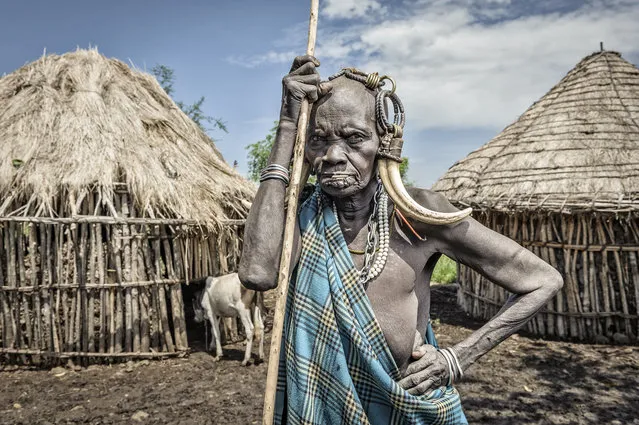
“Old Mursi woman”. Old woman by the huts of her village. Location: Marenke, Omo valley, Ethiopia. (Photo and caption by Jorge Fernandez/National Geographic Traveler Photo Contest)

“Old Mursi woman”. Old woman by the huts of her village. Location: Marenke, Omo valley, Ethiopia. (Photo and caption by Jorge Fernandez/National Geographic Traveler Photo Contest)

ATTENTION! All pictures are presented in high resolution. To see Hi-Res images – just TWICE click on any picture. In other words, click small picture – opens the BIG picture. Click BIG picture – opens VERY BIG picture.
Details
24 Jun 2013 09:55:00
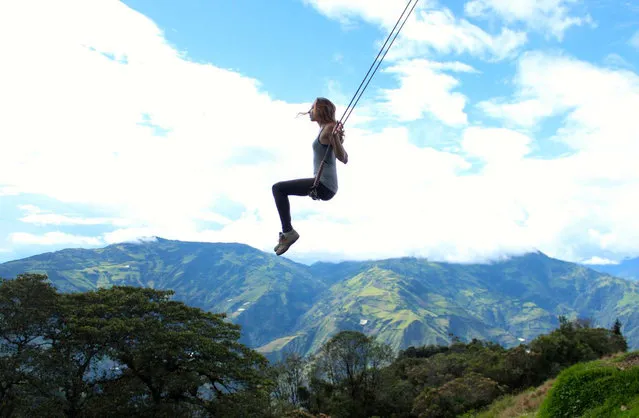
The Crazy Swing At Casa Del Arbol in Ecuador

Located at La Casa Del Arbol or “The Treehouse” in Baños, Ecuador, this small house was built for the stunning view on the Tungurahua Volcano it offers. But the real attraction is the swing attached to one of the tree's branches. It is far from your average swing, and it is surnamed the "Swing at the End of the World" for a good reason. Located off a giant cliff at over 2,600 meters above sea level and with absolutely no safety features, this swing promises a serious thrill to whoever is brave enough to ride it.
Details
10 Mar 2014 13:49:00
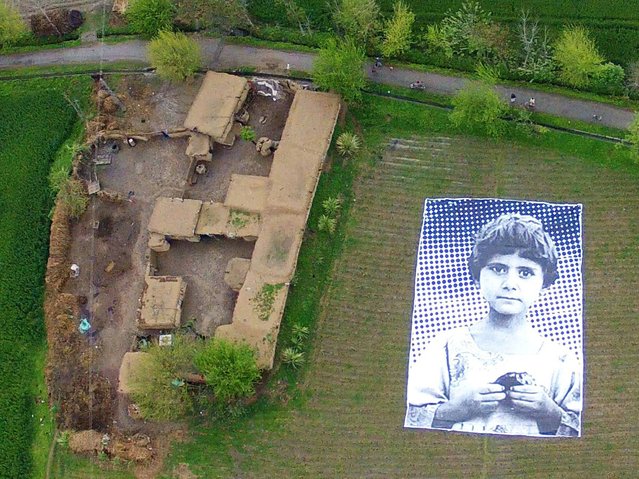
In this undated handout photograph from the “Inside Out Project”, a poster bearing the image of a Pakistani girl whose parents, lawyers say, were killed in a drone strike, lies in a field at an undisclosed location in the northwestern Khyber-Pakhtunkhwa province. (Photo by AFP Photo)

In this undated handout photograph from the “Inside Out Project”, a poster bearing the image of a Pakistani girl whose parents, lawyers say, were killed in a drone strike, lies in a field at an undisclosed location in the northwestern Khyber-Pakhtunkhwa province. A group of artists in Pakistan are hoping to generate “empathy” among US drone operators by placing giant posters of children in the country's troubled tribal regions. (Photo by AFP Photo)
Details
08 Apr 2014 10:39:00
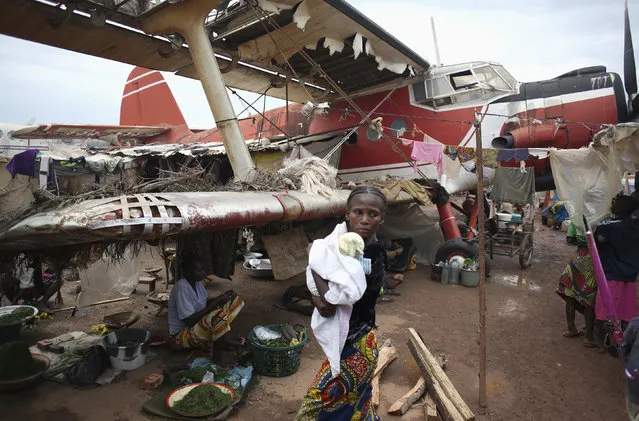
An internally displaced woman carries her child in a camp for internally displaced people (IDPs), located at Bangui International Airport, April 10, 2014. (Photo by Goran Tomasevic/Reuters)

Scores of internally displaced Muslims are at the heart of the humanitarian crisis in Central African Republic, where violence between Christians and Muslims has threatened to spiral into genocide. Photo: An internally displaced woman carries her child in a camp for internally displaced people (IDPs), located at Bangui International Airport, April 10, 2014. (Photo by Goran Tomasevic/Reuters)
Details
18 Apr 2014 08:41:00