Loading...
Done
Stemonitis  Axifera

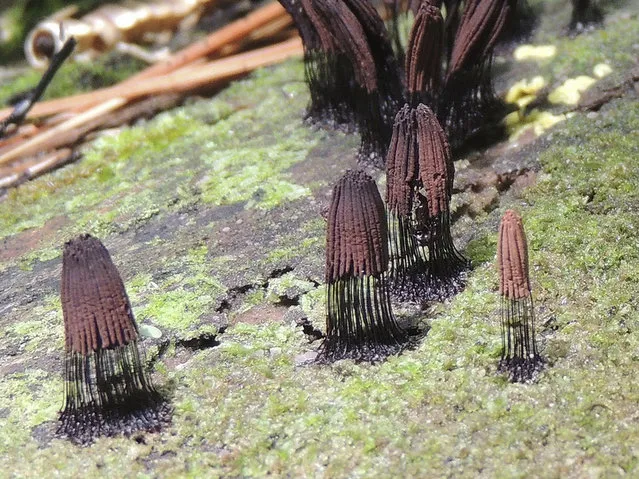
Stemonitis axifera is a species of slime mold. It fruits in clusters on dead wood, and has distinctive tall reddish-brown sporangia, supported on slender stalks. The species was first described as Trichia axifera by Jean Baptiste François Pierre Bulliard in 1791. Thomas Huston MacBride transferred it to the genus Stemonitis in 1889. Stemonitis fasciculata and Stemonitis smithii are synonyms.
Details
08 Feb 2014 10:30:00
An Afghan teacher, in brown, helps school children run from the site of clashes near the Pakistan consulate in Jalalabad, capital of Nangarhar province, Afghanistan, Wednesday, January 13, 2016. Several members of the Afghan security forces were killed Wednesday after unidentified gunmen attacked the Pakistani consulate in a volatile eastern province, an official said on Wednesday. (Photo by Mohammad Anwar Danishyar/AP Photos)

An Afghan teacher, in brown, helps school children run from the site of clashes near the Pakistan consulate in Jalalabad, capital of Nangarhar province, Afghanistan, Wednesday, January 13, 2016. Several members of the Afghan security forces were killed Wednesday after unidentified gunmen attacked the Pakistani consulate in a volatile eastern province, an official said on Wednesday. (Photo by Mohammad Anwar Danishyar/AP Photos)
Details
15 Jan 2016 08:00:00
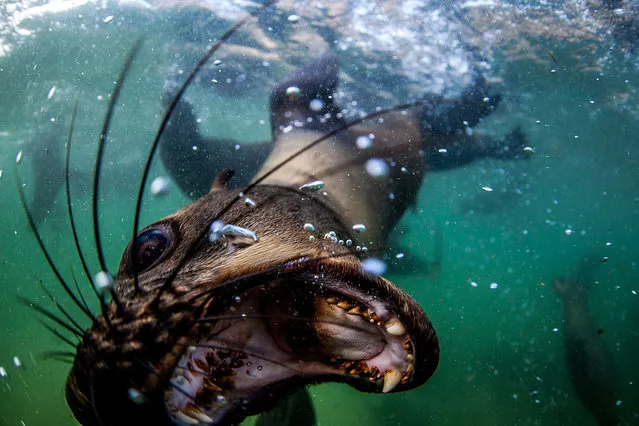
A seal playfully tries to bite the camera, taken on February 2016 in Plettenberg Bay, South Africa. A group of friendly seals get up close and personal with the camera. The pod of brown fur seals, also known as “cape fur seals”, were shot in Plettenberg Bay in South Africa by dive tour operator Rainer Schimpf. The playful creatures prove they are not camera shy in the slightest as they they swim upside down, grin widely and attempt to bite the camera lens. (Photo by Rainer Schimpf/Barcroft Media)

A seal playfully tries to bite the camera, taken on February 2016 in Plettenberg Bay, South Africa. A group of friendly seals get up close and personal with the camera. The pod of brown fur seals, also known as “cape fur seals”, were shot in Plettenberg Bay in South Africa by dive tour operator Rainer Schimpf. The playful creatures prove they are not camera shy in the slightest as they they swim upside down, grin widely and attempt to bite the camera lens. (Photo by Rainer Schimpf/Barcroft Media)
Details
13 Apr 2016 09:38:00
Lady Gaga left her hotel to party in the east end of london for the night on September 10, 2016. She was wearing shiny hot pants and a little crop top showing off some under boob. But had sticky tape covering her nipples. Lady Gaga and Mark Ronson performed her new single “Perfect Illusion” at the General Browning Club in Hackney. Afterwards she went with a few friends to Metropolis strip club in Hackney. Lady Gaga left at 4am and returned to her Hotel. (Photo by Splash News and Pictures)

Lady Gaga left her hotel to party in the east end of london for the night on September 10, 2016. She was wearing shiny hot pants and a little crop top showing off some under boob. But had sticky tape covering her nipples. Lady Gaga and Mark Ronson performed her new single “Perfect Illusion” at the General Browning Club in Hackney. Afterwards she went with a few friends to Metropolis strip club in Hackney. Lady Gaga left at 4am and returned to her Hotel. (Photo by Splash News and Pictures)
Details
11 Sep 2016 10:25:00
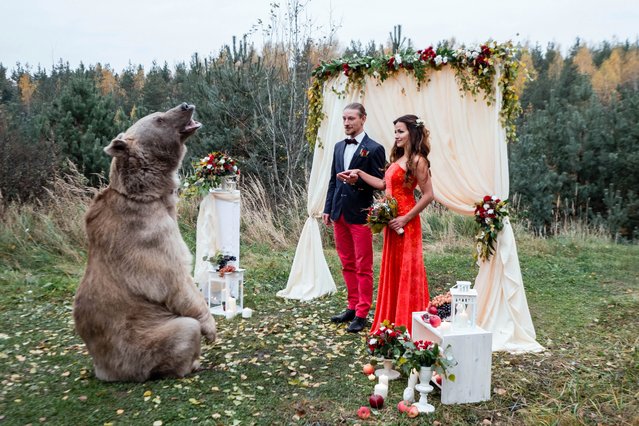
Denis and Nelya, both 30, from Moscow, Russia invited brown bear Stepan along to their very special ceremony. As well as witnessing the couple exchange vows, the bear also played the role of registrar at one point. Denis said: “We both knew Stepan is a very kind bear but still it is a huge, unpredictable animal so we were a bit scared, but still happy to be able to make our dream come true. It was a fantastic experience to have this photoshoot with Stepan”. (Photo by Olga Barantseva/Caters News)

Denis and Nelya, both 30, from Moscow, Russia invited brown bear Stepan along to their very special ceremony. As well as witnessing the couple exchange vows, the bear also played the role of registrar at one point. Denis said: “We both knew Stepan is a very kind bear but still it is a huge, unpredictable animal so we were a bit scared, but still happy to be able to make our dream come true. It was a fantastic experience to have this photoshoot with Stepan”. (Photo by Olga Barantseva/Caters News)
Details
01 Nov 2016 12:14:00
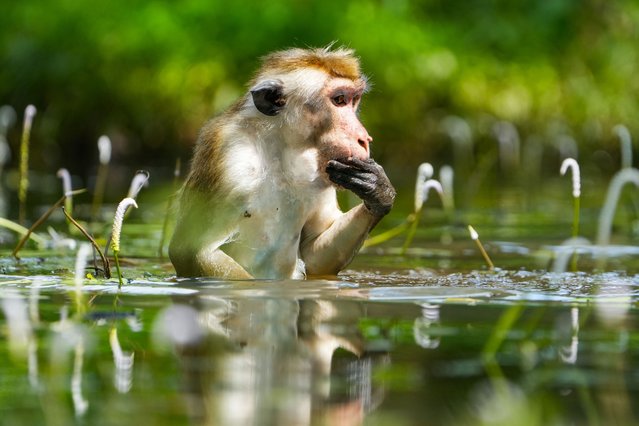
A toque macaque is eating flowers in the water at the pilgrimage site in Polonnaruwa, Sri Lanka, on January 13, 2024. The toque macaque (Macaca sinica), a reddish-brown-colored Old World monkey, is endemic to Sri Lanka, where it is known as the rilewa or rilawa. It is named for the whorl of hair at the crown of its head, which resembles a brimless toque cap. (Photo by Thilina Kaluthotage/NurPhoto/Rex Features/Shutterstock)

A toque macaque is eating flowers in the water at the pilgrimage site in Polonnaruwa, Sri Lanka, on January 13, 2024. The toque macaque (Macaca sinica), a reddish-brown-colored Old World monkey, is endemic to Sri Lanka, where it is known as the rilewa or rilawa. It is named for the whorl of hair at the crown of its head, which resembles a brimless toque cap. (Photo by Thilina Kaluthotage/NurPhoto/Rex Features/Shutterstock)
Details
10 Feb 2024 09:30:00
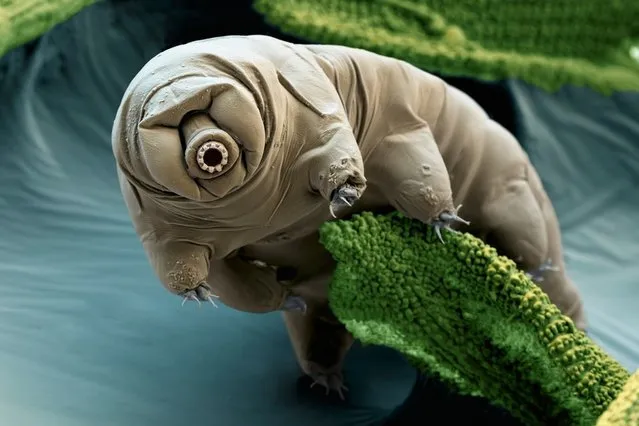
Tardigrades (commonly known as waterbears or moss piglets). (Photo by SPL/East News)

“Tardigrades (commonly known as waterbears or moss piglets) are small, water-dwelling, segmented animals with eight legs. Tardigrades were first discovered in 1773 by Johann August Ephraim Goeze, who called them kleiner Wasserbär, meaning “little water bear” in German. The name Tardigrada means “slow walker” and was given by Lazzaro Spallanzani in 1777. The name water bear comes from the way they walk, reminiscent of a bear's gait. The biggest adults may reach a body length of 1.5 millimetres (0.059 in), the smallest below 0.1 mm. Freshly hatched tardigrades may be smaller than 0.05 mm”. – Wikipedia. Photo: Tardigrades. (Photo by SPL/East News)
Details
26 Sep 2012 09:55:00
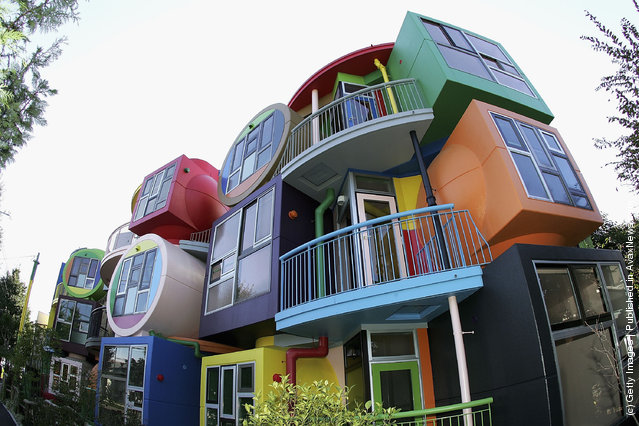
Concept Design Home Reversible Destiny Lofts MITAKA: In Memory Of Helen Keller By Reversible Destiny Foundation and Shusaku Arakawa

“The Reversible Destiny Lofts – Mitaka (In Memory of Helen Keller) is a nine-unit multiple dwelling. It was first completed example of procedural architecture put to residential use. These lofts reflexively articulate the residents’ operative tendencies and coordinating skills essential to and determinative of human thought and behavior; which means to say, the lofts manage, by virtue of how they are constructed, to reveal to their residents the ins and outs of what makes a person, in this case the resident. This is the same set of tendencies and skills to which Arakawa and Madeline Gins gave diagrammatic form in their decades-long research project The Mechanism of Meaning”. – Wikipedia

Photo: The exterior of the concept design home “Reversible Destiny Lofts MITAKA: In Memory of Helen Keller” is seen on October 27, 2005 in Tokyo, Japan. (Photo by Koichi Kamoshida/Getty Images)
Details
30 Nov 2011 11:58:00