Loading...
Done
Jockeys spur buffalos during the Makepung buffalo races at Jembrana in Bali, Indonesia on October 23, 2016. Makepung is a tradition for farmers to celebrate a bumper harvest in Bali. (Photo by Kadek Raharja/Xinhua/Barcroft Images)

Jockeys spur buffalos during the Makepung buffalo races at Jembrana in Bali, Indonesia on October 23, 2016. Makepung is a tradition for farmers to celebrate a bumper harvest in Bali. (Photo by Kadek Raharja/Xinhua/Barcroft Images)
Details
25 Oct 2016 10:50:00
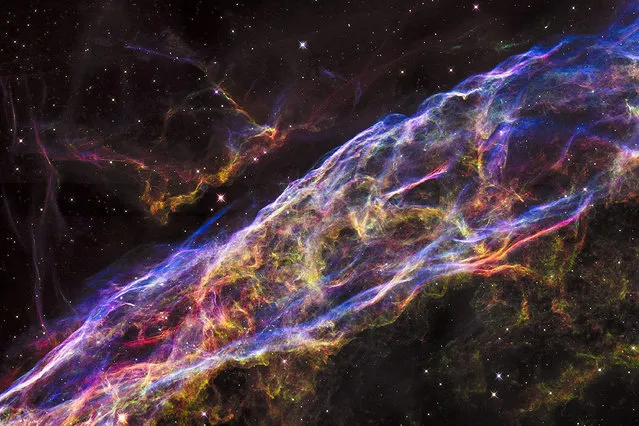
A small section of the expanding remains of the Veil Nebula, a massive star that exploded about 8,000 years ago. The entire nebula is 110 light-years across, covering six full moons on the sky as seen from Earth, and resides about 2,100 light-years away in the constellation Cygnus, the Swan. (Photo by Reuters/NASA/ESA/Hubble)

A small section of the expanding remains of the Veil Nebula, a massive star that exploded about 8,000 years ago. The entire nebula is 110 light-years across, covering six full moons on the sky as seen from Earth, and resides about 2,100 light-years away in the constellation Cygnus, the Swan. (Photo by Reuters/NASA/ESA/Hubble)
Details
29 Feb 2016 11:30:00
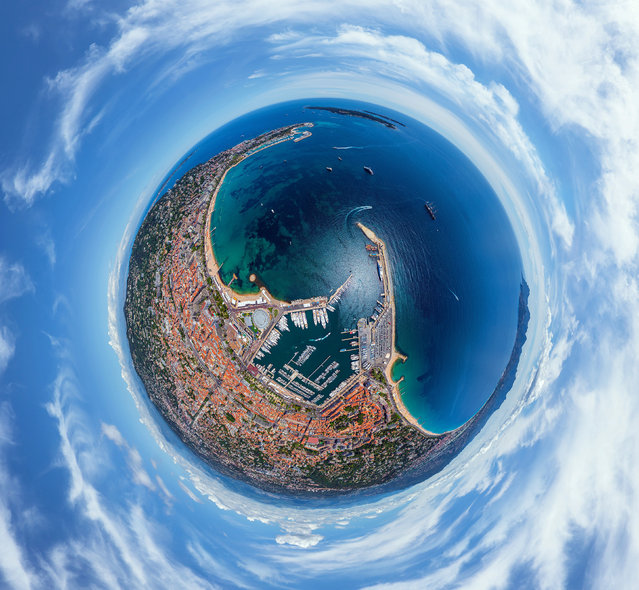
The French Riveria of Cannes, France. (Photo by Airpano/Caters News)

Some of the worlds most iconic cities have been photographed as youve never seen them before in the shape of tiny round planets. By using a pioneering method of aerial photography, each location can be now seen at a full 360 degree angle. After some skilful manipulation on Photoshop known technically as stereographic projection, each sweeping panorama is then turned into a small circular shaped image. Whether its the Eiffel Tower, The Empire State Building or the Shanghai Skyline, each image manages to show hundreds of miles of city landscape. Here: the French Riveria of Cannes, France. (Photo by Airpano/Caters News)
Details
25 Mar 2015 12:14:00
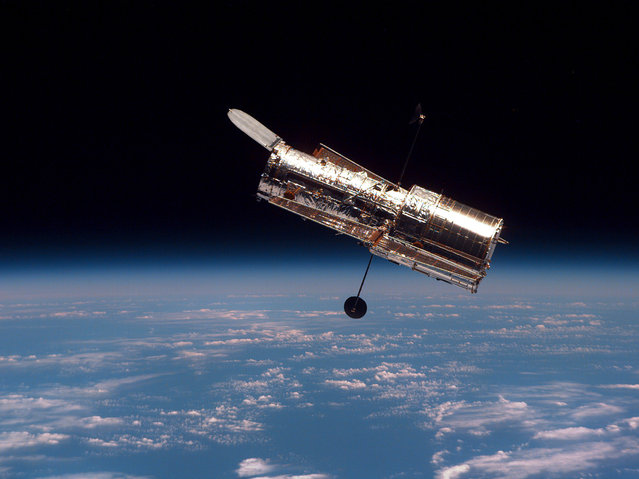
The Hubble Space Telescope is shown following its release from the space shuttle Discovery Wednesday, February 19, 1997. The Hubble Space Telescope, one of NASA'S crowning glories, marks its 25th anniversary on Friday, April 24, 2015. With more than 1 million observations, including those of the farthest and oldest galaxies ever beholden by humanity, no man-made satellite has touched as many minds or hearts as Hubble. (Photo by AP Photo/NASA)

The Hubble Space Telescope is shown following its release from the space shuttle Discovery Wednesday, February 19, 1997. The Hubble Space Telescope, one of NASA'S crowning glories, marks its 25th anniversary on Friday, April 24, 2015. With more than 1 million observations, including those of the farthest and oldest galaxies ever beholden by humanity, no man-made satellite has touched as many minds or hearts as Hubble. (Photo by AP Photo/NASA)
Details
24 Apr 2015 11:25:00
A Tibetan mastiff dog is displayed for sale at a mastiff show in Baoding, Hebei province, south of Beijing on March 9, 2013. Fetching prices up to around 750,000 USD, mastiffs have become a prized status-symbol amongst China's wealthy, with rich buyers across the country sending prices skyrocketing. Owners say the mastiffs, descendents of dogs used for hunting by nomadic tribes in central Asia and Tibet are fiercely loyal and protective. (Photo by Ed Jones/AFP Photo)

A Tibetan mastiff dog is displayed for sale at a mastiff show in Baoding, Hebei province, south of Beijing on March 9, 2013. Fetching prices up to around 750,000 USD, mastiffs have become a prized status-symbol amongst China's wealthy, with rich buyers across the country sending prices skyrocketing. Owners say the mastiffs, descendents of dogs used for hunting by nomadic tribes in central Asia and Tibet are fiercely loyal and protective. Breeders still travel to the Himalayan plateau to collect young puppies, although many are unable to adjust to the low altitudes and die during the journey. (Photo by Ed Jones/AFP Photo)
Details
02 May 2014 09:40:00
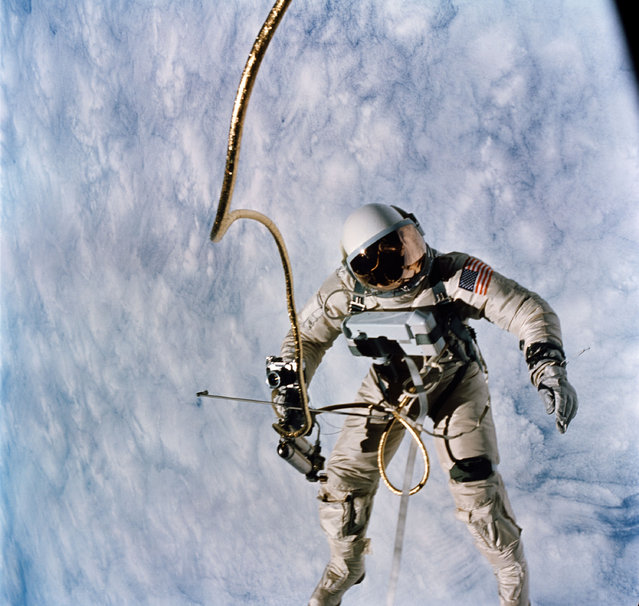
Astronaut Edward H. White II, pilot for the Gemini-Titan 4 (GT-4) spaceflight, floats in the zero-gravity of space during the third revolution of the GT-4 spacecraft on June 3, 1965. White wears a specially designed spacesuit. His face is shaded by a gold-plated visor to protect him from unfiltered rays of the sun. (Photo by NASA)

Astronaut Edward H. White II, pilot for the Gemini-Titan 4 (GT-4) spaceflight, floats in the zero-gravity of space during the third revolution of the GT-4 spacecraft on June 3, 1965. White wears a specially designed spacesuit. His face is shaded by a gold-plated visor to protect him from unfiltered rays of the sun. In his right hand he carries a Hand-Held Self-Maneuvering Unit (HHSMU) that gives him control over his movements in space. White also wears an emergency oxygen chest pack; and he carries a camera mounted on the HHSMU for taking pictures of the sky, Earth and the GT-4 spacecraft. He is secured to the spacecraft by a 25-feet umbilical line and a 23-feet tether line. Both lines are wrapped together in gold tape to form one cord. Astronaut James A. McDivitt, command pilot, remained inside the spacecraft during the extravehicular activity (EVA). Astronaut White died in the Apollo/Saturn 204 fire at Cape Kennedy on January 27, 1967. (Photo by NASA)
Details
22 Jul 2014 12:05:00
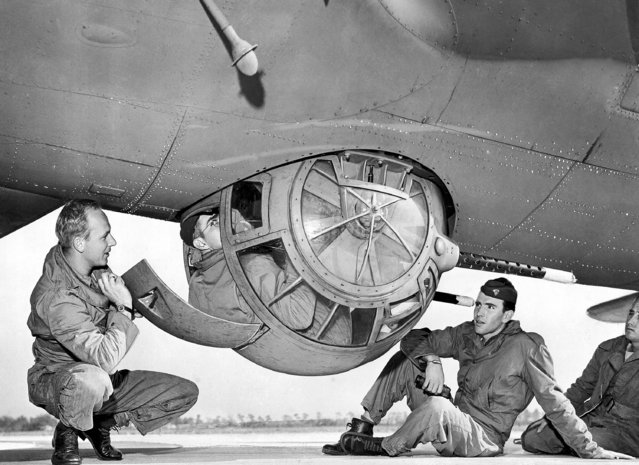
Private Harold L. Langhofer edges into the ball-turret, March 9, 1943. Curled in this position, he can turn the turret so that it fires in any direction. The turret can also be swung around so that the hatch opens into the plane, and the gunner can crawl into it while the Flying Fortress is in motion. (Photo by AP Photo)

Private Harold L. Langhofer edges into the ball-turret, March 9, 1943. Curled in this position, he can turn the turret so that it fires in any direction. The turret can also be swung around so that the hatch opens into the plane, and the gunner can crawl into it while the Flying Fortress is in motion. (Photo by AP Photo)
Details
05 Apr 2018 00:03:00
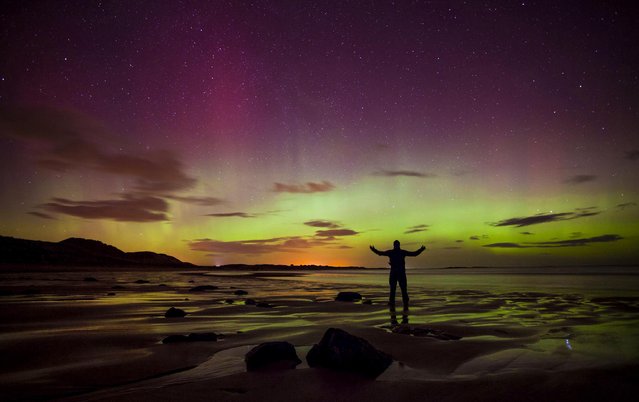
A man poses standing on a rock looking at the aurora borealis, or northern lights, illuminating the night sky at Embleton Bay in Northumberland, England, on February 27, 2014. The northern lights is a fantastical natural light display with fast moving light effects caused by particles charged by the sun colliding with particles in Earth's upper atmosphere. (Photo by Tom White/PA Wire)

A man poses standing on a rock looking at the aurora borealis, or northern lights, illuminating the night sky at Embleton Bay in Northumberland, England, on February 27, 2014. The northern lights is a fantastical natural light display with fast moving light effects caused by particles charged by the sun colliding with particles in Earth's upper atmosphere. (Photo by Tom White/PA Wire)
Details
02 Mar 2014 10:12:00