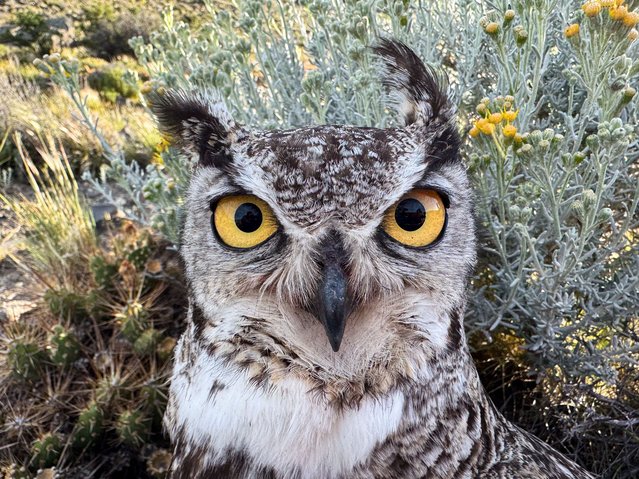
Lesser Horned Owl (Bubo magellanicus) is seen at the meadows of Patagonian valley in Santa Cruz, Argentina on December 21, 2024. Lesser Horned Owl is a large owl of the genus Bubo found in southern South America, with its distinctive “horns”, black-rimmed face and heavily striped abdomen. (Photo by Mehmet Emin Yogurtcuoglu/Anadolu via Getty Images)
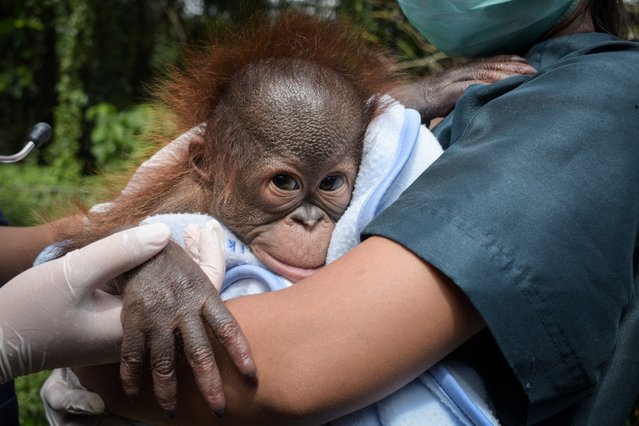
A 71-day-old male Kalimantan orangutan, a critically endangered species, born in the zoo but neglected by its 9-year-old mother Shakila, is held by an animal care taker at Bandung Zoological Gardens in Bandung, West Java on February 21, 2025. (Photo by Timur Matahari/AFP Photo)
A woman walks past debris as Super Typhoon Ragasa hits the Central district in Hong Kong on September 24, 2025. Hong Kong's weather service issued the highest level of typhoon warning in the early hours, as Super Typhoon Ragasa brought powerful winds and lashing rain to the southern Chinese coast. (Photo by Peter Parks/AFP Photo)
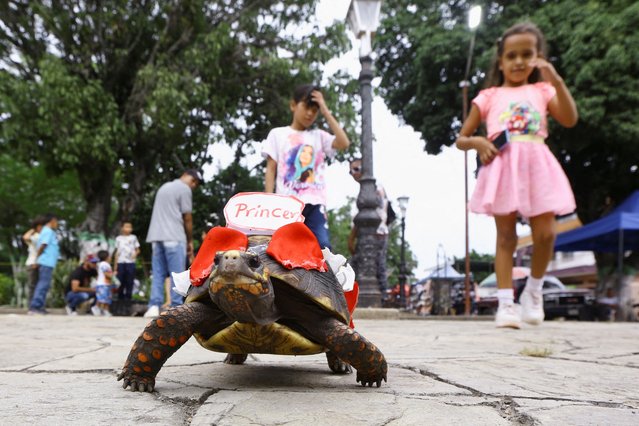
Children walk behind their Morrocoye, a terrestrial tortoise native to South America, before a tortoise race held to celebrate the upcoming feast day of Saint Francis of Assisi, the patron saint of animals, in the town of San Francisco de Asis, Venezuela, on October 3, 2025. (Photo by /Juan Carlos Hernandez/Reuters)
Red Bull's Max Verstappen celebrates with champagne on the podium after winning the Monaco Grand Prix in Monte Carlo on May 28, 2023. (Photo by Stephane Mahe/Reuters)
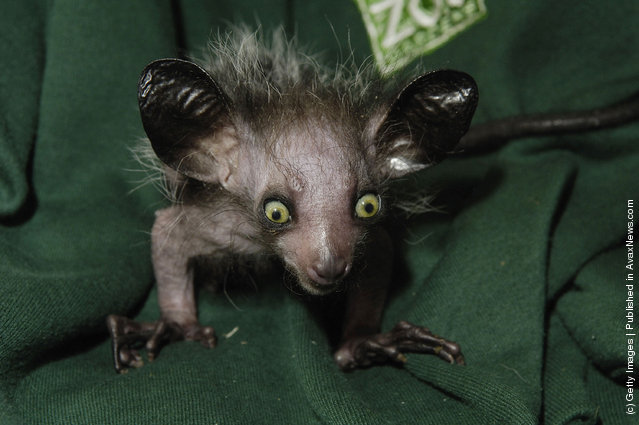
“The aye-aye (Daubentonia madagascariensis) is a lemur, a strepsirrhine primate native to Madagascar that combines rodent-like teeth and a special thin middle finger to fill the same ecological niche as a woodpecker. It is the world's largest nocturnal primate, and is characterized by its unusual method of finding food; it taps on trees to find grubs, then gnaws holes in the wood and inserts its narrow middle finger to pull the grubs out. The only other animal species known to find food in this way is the striped possum. From an ecological point of view the aye-aye fills the niche of a woodpecker as it is capable of penetrating wood to extract the invertebrates within”. – Wikipedia
Photo: In this handout image from Bristol Zoo is seen the first captive bred aye-aye in the UK named “Kintana” (meaning star in Malagasy) April 15, 2005 at Bristol Zoo Gardens, England. The zoo announced today only the second baby aye-aye to be hand-reared in the world (the first was in Jersey Zoo) and has now made his first public appearance since his birth on 11 February 2005. (Photo by Rob Cousins/Bristol Zoo via Getty Images)
Thomas Shelby makes a fire as he prepares to stay the night by the rubble of his home to protect from potential looters in Dawson Springs, Kentucky, on Saturday, December 11, 2021. One or more tornados tore through Dawson Springs late last night. (Photo by Austin Anthony/The Washington Post)