Loading...
Done


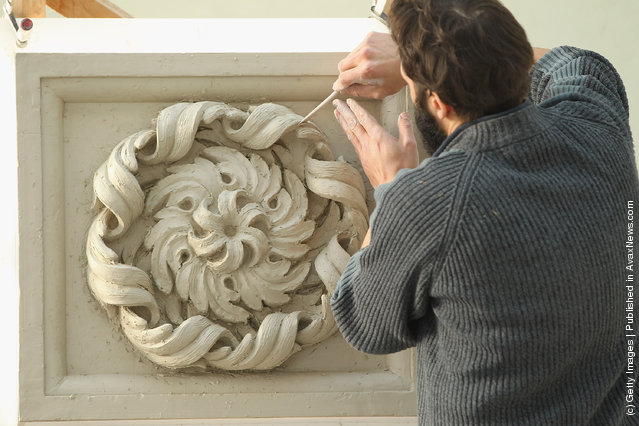
BERLIN, GERMANY - NOVEMBER 11: Sculptor Oleg Bessonov creates a rosette from clay at the Schlossbauhuette studio where a team of sculptors is creating decorative elements for the facade of the Berliner Schloss city palace on November 11, 2011 in Berlin, Germany. The Berliner Schloss was the residence of the Prussian Kaiser and was among the major architectural landmarks of Berlin until it was heavily damaged by Allied bombing in 1945. The communist authorities of East Berlin demolished the building in the 1950s, and today's Berlin government is pursuing an ambitious project to rebuild the palace according to a design by Italian architect Franco Stella, which will recreate the facade of the building but with a modern interior at a cost of approximately EUR 590 million. The Humboldt Forum, the foundation leading the project, has given the Schlossbauhuette sculptors the formidable task of recreating the hundreds of architectural elements that decorated the facade, and though some original pieces were saved, more often the sculptors have only old black and white photos as reference. (Photo by Sean Gallup/Getty Images)
Details
21 Nov 2011 11:22:00
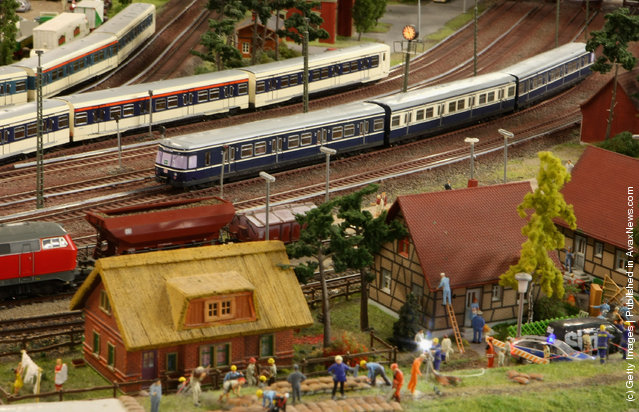
Miniatur Wunderland – The World's Biggest Model Train

“Miniatur Wunderland is a model railway attraction in Hamburg, Germany and the largest of its kind in the world. As of January 2011, the railway consists of 12,000 metres (39,370 ft) of track in HO scale, divided into seven sections: Harz, the fictitious city of Knuffingen, the Alps and Austria, Hamburg, America, Scandinavia, and Switzerland. Of the 6,400 square metres (68,889 sq ft) of floorspace, the model takes 1,150 m2 (12,378 sq ft)”. – Wikipedia

Photo: Details of the “Miniatur Wunderland” are pictured on April 2, 2009 in Hamburg, Germany. The world's largest model railway and one of the most popular tourist attractions in Germany is located next to the Elbe in Hamburg's Speicherstadt. (Photo by Joern Pollex/Getty Images)
Details
29 Nov 2011 09:02:00
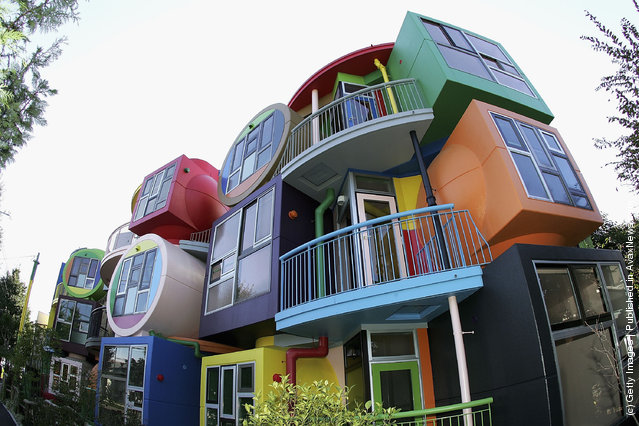
Concept Design Home Reversible Destiny Lofts MITAKA: In Memory Of Helen Keller By Reversible Destiny Foundation and Shusaku Arakawa

“The Reversible Destiny Lofts – Mitaka (In Memory of Helen Keller) is a nine-unit multiple dwelling. It was first completed example of procedural architecture put to residential use. These lofts reflexively articulate the residents’ operative tendencies and coordinating skills essential to and determinative of human thought and behavior; which means to say, the lofts manage, by virtue of how they are constructed, to reveal to their residents the ins and outs of what makes a person, in this case the resident. This is the same set of tendencies and skills to which Arakawa and Madeline Gins gave diagrammatic form in their decades-long research project The Mechanism of Meaning”. – Wikipedia

Photo: The exterior of the concept design home “Reversible Destiny Lofts MITAKA: In Memory of Helen Keller” is seen on October 27, 2005 in Tokyo, Japan. (Photo by Koichi Kamoshida/Getty Images)
Details
30 Nov 2011 11:58:00
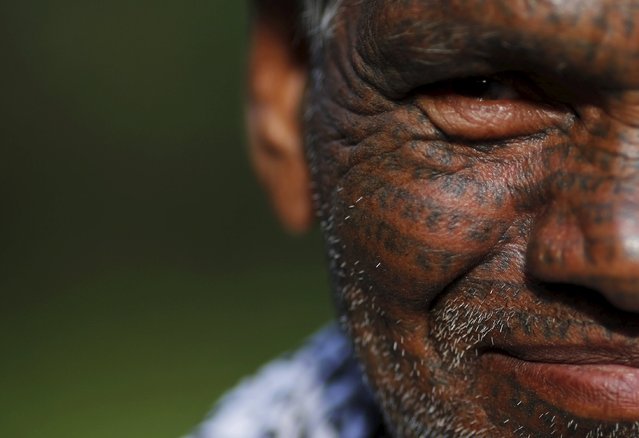
Tiharu Ram, 70, a follower of Ramnami Samaj, who has tattooed the name of the Hindu god Ram on his face, poses for a picture outside his house in the village of Chandlidi, in the eastern state of Chhattisgarh, India, November 16, 2015. (Photo by Adnan Abidi/Reuters)

Tiharu Ram, 70, a follower of Ramnami Samaj, who has tattooed the name of the Hindu god Ram on his face, poses for a picture outside his house in the village of Chandlidi, in the eastern state of Chhattisgarh, India, November 16, 2015. Denied entry to temples and forced to use separate wells, low-caste Hindus in the eastern state of Chhattisgarh first tattooed their bodies and faces more than 100 years ago as an act of defiance and devotion. (Photo by Adnan Abidi/Reuters)
Details
14 Jan 2016 08:05:00
Revellers participate in a parade on the street during a carnival in the village of Vevcani, south of Skopje, Macedonia January 13, 2016. Vevcani village marks the annual Orthodox St. Vasilij Day with a carnival that features a 1,400-year-old celebration with pagan roots. The highlights of the carnival include a political satire where masked villagers act out current events. (Photo by Ognen Teofilovski/Reuters)

Revellers participate in a parade on the street during a carnival in the village of Vevcani, south of Skopje, Macedonia January 13, 2016. Vevcani village marks the annual Orthodox St. Vasilij Day with a carnival that features a 1,400-year-old celebration with pagan roots. The highlights of the carnival include a political satire where masked villagers act out current events. (Photo by Ognen Teofilovski/Reuters)
Details
15 Jan 2016 08:05:00
A Vietnamese artist acting as a medium, performs the "Hau Dong" ritual at Viet Theatre in Hanoi January 16, 2016. (Photo by Reuters/Kham)

A Vietnamese artist acting as a medium, performs the “Hau Dong” ritual at Viet Theatre in Hanoi January 16, 2016. For the first time, Vietnamese drama director Viet Tu has brought the ritual from religious temples to the theatre partly to draw tourists. The “Hau Dong” is a ritual where a medium puts on special costumes and tells stories of gods and heroes while being accompanied by “Chau Van” music, as part of the act of Dao Mau – the worship of mother goddesses in Vietnam. It is believed that the medium is capable of having a direct contact with spirits during the ritual. (Photo by Reuters/Kham)
Details
18 Jan 2016 08:00:00
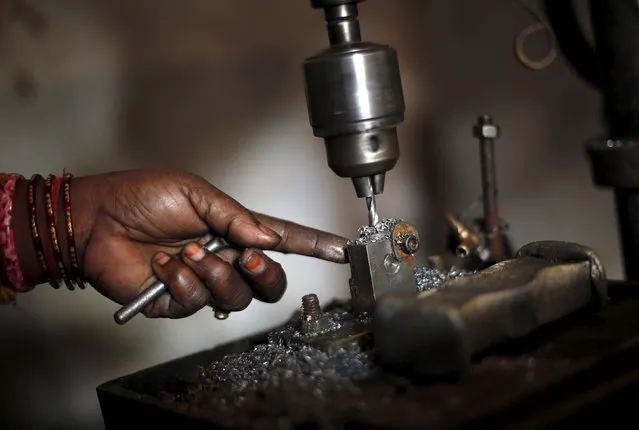
A worker makes auto parts on a machine inside a workshop in Faridabad, India, December 24, 2015. (Photo by Adnan Abidi/Reuters)

A worker makes auto parts on a machine inside a workshop in Faridabad, India, December 24, 2015. Car makers such as Maruti Suzuki India and Hyundai Motor see huge growth in India, set to become the world's third-largest auto market by 2020 as millions buy their first new car. Price tags can be as low as $3,000 for a new Tata Motors Nano mini-car. India is also becoming a low-cost export hub for global car makers such as General Motors and Ford Motor. As the sector expands, some of the work is sub-contracted out to small factories operating on paper-thin margins, where poor contract workers often have little or no access to safety equipment or health benefits. (Photo by Adnan Abidi/Reuters)
Details
23 Jan 2016 13:31:00
“Bazooka”, a one year old stray cat, is treated at the SPCA (Society for Prevention of Cruelty to Animals) clinic in Tel Aviv, Israel, 06 January 2016. Bazooka arrived at the clinic in critical condition after he went through severe abuse with bruises all over his body and painted with pink oxidation. (Photo by Abir Sultan/EPA)

“Bazooka”, a one year old stray cat, is treated at the SPCA (Society for Prevention of Cruelty to Animals) clinic in Tel Aviv, Israel, 06 January 2016. Bazooka arrived at the clinic in critical condition after he went through severe abuse with bruises all over his body and painted with pink oxidation. The Israeli street cat population is estimated to be about two million. Without enough financial support from the state, animal rights organizations find it difficult to keep the up with the pace when it comes to spaying and neutering feral cats, causing the population to grow. (Photo by Abir Sultan/EPA)
Details
27 Jan 2016 13:17:00