Loading...
Done
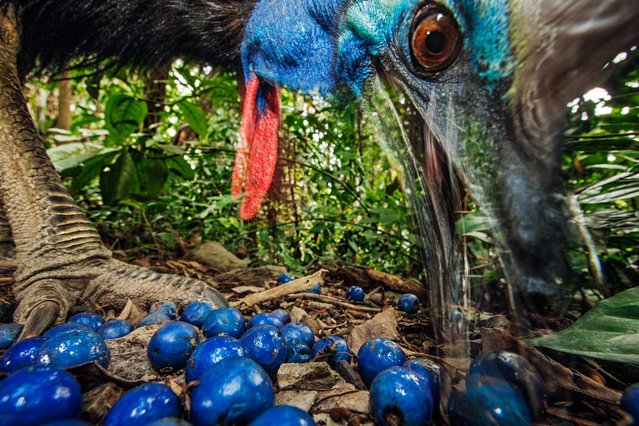
“Cassowaries are large, flightless birds related to emus and (more distantly) to ostriches, rheas, and kiwis”, writes Olivia Judson in the September issue of National Geographic magazine. (Photo by Christian Ziegler/National Geographic)

“Cassowaries are large, flightless birds related to emus and (more distantly) to ostriches, rheas, and kiwis”, writes Olivia Judson in the September issue of National Geographic magazine. How large? People-size: Adult males stand well over five foot five and top 110 pounds. Females are even taller, and can weigh more than 160 pounds. Dangerous when roused, they’re shy and peaceable when left alone. But even birds this big and tough are prey to habitat loss. The dense New Guinea and Australia rain forests where they live have dwindled. Today cassowaries might number 1,500 to 2,000. And because they help shape those same forests – by moving seeds from one place to another – “if they vanish”, Judson writes, “the structure of the forest would gradually change” too. (Photo by Christian Ziegler/National Geographic)
Details
06 Jan 2014 12:21:00
Animal rights activist, stained with fake blood, perform during a protest against the use of animal skins in the clothes and fashion industry, in Madrid, Sunday, December 10, 2017. (Photo by Francisco Seco/AP Photo)

Animal rights activist, stained with fake blood, perform during a protest against the use of animal skins in the clothes and fashion industry, in Madrid, Sunday, December 10, 2017. (Photo by Francisco Seco/AP Photo)
Details
11 Dec 2017 09:50:00
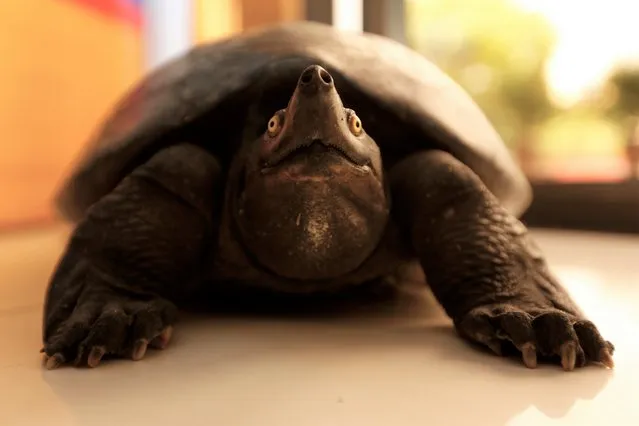
A view of a turtle during an event at the Ministry of Environment in Phnom Penh, Cambodia, 24 June 2020. A Cambodian woman recently bought endangered Royal Turtles from local villagers and gave them to Ministry of Environment. (Photo by Kith Serey/EPA/EFE)

A view of a turtle during an event at the Ministry of Environment in Phnom Penh, Cambodia, 24 June 2020. A Cambodian woman recently bought endangered Royal Turtles from local villagers and gave them to Ministry of Environment. (Photo by Kith Serey/EPA/EFE)
Details
28 Jun 2020 00:01:00
In this Friday, February 1, 2019, photo, Filipino-Chinese display piggy banks at the start of celebrations leading to next week's Lunar New Year in Chinatown, Manila, Philippines. This year is the Year of the Earth Pig on the Lunar calendar and is supposed to represent abundance, diligence and generosity. (Photo by Bullit Marquez/AP Photo)

In this Friday, February 1, 2019, photo, Filipino-Chinese display piggy banks at the start of celebrations leading to next week's Lunar New Year in Chinatown, Manila, Philippines. This year is the Year of the Earth Pig on the Lunar calendar and is supposed to represent abundance, diligence and generosity. (Photo by Bullit Marquez/AP Photo)
Details
09 Feb 2019 00:05:00
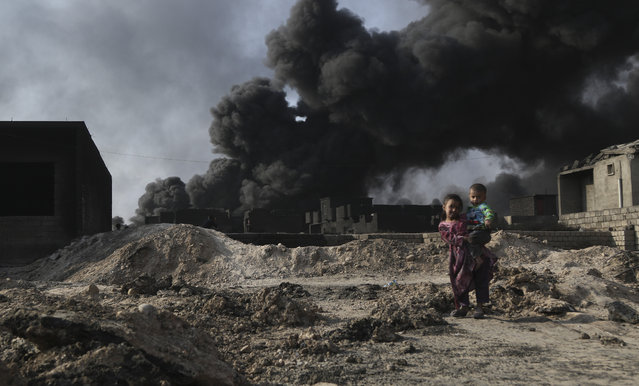
A girl holds her brother in her arm as black smoke rises after an oil well set on fire in the center of al-Kayyara town to the south of Daesh terror organization-held Mosul in Iraq on October 25, 2016. The oil well in the center of al-Kayyara town, which was set alight by retreating Daesh militants in advance of the Iraqi army's takeover of the town on August 24, 2016 has still not entirely been put out. The raw petrol which is still alight is creating black clouds above the city. The residents and wildlife beneath this polluting smoke cloud may find their health at risk. The effects of the fire in the town center on unprotected civilians' health can easily be seen on the hands and faces of children playing on the street. (Photo by dris Okuducu/Anadolu Agency/Getty Images)

A girl holds her brother in her arm as black smoke rises after an oil well set on fire in the center of al-Kayyara town to the south of Daesh terror organization-held Mosul in Iraq on October 25, 2016. The oil well in the center of al-Kayyara town, which was set alight by retreating Daesh militants in advance of the Iraqi army's takeover of the town on August 24, 2016 has still not entirely been put out. The raw petrol which is still alight is creating black clouds above the city. The residents and wildlife beneath this polluting smoke cloud may find their health at risk. The effects of the fire in the town center on unprotected civilians' health can easily be seen on the hands and faces of children playing on the street. (Photo by dris Okuducu/Anadolu Agency/Getty Images)
Details
27 Oct 2016 11:54:00
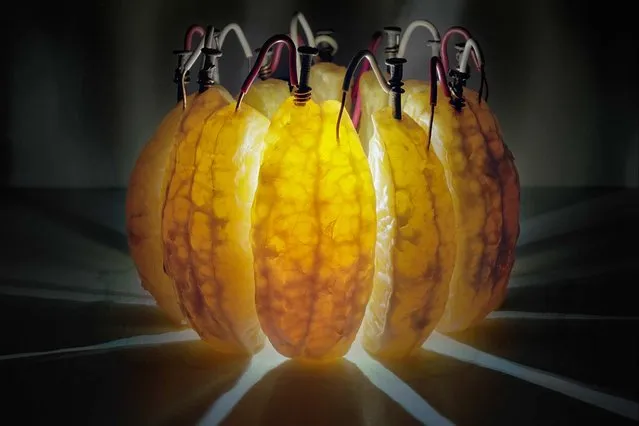
Wedges of an orange generate enough current and electrical juice – 3.5 volts – to power an LED. The fruit’s citric acid helps electrons flow from galvanized nails to copper wire in this 14-hour exposure. This image was published in September’s Visions of Earth, a trio of photos that appear in each issue of National Geographic. (Photo by Caleb Charland/National Geographic)

Wedges of an orange generate enough current and electrical juice – 3.5 volts – to power an LED. The fruit’s citric acid helps electrons flow from galvanized nails to copper wire in this 14-hour exposure. This image was published in September’s Visions of Earth, a trio of photos that appear in each issue of National Geographic. (Photo by Caleb Charland/National Geographic)
Details
06 Jan 2014 12:09:00
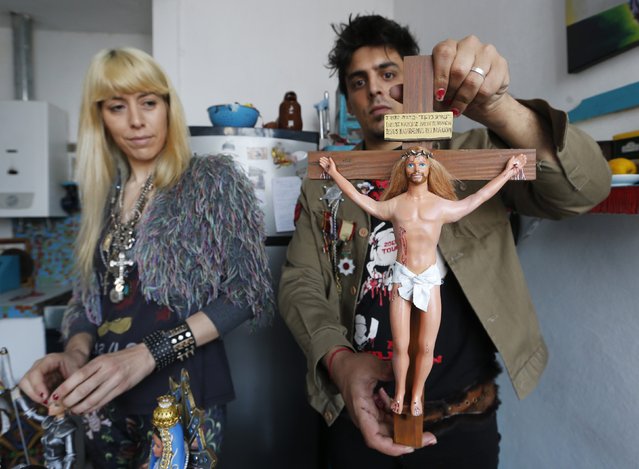
Artist Emiliano Paolini (R), and his partner Marianela Perelli, show their “Ken” doll that they have re-designed into the religious figure of Jesus Christ at their workshop in Rosario, north of Buenos Aires September 23, 2014. (Photo by Enrique Marcarian/Reuters)

Artist Emiliano Paolini (R), and his partner Marianela Perelli, show their “Ken” doll that they have re-designed into the religious figure of Jesus Christ at their workshop in Rosario, north of Buenos Aires September 23, 2014. Paolini and Perelli have adapted religious figures such as Jesus Christ, Moses and the Virgin of Guadalupe to Mattel's line of Barbie and Ken dolls and are working on more religious figures, although they say they will not be using the Prophet Muhammad to avoid controversy. They plan to have a gallery show in Buenos Aires next October. (Photo by Enrique Marcarian/Reuters)
Details
27 Sep 2014 11:47:00
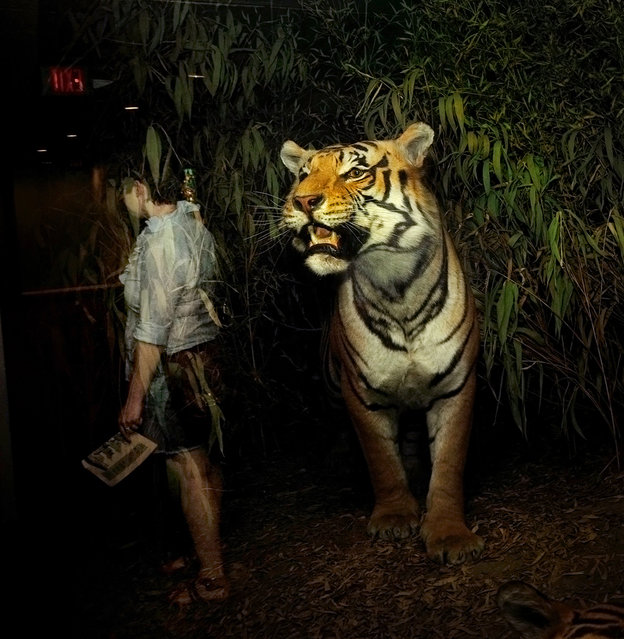
“Natural History”: Tiger. (Photo by Traer Scott)

“Natural History” is a series of completely candid single exposure images that merge the living and the dead to create allegorical narratives of our troubled co-existence with nature. Ghost-like reflections of modern visitors viewing wildlife dioramas are juxtaposed against the antique taxidermied subjects housed behind thick glass, their faces molded into permanent expressions of fear, aggression or fleeting passivity. After decades of over-hunting, climate change, poaching and destruction of habitat, many of these long dead diorama specimens now represent endangered or completely extinct species”. – Traer Scott. (Photo by Traer Scott)
Details
27 Oct 2014 11:39:00