Loading...
Done
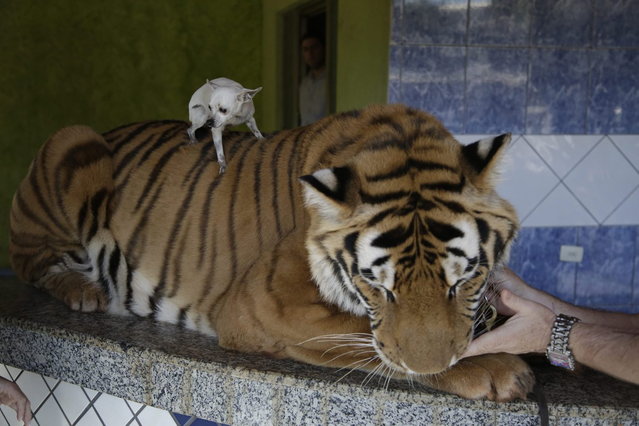
The Borges' family pet dog, Little, is placed on the back of Tom, their tiger, for a photo to be taken, in Maringa, Brazil, Friday, September 27, 2013. The Brazilian family is now locked in a legal dispute for the big cats, they have eight tigers and two lions, with federal wildlife officials working to take them away. While Borges does have a license to raise the animals, Brazilian wildlife officials say he illegally bred the cats, creating a public danger. (Photo by Renata Brito/AP Photo)

“Ary Borges and his family live in southern Brazil like most families the Borges' love animals and have an array of cats living in their home. The only difference between the cats owned by the Borges family and the cat that is cuddled up on your lap as you read this is the Borges' cats weigh over 700 pounds and could kill you just as soon as look at you. The Borges family shares their home with nine tigers, two lionesses, a chimp and a Chihuahua”. – Amanda Schiavo via Latin Times. Photo: The Borges' family pet dog, Little, is placed on the back of Tom, their tiger, for a photo to be taken, in Maringa, Brazil, Friday, September 27, 2013. (Photo by Renata Brito/AP Photo)
Details
04 Oct 2013 11:51:00
Galapagos – Rocking the Cradle: Four major ocean currents converge along the Galapagos archipelago, creating the conditions for an extraordinary diversity of animal life, April 25, 2016. The islands are home to at least 7,000 flora and fauna species, of which 97 percent of the reptiles, 80 percent of the land birds, 50 percent of the insects and 30 percent of the plants are endemic. The local ecosystem is highly sensitive to the changes in temperature, rainfall and ocean currents that characterize the climatic events known as El Niño and La Niña. These changes cause marked fluctuations in weather and food availability. Many scientists expect the frequency of El Niño and La Niña to increase as a result of climate change, making the Galapagos a possible early-warning location for its effects. (Photo by Thomas P. Peschak for National Geographic/World Press Photo)

Galapagos – Rocking the Cradle: Four major ocean currents converge along the Galapagos archipelago, creating the conditions for an extraordinary diversity of animal life, April 25, 2016. The islands are home to at least 7,000 flora and fauna species, of which 97 percent of the reptiles, 80 percent of the land birds, 50 percent of the insects and 30 percent of the plants are endemic. (Photo by Thomas P. Peschak for National Geographic/World Press Photo)
Details
16 Apr 2018 00:01:00
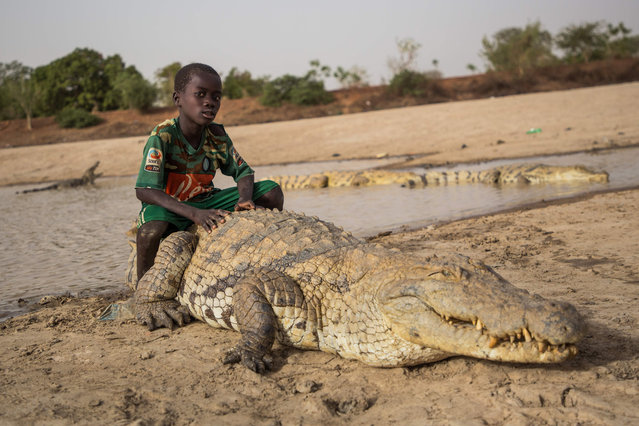
A boy sits on the back of a crocodile on May 19, 2018 at a pond in Bazoule in Burkina Faso, a village which happily shares its local pond with “sacred” crocodiles. Crocodiles may be one of the deadliest hunters in the animal kingdom, but in a small village in Burkina Faso it is not unusual to see someone sitting atop one of the fearsome reptiles. According to local legend, the startling relationship with the predators dates back to at least the 15 th century. The village was in the grip of an agonising drought until the crocodiles led women to a hidden pond where the population could slake their thirst. (Photo by Olympia de Maismont/AFP Photo)

A boy sits on the back of a crocodile on May 19, 2018 at a pond in Bazoule in Burkina Faso, a village which happily shares its local pond with “sacred” crocodiles. Crocodiles may be one of the deadliest hunters in the animal kingdom, but in a small village in Burkina Faso it is not unusual to see someone sitting atop one of the fearsome reptiles. According to local legend, the startling relationship with the predators dates back to at least the 15 th century. The village was in the grip of an agonising drought until the crocodiles led women to a hidden pond where the population could slake their thirst. (Photo by Olympia de Maismont/AFP Photo)
Details
17 Jul 2018 00:01:00
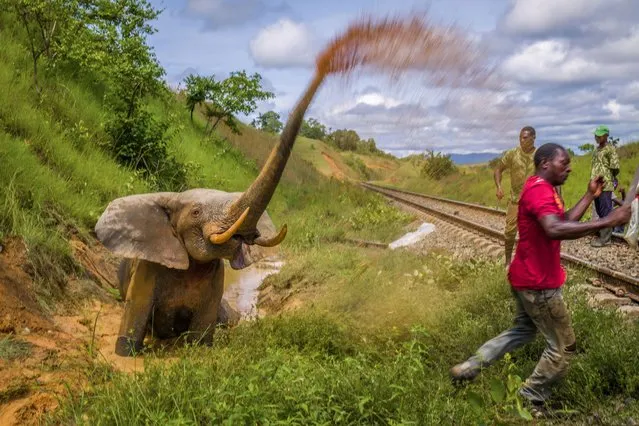
Grand prize winner: environmental photographer of the year 2023; also 1st place in the humanity v nature category; and winner of the 2023 public award. Lopé national park, Gabon, 2021. An angry elephant tries to defend itself after it was hit by a train that crosses paths the animals use within Lopé national park. Park officials decided the elephant was too severely injured to be saved. After it was killed, the park director distributed the meat to local people. As the forest loses its carrying capacity to sustain its megafauna, this kind of human-wildlife conflict is increasing. (Photo by Jasper Doest/Environmental Photography Award)

Grand prize winner: environmental photographer of the year 2023; also 1st place in the humanity v nature category; and winner of the 2023 public award. Lopé national park, Gabon, 2021. An angry elephant tries to defend itself after it was hit by a train that crosses paths the animals use within Lopé national park. Park officials decided the elephant was too severely injured to be saved. After it was killed, the park director distributed the meat to local people. As the forest loses its carrying capacity to sustain its megafauna, this kind of human-wildlife conflict is increasing. (Photo by Jasper Doest/Environmental Photography Award)
Details
09 Jul 2023 03:06:00
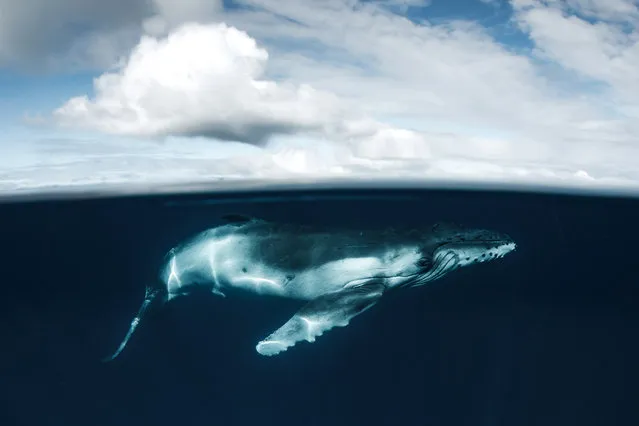
The images were taken off the coast of Tonga in the South Pacific. Photographer Grant Thomas said: “Through my images I aim to show off the amazing life we have on our planet in hope of inspiring more people to experience it for themselves and, most importantly, care for it. There is nothing to be afraid of with the humpback whales, as these animals are some of the most majestic and peaceful creatures in the sea. They will often be very curious of people in the water and will even seek out interactions with us”. (Photo by Grant Thomas/Caters News Agency)

The images were taken off the coast of Tonga in the South Pacific. Photographer Grant Thomas said: “Through my images I aim to show off the amazing life we have on our planet in hope of inspiring more people to experience it for themselves and, most importantly, care for it”. (Photo by Grant Thomas/Caters News Agency)
Details
28 Nov 2019 00:03:00
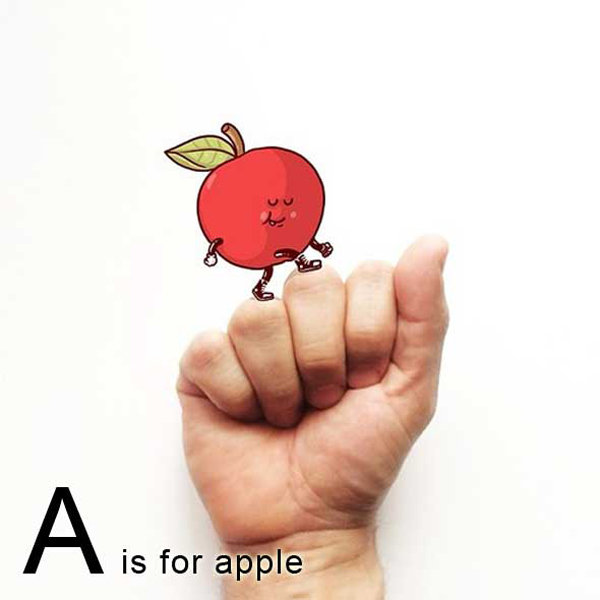
Sign Language Alphabet Doodles By Alex Solis

Have you ever been interested in the sign language? Surely you’ve always wanted to learn the art of sending a message using just your hands. To help people achieve this goal, Alex Solis has taken a photo of a hand showing each letter of the alphabet. However, this has been done many times before, which is why Alex decided to make each of the photos more interesting by placing little drawn animals and creatures onto each photo. Thanks to these cute little drawings the pictures become very endearing and memorable. All the little creatures blend in seamlessly into the pictures thanks to their well-chosen poses. This project, created by Alex Solis, is very unique and useful, allowing anyone to quickly remember all the listed hand gestures. (Photo by Alex Solis)
Details
08 Jan 2015 14:28:00
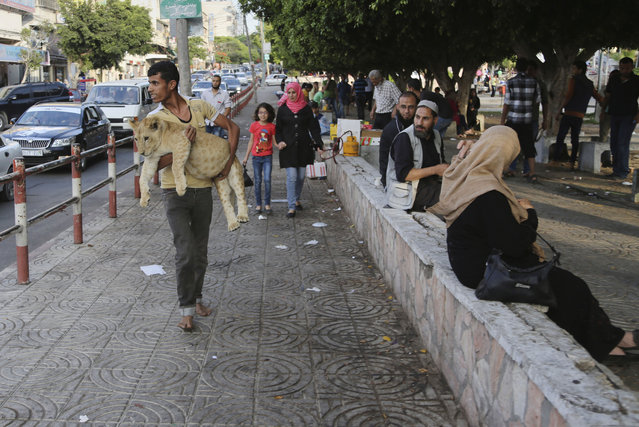
In this Monday, June 15, 2015 photo, Ahmad Abu Jereda, 16, carries Max, the male lion cub, as he passes by Palestinians at the main garden in Gaza City, in the northern Gaza Strip. (Photo by Adel Hana/AP Photo)

In this Monday, June 15, 2015 photo, Ahmad Abu Jereda, 16, carries Max, the male lion cub, as he passes by Palestinians at the main garden in Gaza City, in the northern Gaza Strip. A pair of lion cubs are stuck at a Gaza-Israel border crossing en route to a Jordan animal sanctuary, after being kept for a year by a family in crowded Gaza. Saduldin al-Jamal had bought the cubs from the Gaza zoo, hit during last summer's Israel-Hamas war. His family would take them to parks or the beach and children – those brave enough – would come up to pet them. (Photo by Adel Hana/AP Photo)
Details
04 Jul 2015 11:07:00


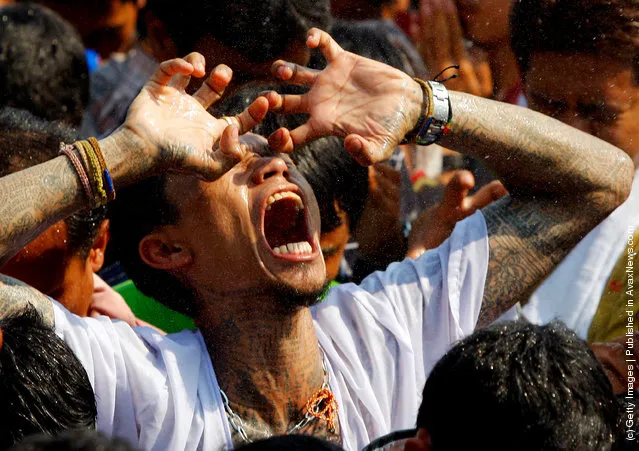
A Thai devotee in a state of trance screams while holy water is sprayed as thousands race towards the edifice of the founder monk during the annual Tattoo fesitval at Wat Bang Phra on March 7, 2009 in Nakhom Pathom, Thailand. Some men take on the characteristics of sacred animals that have been carved onto their skin. Thousands of believers from all over Thailand come to take part in one of the country's most bizarre festivals about 50 miles outside Bangkok to pay respect to the temple's monks who are master tattooist. In Thai culture the tattoo or Thai word sak yant is worn as a symbol of spiritual and physical protection, many believe that the tattoo have mystical powers. Many tattoo fanatics choose to have monkeys and tigers as well as the Khmer/Cambodia ancient script on their bodies. (Photo Paula Bronstein/Getty Images)
Details
27 Jun 2011 10:43:00