Loading...
Done
During the recession and looking for work she began sketching birds on the inside of books, seeing the practice as a creative way to mutate the pages into something fresh. Bluebird drawing on an AT&T bill. (Photo by Paula Swisher/Caters News)

“Artist Paula Swisher has come up with a quirky way of lessening the stress of household bills - by doodling highly intricate birds on each one. Swisher, 37, has drawn hundreds of birds in her lifetime and puts her love of ornithology down to the nature walks she went on as a youngster. Looking for work during the recession, she began sketching birds on the inside of books, seeing the practice as a creative way to mutate the pages into something fresh. But now she's made the transition from books to bills – while admittedly making a playful commentary on the predatory banking businesses”. – Caters News. (Photo by Paula Swisher/Caters News)
Details
02 May 2014 11:36:00
A dinosaur robot produced by Tyco Electronics Japan G.K. is controlled by a smartphone at CEATEC (Combined Exhibition of Advanced Technologies) Japan 2014 held at at Makuhari Messe in Chiba, east of Tokyo, Japan, 07 October 2014. The CEATEC opened on 07 October for a five-day exhibition. (Photo by Kimimasa Mayama/EPA)

A dinosaur robot produced by Tyco Electronics Japan G.K. is controlled by a smartphone at CEATEC (Combined Exhibition of Advanced Technologies) Japan 2014 held at at Makuhari Messe in Chiba, east of Tokyo, Japan, 07 October 2014.With a Sharp Aquos ZETA mobile phone model, users can make the 6.5-meter (21 feet, 4 inches) long, 2.1-meter (6 feet, 11 inches) tall dinosaur robot to walk forward and backward, jump, move its head, hands and legs up and down, left and right, open and close its mouth by touching the screen panel and make it bark by shaking the handheld. (Photo by Kimimasa Mayama/EPA)
Details
08 Oct 2014 11:54:00
A “Maya” girl sits in an altar during the traditional celebration of “Las Mayas” on the streets in Madrid, Spain Sunday, May 10, 2015. The festivity of the Maya comes from pagan rites and dates from the medieval age, appearing in ancient documents. It takes place every year in the beginning of May and celebrates the beginning of the spring. (Photo by Daniel Ochoa de Olza/AP Photo)

A “Maya” girl sits in an altar during the traditional celebration of “Las Mayas” on the streets in Madrid, Spain Sunday, May 10, 2015. The festivity of the Maya comes from pagan rites and dates from the medieval age, appearing in ancient documents. It takes place every year in the beginning of May and celebrates the beginning of the spring. Girls between 7 and 11 years old are chosen as “Maya” and should sit still, serious and quiet for a couple of hours in altars on the street decorated with flowers and plants and afterwards they walk to the church with their family where they attend a ceremony. (Photo by Daniel Ochoa de Olza/AP Photo)
Details
14 May 2015 11:12:00
Automated guided vehicle robot “Ray” lifts up an Audi car during a pilot project at the parking area of the Audi plant in Ingolstadt, Germany, May 13, 2015. (Photo by Michaela Rehle/Reuters)

Automated guided vehicle robot “Ray” lifts up an Audi car during a pilot project at the parking area of the Audi plant in Ingolstadt, Germany, May 13, 2015. The robot has been designed to help make work more efficient and more comfortable for employees, some whom walk up to eight kilometres a day, while coordinating the finished cars for the subsequent train transportation. “Robot Ray” technology, currently being used at Dusseldorf International Airport in Germany, claims to be able to park 60 per cent more vehicles in one area compared with a human driver. (Photo by Michaela Rehle/Reuters)
Details
14 May 2015 12:04:00
Villagers from Jiexi Jiantan village perform a ritual of “Zha Laoye”, or “Cracking local spirits”, in Chaoshan, Guangdong Province, China, 10 February 2019. Jiexi Jiantan Village celebrates the annual custom of “Zha Laoye” where Laoye are local spirits. Every third day of the lunar New Year, statues of local spirits known as the “Thousand-mile Eye” Laoye and “Ear Following the Wind” Laoye are brought out to the village committee to receive incensed tea offered by believers. By the sixth day of the year, the “Zha Laoye” activities begin with each man holding one of the statues on a chair above his head while run around a bonfire. Two other men light firecrackers strung up on a long bamboo poles and chase the spirit around the bonfire, signifying a bountiful new year. (Photo by EPA/EFE/ZNSEN)

Villagers from Jiexi Jiantan village perform a ritual of “Zha Laoye”, or “Cracking local spirits”, in Chaoshan, Guangdong Province, China, 10 February 2019. Jiexi Jiantan Village celebrates the annual custom of “Zha Laoye” where Laoye are local spirits. Every third day of the lunar New Year, statues of local spirits known as the “Thousand-mile Eye” Laoye and “Ear Following the Wind” Laoye are brought out to the village committee to receive incensed tea offered by believers. (Photo by EPA/EFE/ZNSEN)
Details
23 Feb 2019 00:07:00
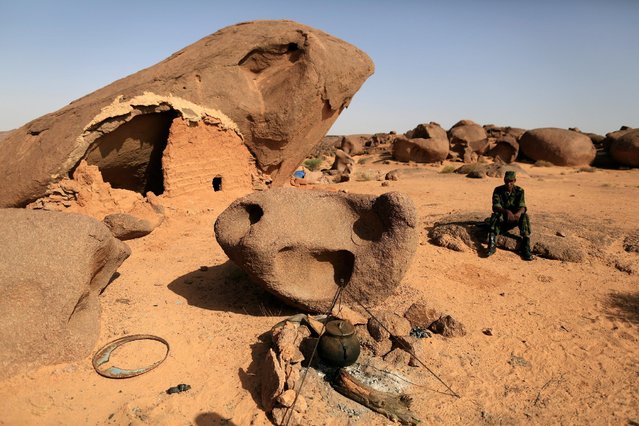
A Polisario fighter sits on a rock at a forward base on the outskirts of Tifariti, Western Sahara, September 9, 2016. At a rocky outpost in Western Sahara, a new generation of soldiers who have never known war are mobilising as tensions resurface in one of Africa's oldest disputes after a quarter century of uneasy peace. Young Sahrawi troops man new desert posts for the Polisario Front, which for more than 40 years has sought independence for the vast desert region - first in a guerrilla war against Morocco and then politically since a ceasefire deal in 1991. Now a standoff with Morocco, which controls the majority of Western Sahara, is renewing pressure for a diplomatic solution to ensure foot soldiers don't return to fighting as the last generation of commanders once did. The standoff since August has brought Moroccan and Polisario forces within 200 metres of each other in a narrow strip of land near the Mauritanian border. Rich in phosphate, Western Sahara has been contested since 1975 when Spanish colonial powers left. Morocco claimed the territory and fought the 16-year war with Polisario. (Photo by Zohra Bensemra/Reuters)

A Polisario fighter sits on a rock at a forward base on the outskirts of Tifariti, Western Sahara, September 9, 2016. At a rocky outpost in Western Sahara, a new generation of soldiers who have never known war are mobilising as tensions resurface in one of Africa's oldest disputes after a quarter century of uneasy peace. (Photo by Zohra Bensemra/Reuters)
Details
04 Nov 2016 12:09:00
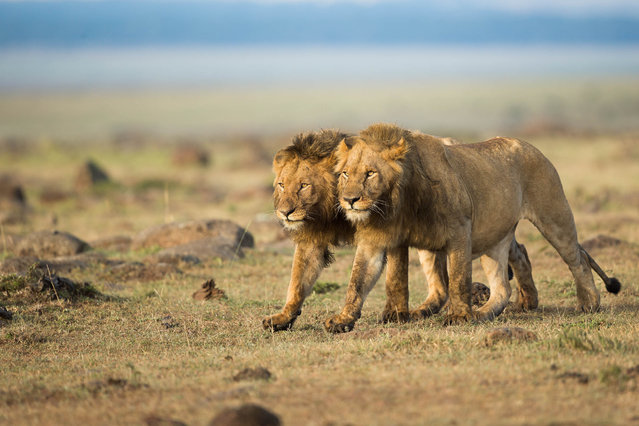
“Two Brothers”. We found about 20 lions eating a buffalo. When the male leaved the group we anticipated him to take photos. It is 8AM, light is perfect and the position too. The lion stops and looks down from the hill, another lion is coming up, it stiffens, I think that will be a fight, i'm tense, the camera is OK, the shots previously made perfect. Photo location: Masai Mara, Kenya. (Photo and caption by Massimo Mei/National Geographic Photo Contest)

“Two Brothers”. We found about 20 lions eating a buffalo. When the male leaved the group we anticipated him to take photos. It is 8AM, light is perfect and the position too. The lion stops and looks down from the hill, another lion is coming up, it stiffens, I think that will be a fight, i'm tense, the camera is OK, the shots previously made perfect. The two meet, looking directly into their eyes, they sniff, rub against their heads, the tension drops, they start walking with the same step as when they were puppies, they are two brothers. Photo location: Masai Mara, Kenya. (Photo and caption by Massimo Mei/National Geographic Photo Contest)
Details
02 Jul 2014 09:45:00
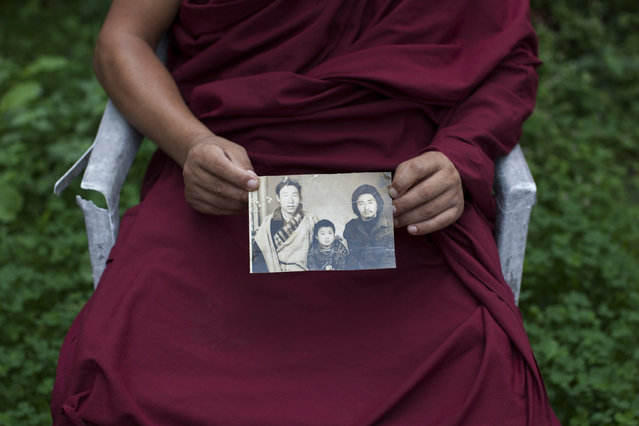
In this Saturday, September 27, 2014 photo, Tibetan monk Dorjee, 38, displays a photograph of his father, left, and himself, center, taken in Tibet, in Dharamsala, India. Dorjee said he held back his tears when he spoke with his parents on the phone after a separation period of 27 years. He exchanged a few words with his father but said his mother fainted on hearing his voice. (Photo by Tsering Topgyal/AP Photo)

“When I was 8 years old, my parents paid a smuggler to take me across the Himalayas, a weekslong walk over the mountains from Tibet to India. It was a trek that tens of thousands of other Tibetans have taken since the Dalai Lama fled a failed 1959 uprising against Chinese rule. My parents must have had their reasons to send me here; they must have had the best of intentions. But 18 years later, I still don't know why they did it. They are not political people. They are small farmers who raise barley and a few yak in a rural area not far from Lhasa, the Tibetan capital. I have not seen them since I left...”. – Tsering Topgyal via The Associated Press. (Photo by Tsering Topgyal/AP Photo)
Details
05 Nov 2014 12:27:00