Loading...
Done
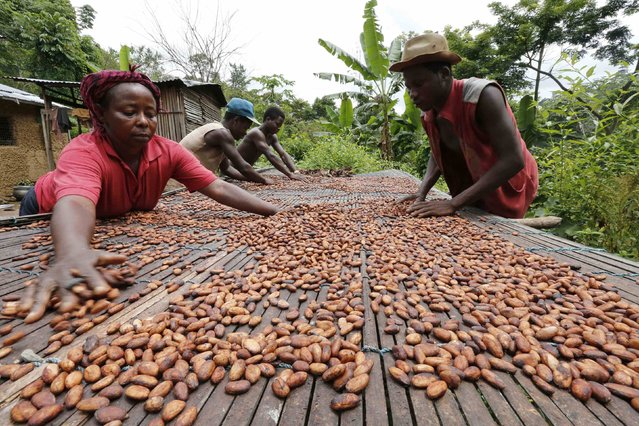
People work with cocoa beans in Enchi June 17, 2014. Picture taken June 17, 2014. Ghana emerged as a success story during the 2000s, when war, political instability and a disastrous liberalization brought Ivory Coast's cocoa sector to its knees. Ghana's output more than tripled from 340,000 tons in the 2001/02 season to a record 1,025,000 tons a decade later. Strict controls cemented its reputation as a producer of top quality beans, establishing a brand that fetches a premium. (Photo by Thierry Gouegnon/Reuters)

People work with cocoa beans in Enchi June 17, 2014. Picture taken June 17, 2014. Ghana emerged as a success story during the 2000s, when war, political instability and a disastrous liberalization brought Ivory Coast's cocoa sector to its knees. Ghana's output more than tripled from 340,000 tons in the 2001/02 season to a record 1,025,000 tons a decade later. Strict controls cemented its reputation as a producer of top quality beans, establishing a brand that fetches a premium. (Photo by Thierry Gouegnon/Reuters)
Details
03 Aug 2014 07:17:00
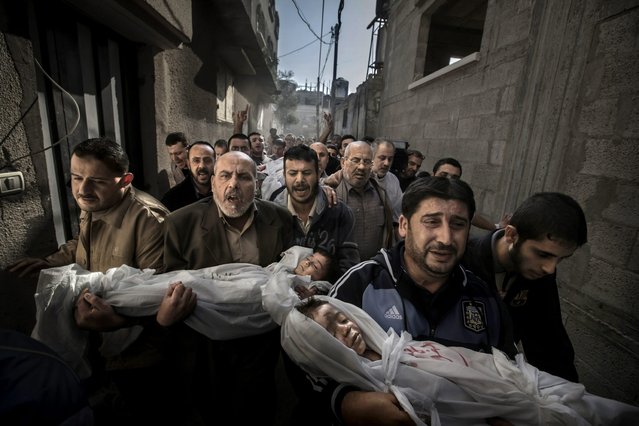
In this photo provided on Friday Feb. 15, 2013 by World Press Photo, the 2013 World Press Photo of the year by Paul Hansen, Sweden, for Dagens Nyheter, shows two-year-old Suhaib Hijazi and her three-year-old brother Muhammad who were killed when their house was destroyed by an Israeli missile strike. (Photo by Paul Hansen/Dagens Nyheter/AP Photo)

Swedish photographer Paul Hansen won the 2012 World Press Photo award Friday for newspaper Dagens Nyheter with a picture of two Palestinian children killed in an Israeli missile strike being carried to their funeral.

Photo: In this photo provided on Friday February 15, 2013 by World Press Photo, the 2013 World Press Photo of the year by Paul Hansen, Sweden, for Dagens Nyheter, shows two-year-old Suhaib Hijazi and her three-year-old brother Muhammad who were killed when their house was destroyed by an Israeli missile strike. Their father, Fouad, was also killed and their mother was put in intensive care. Fouad's brothers carry his children to the mosque for the burial ceremony as his body is carried behind on a stretcher in Gaza City, Palestinian Territories, November 20, 2012. (Photo by Paul Hansen/Dagens Nyheter/AP Photo)
Details
16 Feb 2013 12:17:00
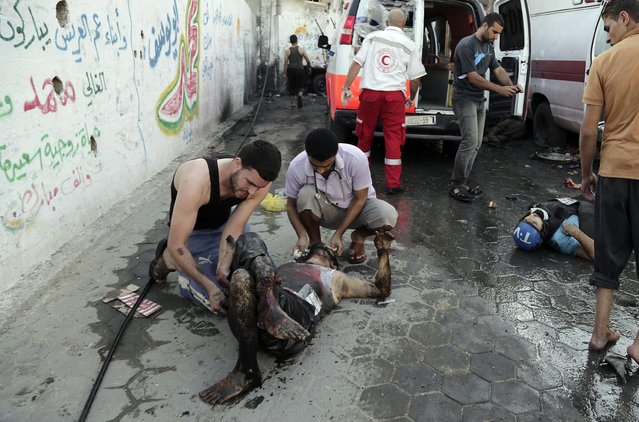
In this July 30, 2014 photo, neighbors help gravely injured Mohammed al-Selek, 39, wounded by an Israeli mortar strike as he lays next to the body of Palestinian journalist Rami Reyan who was killed, in the Shijaiyah neighborhood of the northern Gaza Strip. Al-Selek's life changed forever last July 30, when the shells slammed into his home killing all his three children, his father and six other relatives. (Photo by Adel Hana/AP Photo)

In this July 30, 2014 photo, neighbors help gravely injured Mohammed al-Selek, 39, wounded by an Israeli mortar strike as he lays next to the body of Palestinian journalist Rami Reyan who was killed, in the Shijaiyah neighborhood of the northern Gaza Strip. Al-Selek's life changed forever last July 30, when the shells slammed into his home killing all his three children, his father and six other relatives. A year later, al-Selek, who lost his leg during the airstrike, still struggles to recover and come to terms with his family's loss in the 50-day Israel-Hamas war. (Photo by Adel Hana/AP Photo)
Details
07 Jul 2015 11:28:00
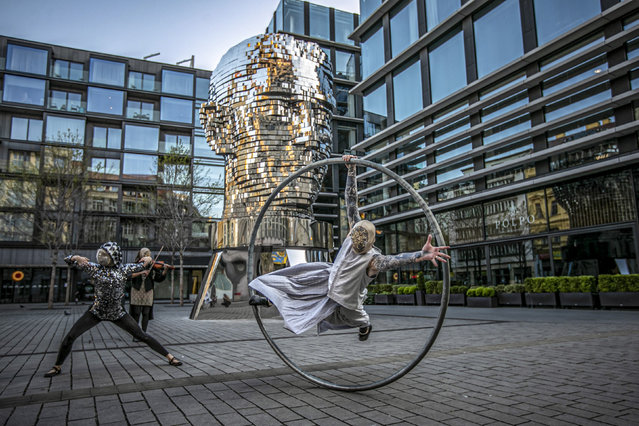
Members of the contemporary circus company Cirk La Putyka perform in front of sculpture of Franz Kafka's head to entertain local residents in Prague, Czech Republic, 21 April 2020. The aim of the Cirk La Putyka events in the streets of Czech capital is to get live art back to people during the lockdown. According to them, when people can't go to the artists, to the theater, the actors go to the people. The Czech government has imposed a lockdown in an attempt to slow down the spread of the pandemic COVID-19 disease caused by the SARS-CoV-2 coronavirus. (Photo by Martin Divisek/EPA/EFE/Rex Features/Shutterstock)

Members of the contemporary circus company Cirk La Putyka perform in front of sculpture of Franz Kafka's head to entertain local residents in Prague, Czech Republic, 21 April 2020. The aim of the Cirk La Putyka events in the streets of Czech capital is to get live art back to people during the lockdown. According to them, when people can't go to the artists, to the theater, the actors go to the people. The Czech government has imposed a lockdown in an attempt to slow down the spread of the pandemic COVID-19 disease caused by the SARS-CoV-2 coronavirus. (Photo by Martin Divisek/EPA/EFE/Rex Features/Shutterstock)
Details
23 Apr 2020 00:01:00
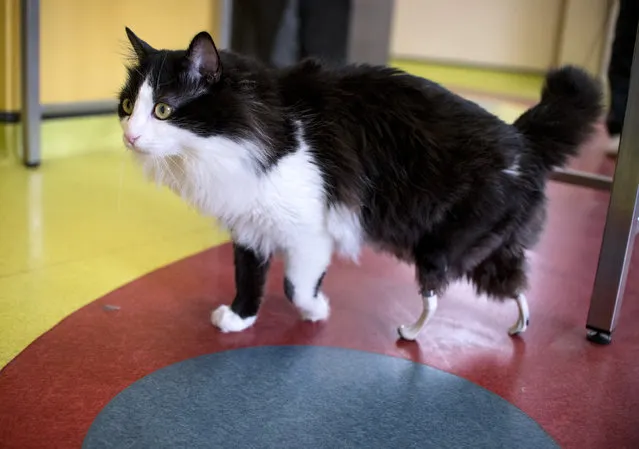
Pooh, a one-year-old cat, who lost his hind legs in an accident and has been given bionic paws, walks in a vet clinic in Sofia on January 31, 2017. Pooh, who is thought to have lost his legs in a car or train accident last April, is back on the prowl thanks to Bulgarian veterinary surgeon Vladislav Zlatinov. He is the first vet in Europe to successfully apply the pioneering method of Irish neuro-orthopaedic surgeon Noel Fitzpatrick, who shot to fame in 2009 when making Oscar the first bionic cat by fitting him with new hind legs in Britain. (Photo by Nikolay Doychinov/AFP Photo)

Pooh, a one-year-old cat, who lost his hind legs in an accident and has been given bionic paws, walks in a vet clinic in Sofia on January 31, 2017. Pooh, who is thought to have lost his legs in a car or train accident last April, is back on the prowl thanks to Bulgarian veterinary surgeon Vladislav Zlatinov. He is the first vet in Europe to successfully apply the pioneering method of Irish neuro-orthopaedic surgeon Noel Fitzpatrick, who shot to fame in 2009 when making Oscar the first bionic cat by fitting him with new hind legs in Britain. (Photo by Nikolay Doychinov/AFP Photo)
Details
03 Feb 2017 07:35:00
An Iranian Shiite Muslim prays in Laylat al-Qadr, or the night of destiny, during holy fasting month of Ramadan after midnight, in central Tehran, Iran, early Sunday, June 18, 2017. Laylat al-Qadr is the night when Muslims believe the Quran was first revealed to prophet Muhammad. Worshipers gather in religious ceremonies to pray, ask forgiveness and make wishes on one of the most important nights of the Islamic calendar. Shiite Muslims, the vast majority of Iranians, believe the night happens either on 19th, 21st or 23rd of the holy month of Ramadan. (Photo by Ebrahim Noroozi/AP Photo)

An Iranian Shiite Muslim prays in Laylat al-Qadr, or the night of destiny, during holy fasting month of Ramadan after midnight, in central Tehran, Iran, early Sunday, June 18, 2017. Laylat al-Qadr is the night when Muslims believe the Quran was first revealed to prophet Muhammad. Worshipers gather in religious ceremonies to pray, ask forgiveness and make wishes on one of the most important nights of the Islamic calendar. Shiite Muslims, the vast majority of Iranians, believe the night happens either on 19th, 21st or 23rd of the holy month of Ramadan. (Photo by Ebrahim Noroozi/AP Photo)
Details
18 Jun 2017 03:43:00
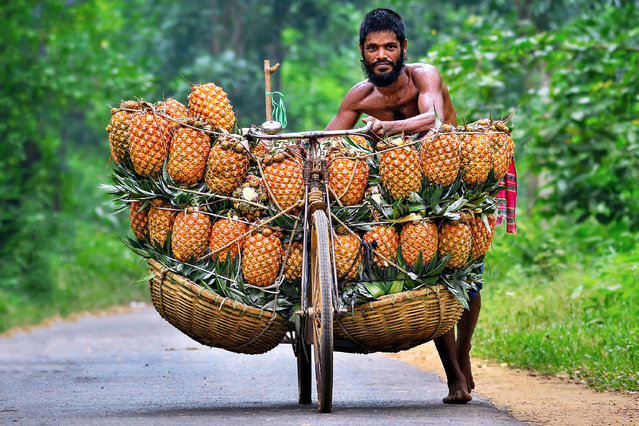
Cyclists desperately try to keep their heavily-laden bicycles upright as they arrive at a market with baskets full of pineapples on August 23, 2018. The men travel up to 12 and a half miles with two baskets tied to the sides of their bikes, carrying between 50 and 100 pineapples to sell. Each of the bicycles is so heavily laden with fruit it is impossible for the men to actually ride their bikes, instead having to walk alongside them. When they arrive at the market place in Madhupur, Bangladesh, buyers will pay up to 30 Taka for a pineapple – the equivalent of around 28 pence. (Photo by Abdul Momin/Solent News & Photo Agency UK)

Cyclists desperately try to keep their heavily-laden bicycles upright as they arrive at a market with baskets full of pineapples on August 23, 2018. The men travel up to 12 and a half miles with two baskets tied to the sides of their bikes, carrying between 50 and 100 pineapples to sell. Each of the bicycles is so heavily laden with fruit it is impossible for the men to actually ride their bikes, instead having to walk alongside them. When they arrive at the market place in Madhupur, Bangladesh, buyers will pay up to 30 Taka for a pineapple – the equivalent of around 28 pence. (Photo by Abdul Momin/Solent News & Photo Agency UK)
Details
21 Sep 2018 00:03:00
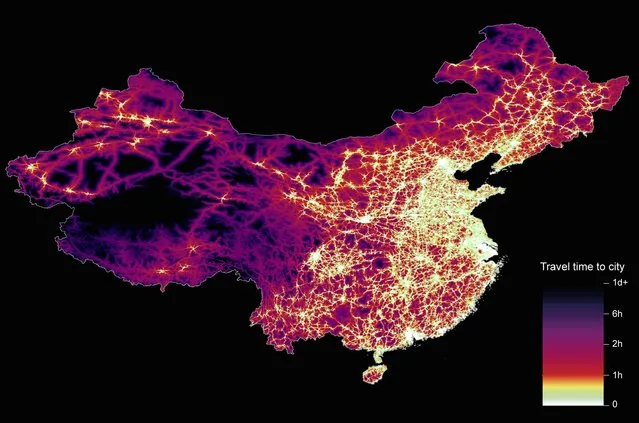
From Britain to China to Mali, new maps showing travel times to the nearest urban centre reveal huge differences between countries. Using Open Street Map and Google, a University of Oxford team have created a visual breakdown that suggests major inequalities when it comes to commuting. Here: China. The dataset used for China was unique as it relied solely on Open Street Map, due to restrictions on accessing Google data. The population is densely concentrated in the east and accessibility is increased, whereas rural provinces in the west remain remote. (Photo by Daniel Weiss/Jennifer Rozier/Malaria Atlas Project/University of Oxford )

From Britain to China to Mali, new maps showing travel times to the nearest urban centre reveal huge differences between countries. Using Open Street Map and Google, a University of Oxford team have created a visual breakdown that suggests major inequalities when it comes to commuting. Here: China. The dataset used for China was unique as it relied solely on Open Street Map, due to restrictions on accessing Google data. The population is densely concentrated in the east and accessibility is increased, whereas rural provinces in the west remain remote. (Photo by Daniel Weiss/Jennifer Rozier/Malaria Atlas Project/University of Oxford)
Details
12 Jan 2018 06:43:00