Loading...
Done
A vendor (C) cuts slaughtered dogs for sale at his roadside stall in Duong Noi village, outside Hanoi December 16, 2011. While animal rights activists have condemned eating dog meat as cruel treatment of the animals, it is still an accepted popular delicacy for some Vietnamese, as well in some other Asian countries. (Photo by Reuters/Kham)

A vendor (C) cuts slaughtered dogs for sale at his roadside stall in Duong Noi village, outside Hanoi December 16, 2011. While animal rights activists have condemned eating dog meat as cruel treatment of the animals, it is still an accepted popular delicacy for some Vietnamese, as well in some other Asian countries. Duong Noi is well-known as a dog-meat village, where hundreds of dogs are killed each day for sale as popular traditional food. Dog-eating as a custom is rooted in Vietnam and was developed as a result of poverty. One kilogram of dog meat costs about 130,000 dongs ($6.2). (Photo by Reuters/Kham)
Details
16 Jul 2013 11:40:00
Ethnic Cham Muslim people pass the time near their boats on banks of Mekong river in Phnom Penh July 29, 2013. (Photo by Damir Sagolj/Reuters)

Ethnic Cham Muslim people pass the time near their boats on banks of Mekong river in Phnom Penh July 29, 2013. About 100 ethnic Cham families, made up of nomads and fishermen without houses or land who arrived at the Cambodian capital in search of better lives, live on their small boats on a peninsula where the Mekong and Tonle Sap rivers meet, just opposite the city's centre. The community has been forced to move several times from their locations in Phnom Penh as the land becomes more valuable. They fear that their current home, just behind a new luxurious hotel under construction at the Chroy Changva district is only temporary and that they would have to move again soon. (Photo by Damir Sagolj/Reuters)
Details
31 Jul 2013 06:34:00
Isabel Schmalenbach, an environmental scientist with the Helgoland Biological Institute (Biologische Anstalt Helgoland), part of the Alfred Wegener Institute for Polar and Marine Research, holds a one-year old baby European lobster (Homarus gammarus) raised at the institute on August 3, 2013 on Helgoland Island, Germany. (Photo by Sean Gallup/Getty Images)

Isabel Schmalenbach, an environmental scientist with the Helgoland Biological Institute (Biologische Anstalt Helgoland), part of the Alfred Wegener Institute for Polar and Marine Research, holds a one-year old baby European lobster (Homarus gammarus) raised at the institute on August 3, 2013 on Helgoland Island, Germany. Later in the day Schmalenbach and her colleagues released a total of 415 one-year old lobsters into the North Sea as part of an effort to repopulate the lobster population around Helgoland (also called Heligoland). In the 19th century local fishermen caught up to 80,000 lobsters a year in the surrounding waters, combined with the heavy allied bombing of the island during and after World War II, as well as other environmental factors, decimated the lobster population. (Photo by Sean Gallup)
Details
05 Aug 2013 08:39:00
Santa, a dog abandoned two days before Christmas, is looked after by Charlene Gunner at Battersea Dogs and Cats Home on December 27, 2012 in London, England.  The home was founded 150 years ago and has rescued, reunited and rehomed over three million dogs and cats. The average stay for a dog is just 28 days although some stay much longer. Around 550 dogs and 200 cats are provided refuge by Battersea at any given time.  (Photo by Peter Macdiarmid)

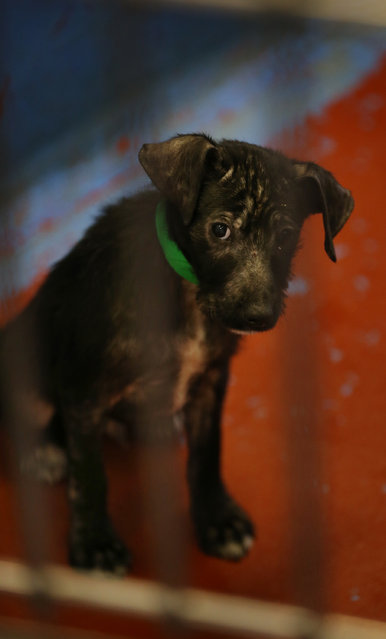
Santa, a dog abandoned two days before Christmas, is looked after by Charlene Gunner at Battersea Dogs and Cats Home on December 27, 2012 in London, England. The home was founded 150 years ago and has rescued, reunited and rehomed over three million dogs and cats. The average stay for a dog is just 28 days although some stay much longer. Around 550 dogs and 200 cats are provided refuge by Battersea at any given time. (Photo by Peter Macdiarmid)
Details
28 Dec 2012 08:52:00
The main feature of the Mitsuyama Taisai Festival, three 18 meters tall 'mountains.' are displayed at the Itate Hyozu Shrine on March 31, 2013 in Himeji, Japan. The festival is held once in 20 years since 1593, Priests of Itate Hyozu Shrine welcome to all the gods across the country for top of the three mountains and treat with food seven days from today as to pray for peace and prosperity.  (Photo by Buddhika Weerasinghe)

The main feature of the Mitsuyama Taisai Festival, three 18 meters tall “mountains”. are displayed at the Itate Hyozu Shrine on March 31, 2013 in Himeji, Japan. The festival is held once in 20 years since 1593, Priests of Itate Hyozu Shrine welcome to all the gods across the country for top of the three mountains and treat with food seven days from today as to pray for peace and prosperity. (Photo by Buddhika Weerasinghe)
Details
02 Apr 2013 12:14:00
Protesters wearing masks perform during anti-austerity and anti-graft protests in Ljubljana, Slovenia, on January 11, 2013. More than 5,000 Slovenians gathered in the center of Ljubljana on Friday to protest against a corruption scandal that threatens to bring down the government. Slovenia's anti-corruption commission said earlier this week that Prime Minister Janez Jansa had been unable to explain the source of some of his income in recent years. (Photo by Srdjan Zivulovic/Reuters /The Atlantic)

Protesters wearing masks perform during anti-austerity and anti-graft protests in Ljubljana, Slovenia, on January 11, 2013. More than 5,000 Slovenians gathered in the center of Ljubljana on Friday to protest against a corruption scandal that threatens to bring down the government. Slovenia's anti-corruption commission said earlier this week that Prime Minister Janez Jansa had been unable to explain the source of some of his income in recent years. (Photo by Srdjan Zivulovic/Reuters via The Atlantic)
Details
05 Apr 2013 08:55:00
The chariot of God Bhairab is pulled through the city centre of Bhaktapur near Kathmandu during the Bisket festival April 10, 2015. The festival, which runs for more than a week and coincides with the Nepalese New Year, involves devotees offering prayers and the pulling of two chariots, one carrying the idol of God Bhairab and the other with the idol of Goddess Bhadrakali, around the ancient city of Bhaktapur. (Photo by Navesh Chitrakar/Reuters)

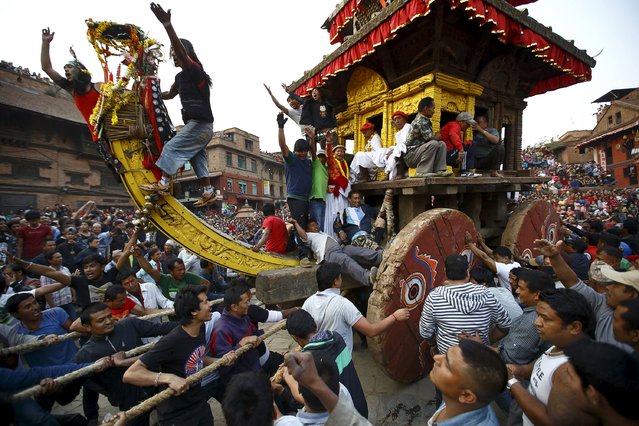
The chariot of God Bhairab is pulled through the city centre of Bhaktapur near Kathmandu during the Bisket festival April 10, 2015. The festival, which runs for more than a week and coincides with the Nepalese New Year, involves devotees offering prayers and the pulling of two chariots, one carrying the idol of God Bhairab and the other with the idol of Goddess Bhadrakali, around the ancient city of Bhaktapur. Devotees participate in the festival with the belief that they will be blessed with good health, fortune and harvest for the coming year. (Photo by Navesh Chitrakar/Reuters)
Details
12 Apr 2015 07:52:00
A lady-in-waiting adjusts the dress and Christian Louboutin shoes of Dayangku Raabi'atul 'Adawiyyah Pengiran Haji Bolkiah as Adawiyyah waits for Prince Abdul Malik to arrive for the “bersanding” or enthronement ceremony at their wedding in the Nurul Iman Palace in Bandar Seri Begawan April 12, 2015. (Photo by Olivia Harris/Reuters)

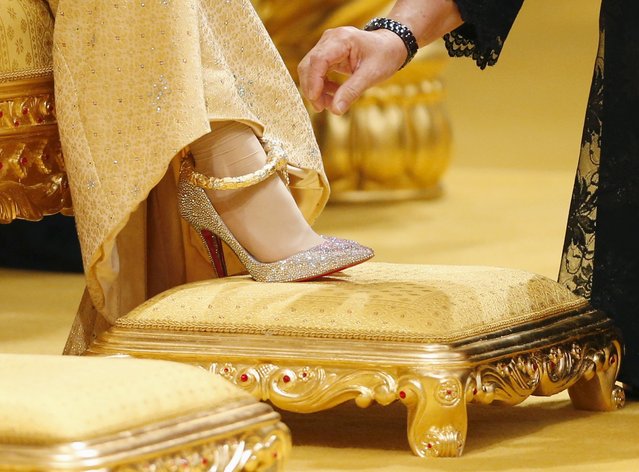
A lady-in-waiting adjusts the dress and Christian Louboutin shoes of Dayangku Raabi'atul 'Adawiyyah Pengiran Haji Bolkiah as Adawiyyah waits for Prince Abdul Malik to arrive for the “bersanding” or enthronement ceremony at their wedding in the Nurul Iman Palace in Bandar Seri Begawan April 12, 2015. Malik is the son of Brunei's Sultan Hassanal Bolkiah, one of the world's richest men. (Photo by Olivia Harris/Reuters)
Details
13 Apr 2015 12:32:00