Loading...
Done


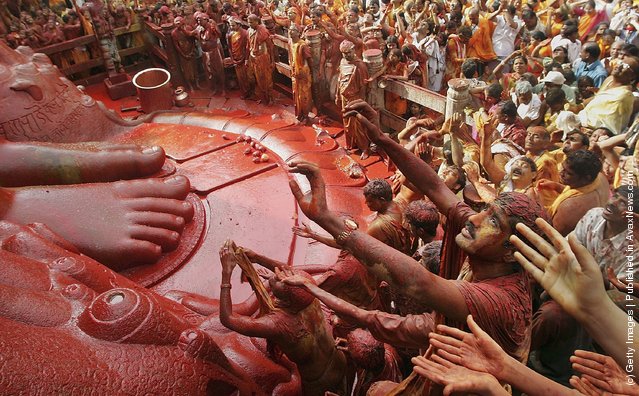
“The Mahamasthakabhisheka (or Mahamasthak Abhishek) is an important Jain festival held once every twelve years in the town of Shravanabelagola in Karnataka state, India. The festival is held in veneration of an immense 18 meter high statue of the Bhagwan (or Saint) Gomateshwara Bahubali. The anointing last took place in February 2006, and the next ceremony will occur in 2018”. – Wikipedia

Photo: A Jain Sadhu (2nd L) and devotees gather and pray at the feet of the monolithic statue of Jain sage Gomateswara during preparations for the Mahamastak Abhisheka ceremony February 7, 2006 in Shravanabelagola, India. The Mahamastak Abhisheka ceremony is held just once every twelve years where the statue will be bathed with milk, yogurt, saffron, gold coins and other religious items. The statue is said to be the world's largest monolith. The ceremony officially runs February 8-19. (Photo by Mario Tama/Getty Images)
Details
21 Jun 2011 12:27:00


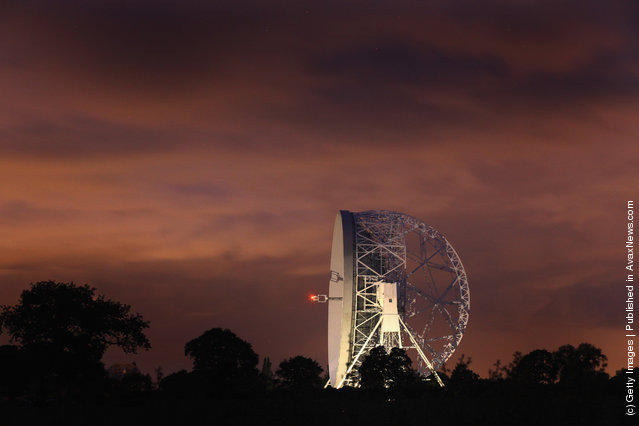
“The Lovell Telescope is a radio telescope at Jodrell Bank Observatory, near Goostrey, Cheshire in the north-west of England. When it was constructed in 1955, the telescope was the largest steerable dish radio telescope in the world at 76.2 m (250 ft) in diameter; it is now the third largest, after the Green Bank telescope in West Virginia, USA, and the Effelsberg telescope in Germany. It was originally known as the 250 ft (76 m) telescope or the Radio Telescope at Jodrell Bank, before becoming the Mark I telescope around 1961 when future telescopes (the Mark II, III, and IV) were being discussed. It was renamed to the Lovell Telescope in 1987 after Bernard Lovell, and became a Grade I listed building in 1988. The telescope forms part of the MERLIN and European VLBI Network arrays of radio telescopes”. – Wikipedia

Photo: The Lovell Telescope listens to the night sky for radio signals from space at Jodrell Bank on June 22, 2011 in Holmes Chapel, England. Jodrell Bank Centre for Astrophysics and it's world famous Lovell Telescope is on the shortlist of Britain's submission for Unesco World Heritage Site status. (Photo by Christopher Furlong/Getty Images)
Details
24 Jun 2011 09:34:00
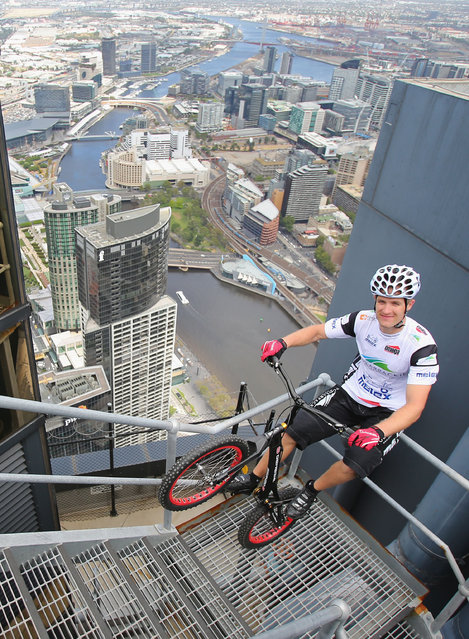
Krystian Herba, a Polish extreme cyclist jumps up the steps of Eureka Tower on a bicycle as he breaks a Guinness World Record at Eureka Tower on February 4, 2014 in Melbourne, Australia. Herba jumped up 2,919 steps on his bicycle in 1 hour 45 minutes without supporting himself with his hands or feet to break his own Guinness World Record. (Photo by Scott Barbour/Getty Images)

Krystian Herba, a Polish extreme cyclist jumps up the steps of Eureka Tower on a bicycle as he breaks a Guinness World Record at Eureka Tower on February 4, 2014 in Melbourne, Australia. Herba jumped up 2,919 steps on his bicycle in 1 hour 45 minutes without supporting himself with his hands or feet to break his own Guinness World Record. (Photo by Scott Barbour/Getty Images)
Details
05 Feb 2014 10:45:00
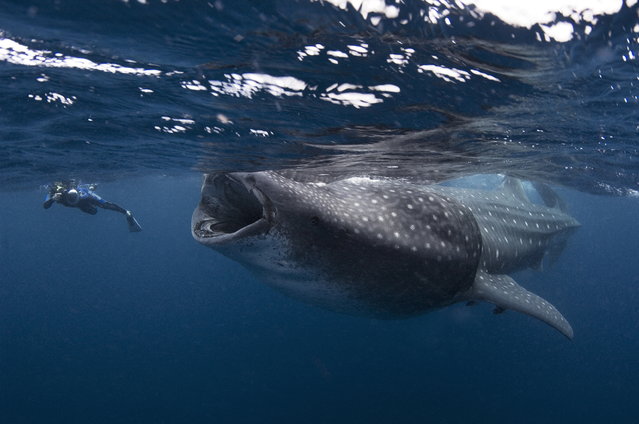
This diver almost got sucked into the mouth of a massive whale shark as it feeds on plankton. But far from staring into the jaws of death – the shark, which are the  sea's largest fish, is actually vegetarian. The relieved diver escaped from the encounter unscathed and continued to  enjoy the presence of the incredibly docile animals. The stunning photograph, by Mauricio Handler, was taken during a feeding session where more than 600 of the huge creatures  gathered to feed on tuna spawn. (Photo by Mauricio Handler/Daily Mail/Solent)

This diver almost got sucked into the mouth of a massive whale shark as it feeds on plankton. But far from staring into the jaws of death – the shark, which are the sea's largest fish, is actually vegetarian. The relieved diver escaped from the encounter unscathed and continued to enjoy the presence of the incredibly docile animals. The stunning photograph, by Mauricio Handler, was taken during a feeding session where more than 600 of the huge creatures gathered to feed on tuna spawn. (Photo by Mauricio Handler/Daily Mail/Solent)
Details
16 Feb 2014 12:23:00
A Hindu holy man, or sadhu, smokes marijuana on a chillum (pipe) at the premises of Pashupatinath Temple during the Shivaratri festival in Kathmandu February 27, 2014. Hindu holy men from Nepal and India come to this temple to take part in the Shivaratri festival. Celebrated by Hindu devotees all over the world, Shivaratri is dedicated to Lord Shiva, and holy men mark the occasion by praying, smoking marijuana or smearing their bodies with ashes. (Photo by Navesh Chitrakar/Reuters)

A Hindu holy man, or sadhu, smokes marijuana on a chillum (pipe) at the premises of Pashupatinath Temple during the Shivaratri festival in Kathmandu February 27, 2014. Hindu holy men from Nepal and India come to this temple to take part in the Shivaratri festival. Celebrated by Hindu devotees all over the world, Shivaratri is dedicated to Lord Shiva, and holy men mark the occasion by praying, smoking marijuana or smearing their bodies with ashes. (Photo by Navesh Chitrakar/Reuters)
Details
27 Feb 2014 08:40:00
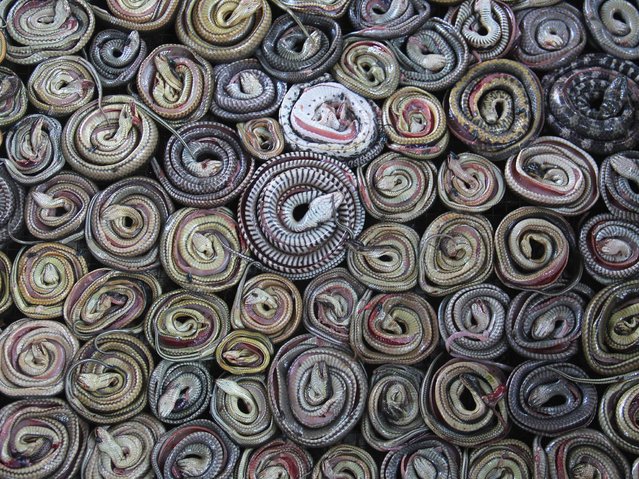
Snakes are collected and rolled before putting into the oven on March 2, 2014 in the village of Kertasura, Cirebon, Indonesia. (Photo by Nurcholis Anhari Lubis/Getty Images)

Snakes are collected and rolled before putting into the oven on March 2, 2014 in the village of Kertasura, Cirebon, Indonesia. At slaughter house snake skins measuring in the hundreds of metres, are sold to bag factories in the West and Central Java provinces on a monthly basis. From snake skin was manufactured into bags, shoes, wallets and belts. The price of a bag made from snake skin costs between 150,000 rupiah ($15 USD) and 300,000 rupiah ($30 USD), depending on its size. When snake skins reach Western fashion houses their price can increase dramatically and sell for up to $4,000 USD. (Photo by Nurcholis Anhari Lubis/Getty Images)
Details
05 Mar 2014 07:31:00


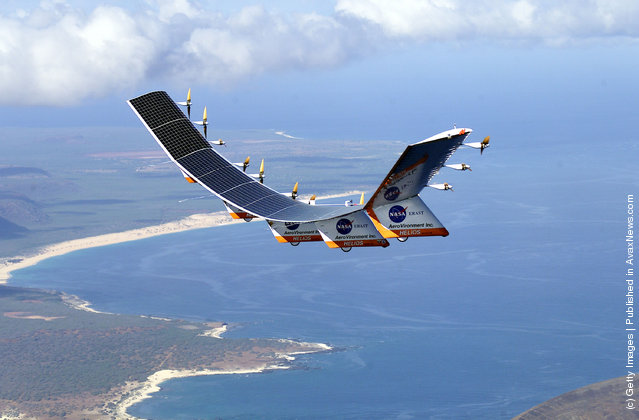
“NASA's Pathfinder, Pathfinder Plus, Centurion and Helios Prototype were an evolutionary series of solar- and fuel-cell-system-powered unmanned aerial vehicles. AeroVironment, Inc. developed the vehicles under NASA's Environmental Research Aircraft and Sensor Technology (ERAST) program. They were built to develop the technologies that would allow long-term, high-altitude aircraft to serve as “atmospheric satellites”, to perform atmospheric research tasks as well as serve as communications platforms”. – Wikipedia

Photo: The solar-electric Helios Prototype flying wing is flies over the Hawaiian islands of Niihau and Lehua during the first solar-powered test flight July 14, 2001 from the U.S. Navy's Pacific Missile Range Facility on Kauai, HI. The 18-hour flight was a functional checkout of the aircraft's systems and performance in preparation for an attempt to reach sustained flight at 100,000 feet altitude later in the summer. (Photo Courtesy of NASA/Getty Images)
Details
14 Jul 2011 09:24:00


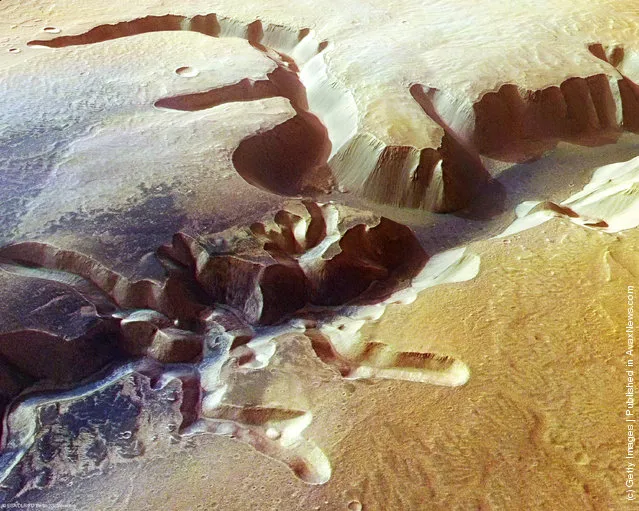
“Echus Chasma is a chasma in the Lunae Planum high plateau north of the Valles Marineris canyon system of Mars. Clay has been found in Echus Chasma that means that water once sat there for a time. Echus Chasma is approximately 100 km long and 10 km wide, with valleys ranging in depth from around 1 km to 4 km”. – Wikipedia

Photo: In this handout image supplied by the European Space Agency (ESA) on July 16, 2008, The Echus Chasma, one of the largest water source regions on Mars, is pictured from ESA's Mars Express. The data was acquired on September 25, 2005. The dark material shows a network of light-coloured, incised valleys that look similar to drainage networks known on Earth. It is still debated whether the valleys originate from precipitation, groundwater springs or liquid or magma flows on the surface. (Photo by ESA via Getty Images)
Details
18 Jul 2011 11:47:00