Loading...
Done
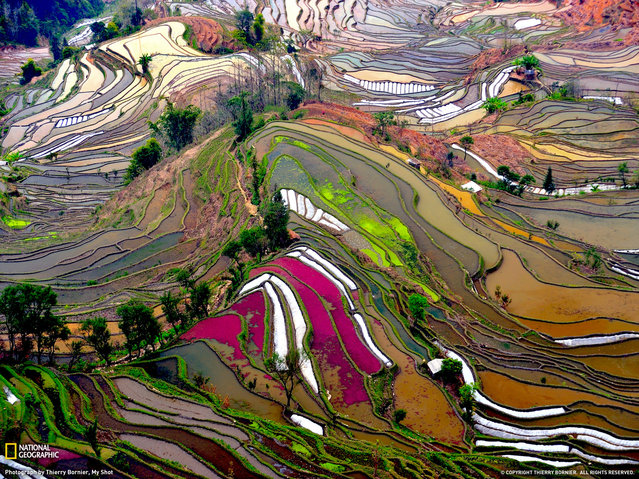
Longsheng Rice Terraces

The Longsheng Rice Terraces are located in Longsheng County, about 100 km (2 hours drive) from Guilin, Guangxi, China. The most popular are Ping An Rice Terrace and Jinkeng Rice Terrace. The terraced fields are built along the slope winding from the riverside up to the mountain top, the highest part being 880 m in elevation while the lowest part is 380 m[citation needed]. The coiling line that starts from the mountain foot up to the mountain top divides the mountain into layers of water glittering in the sun in spring, layers of green rice shoots in summer, layers of golden rice in fall, and layers of silvery frost in winter. The terraced fields were mostly built during the Ming Dynasty, about 500 years ago.
Details
18 Oct 2013 12:45:00
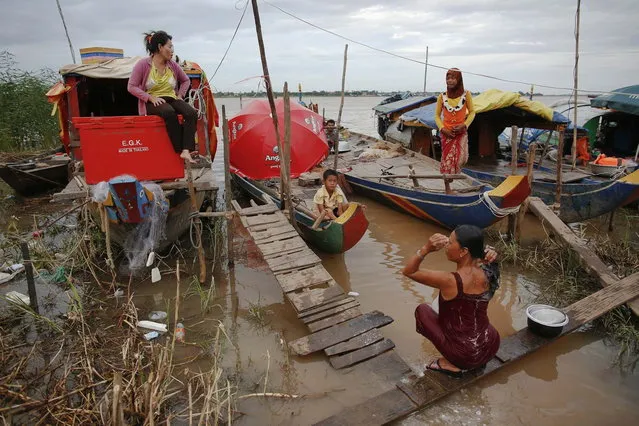
Ethnic Cham Muslim people pass the time near their boats on banks of Mekong river in Phnom Penh July 29, 2013. (Photo by Damir Sagolj/Reuters)

Ethnic Cham Muslim people pass the time near their boats on banks of Mekong river in Phnom Penh July 29, 2013. About 100 ethnic Cham families, made up of nomads and fishermen without houses or land who arrived at the Cambodian capital in search of better lives, live on their small boats on a peninsula where the Mekong and Tonle Sap rivers meet, just opposite the city's centre. The community has been forced to move several times from their locations in Phnom Penh as the land becomes more valuable. They fear that their current home, just behind a new luxurious hotel under construction at the Chroy Changva district is only temporary and that they would have to move again soon. (Photo by Damir Sagolj/Reuters)
Details
31 Jul 2013 06:34:00
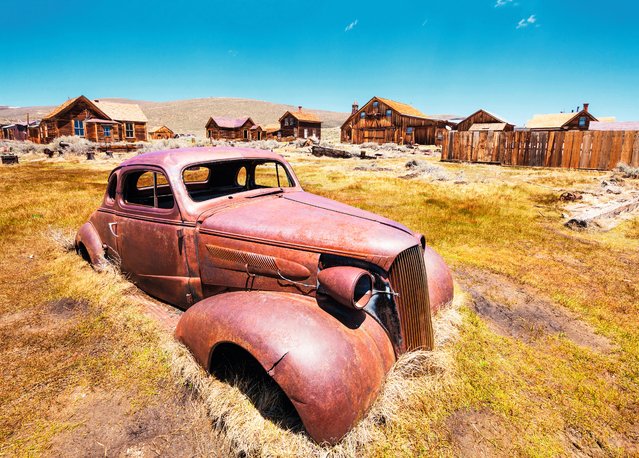
Bodie, Mono County, California. Gold was discovered at Bodie in 1859 (just after the initial California gold rush) and it went from mining camp to boomtown. Its decline began in 1880, when word spread of new boomtowns elsewhere. The Standard Consolidated Mine closed in 1913, and four years later the Bodie Railway was abandoned. By 1940 the population was down to 40. Today, Bodie is maintained in a state of arrested decay as a visitor attraction. (Photo by Alamy Stock Photo)

Kieron Connolly’s new book of photographs of more than 100 once-busy and often elegant buildings gives an idea of how the world might look if humankind disappeared. Here: Bodie, Mono County, California. Gold was discovered at Bodie in 1859 (just after the initial California gold rush) and it went from mining camp to boomtown. Its decline began in 1880, when word spread of new boomtowns elsewhere. The Standard Consolidated Mine closed in 1913, and four years later the Bodie Railway was abandoned. By 1940 the population was down to 40. Today, Bodie is maintained in a state of arrested decay as a visitor attraction. (Photo by Alamy Stock Photo)
Details
07 Sep 2016 09:50:00
Tridacna Gigas, or Giant Clams

“The giant clam, Tridacna gigas (known as pā’ua in Cook Islands Māori), is the largest living bivalve mollusc. T. gigas is one of the most endangered clam species. It was mentioned as early as 1825 in scientific reports. One of a number of large clam species native to the shallow coral reefs of the South Pacific and Indian oceans, they can weigh more than 200 kilograms (440 lb) measure as much as 120 cm (47 in) across, and have an average lifespan in the wild of 100 years or more”. – Wikipedia

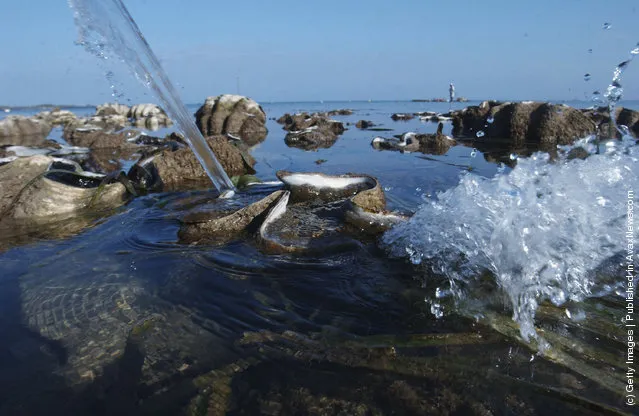
Photo: Tridacna Gigas, or Giant Clams spew water as a traditional fisherman passes by a small sanctuary on January 23, 2004 near Bolinao in the Northern Philippines. The clams, prime builders for coral reefs and providing shelter for spawning fish and other marine life, are exposed by low tides in the sanctuary. Overfishing and pollution throughout the country are not only threatening food security, but are also starting to choke one of the few working clam sanctuaries in the world. (Photo by David Greedy/Getty Images)
Details
01 Oct 2011 13:10:00
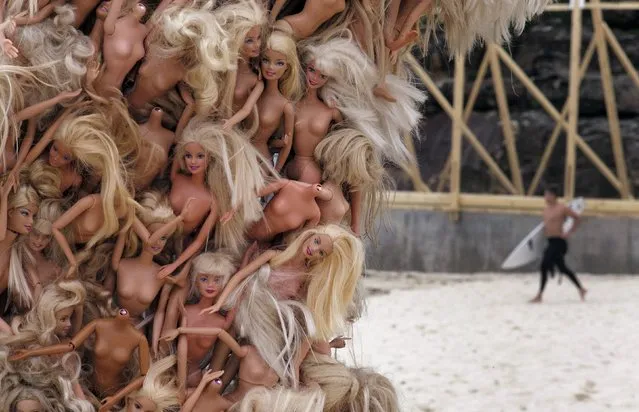
A surfer runs down the beach past hundreds of Barbie dolls comprising the sculpture 'Wave 2' by West Australian artist Annette Thas on Tamarama Beach during the 19th annual Sculptures by the Sea exhibition in Sydney, October 23, 2015. (Photo by Jason Reed/Reuters)

A surfer runs down the beach past hundreds of Barbie dolls comprising the sculpture 'Wave 2' by West Australian artist Annette Thas on Tamarama Beach during the 19th annual Sculptures by the Sea exhibition in Sydney, October 23, 2015. Sydney's coastal walk between Bondi and Tamarama has been transformed into a temporary sculpture park featuring over 100 sculptures from Australian and international artists, billed as the largest free sculpture exhibition in the world. (Photo by Jason Reed/Reuters)
Details
27 Oct 2015 08:05:00
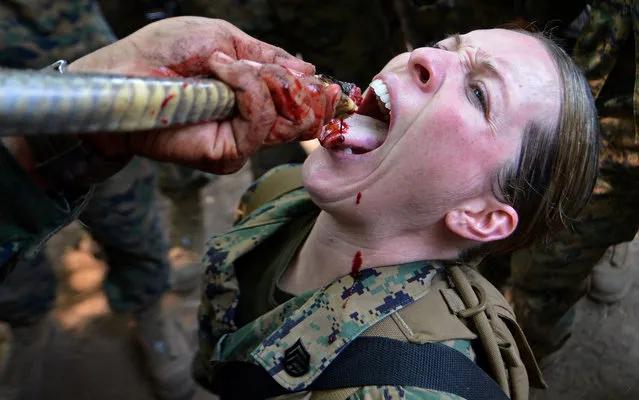
In a military base in the Thai province of Chon Buri February 20 U.S. Marines Navy with Thailand began their studies in jungle survival. The event is held in joint military exercises “Cobra Gold 2013”. During a jungle survival program February 20, 2013 taught by Royal Thai Special Forces in Sannapit, Thailand, U.S. Marines learned to catch cobras and drink their fresh blood, not to mention eat forest insects and pull the heads off of chicken. The training was part of Operation Cobra Gold 13, the 32nd edition of international military exercises hosted by the Thai. According to a U.S. Marines press release, Cobra Gold is the largest exercise of its kind in Asia and incorporates troops from five other nations in addition to the U.S. and Thailand. The Daily Mail reports that the Marines were invited to experience the local custom of drinking cobra blood after being taught to catch and kill cobras in the wild. As CNN notes, Cobra blood is believed to be a panacea and aphrodiasic in parts of Southeast Asia. In Jakarta, vendors can earn over $100 a night selling shots of cobra blood mixed with liquor. (Photo by Pornchai Kittiwongsakul/AFP Photo)

During a jungle survival program February 20, 2013 taught by Royal Thai Special Forces in Sannapit, Thailand, U.S. Marines learned to catch cobras and drink their fresh blood, not to mention eat forest insects and pull the heads off of chicken. The training was part of Operation Cobra Gold 13, the 32nd edition of international military exercises hosted by the Thai. According to a U.S. Marines press release, Cobra Gold is the largest exercise of its kind in Asia and incorporates troops from five other nations in addition to the U.S. and Thailand. The Daily Mail reports that the Marines were invited to experience the local custom of drinking cobra blood after being taught to catch and kill cobras in the wild. As CNN notes, Cobra blood is believed to be a panacea and aphrodiasic in parts of Southeast Asia. In Jakarta, vendors can earn over $100 a night selling shots of cobra blood mixed with liquor. (Photo by Pornchai Kittiwongsakul/AFP Photo)
Details
23 Feb 2013 11:52:00
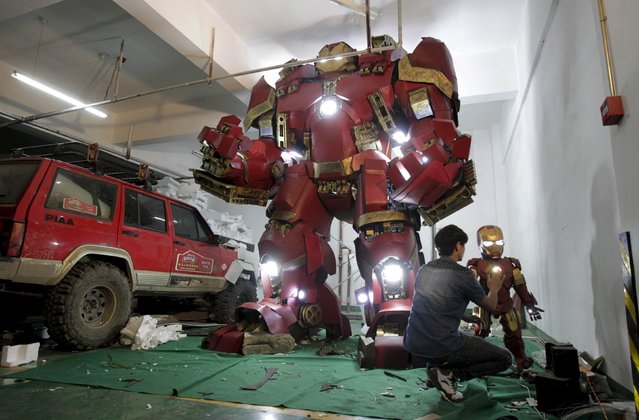
A man works on a small replica of the Iron Man armor next to a homemade replica of the “Hulkbuster” Iron Man armour from the movie “Avengers: Age of Ultron”, at an underground parking lot in Zhengzhou, Henan province, China, May 12, 2015. (Photo by Reuters/Stringer)

A man works on a small replica of the Iron Man armor next to a homemade replica of the “Hulkbuster” Iron Man armour from the movie “Avengers: Age of Ultron”, at an underground parking lot in Zhengzhou, Henan province, China, May 12, 2015. The 3.4-metre-tall replica is made of over 100 fiber-reinforced plastic components. It took Xing and his friends two months to put them together after watching the trailer of the movie in March, local media reported. (Photo by Reuters/Stringer)
Details
16 May 2015 12:41:00
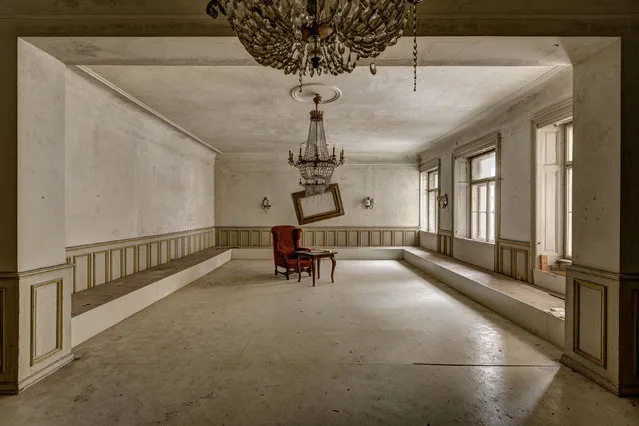
Grand banqueting halls, opulent lobbies and vast ballrooms; you could easily be forgiven for thinking this was a collection of photographs was documenting some of Europe’s grandest hotels. However, a closer look will reveal the majestic rooms to be engulfed in swathes of dust and moss; hotels that once hosted royals and high society abandoned to the elements. (Photo by Thomas Windisch/Caters News)

Grand banqueting halls, opulent lobbies and vast ballrooms; you could easily be forgiven for thinking this was a collection of photographs was documenting some of Europe’s grandest hotels. However, a closer look will reveal the majestic rooms to be engulfed in swathes of dust and moss; hotels that once hosted royals and high society abandoned to the elements. This is the latest result of urban exploration photography, going beyond “no entry” signs to capture images of dilapidated buildings across Europe. IT worker Thomas Windisch, from Graz in Austria, indulged his passion for photography by traveling across the continent, visiting over 100 abandoned hotels along the way. Here: inside a hotel in Austria. (Photo by Thomas Windisch/Caters News)
Details
24 Mar 2015 10:26:00