Loading...
Done
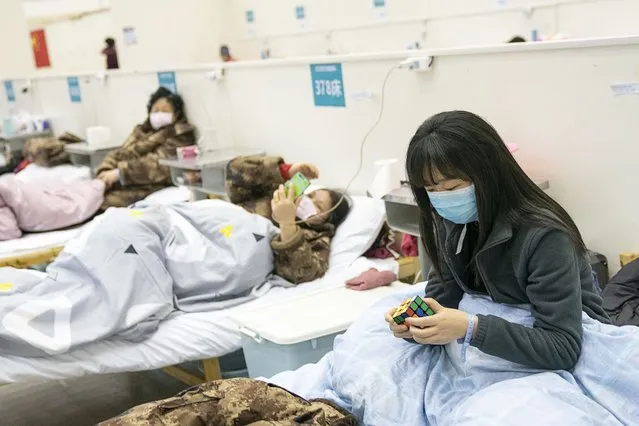
A patient solves a rubik's cube at a temporary hospital converted from “Wuhan Livingroom” in central China's Hubei Province on February 10, 2020. In face of the outbreak of the novel coronavirus pneumonia epidemic, Wuhan authorities have transformed public venues such as exhibition centers and gymnasiums into temporary hospitals. The hospitals have a large capacity of treating patients with mild symptoms and play an important role in isolating the source of infection and cutting off the routes of infection during epidemic prevention. The first batch of patients was hospitalized on Feb. 5. (Photo by Chine Nouvelle/SIPA Press/Rex Features/Shutterstock)

A patient solves a rubik's cube at a temporary hospital converted from “Wuhan Livingroom” in central China's Hubei Province on February 10, 2020. In face of the outbreak of the novel coronavirus pneumonia epidemic, Wuhan authorities have transformed public venues such as exhibition centers and gymnasiums into temporary hospitals. The hospitals have a large capacity of treating patients with mild symptoms and play an important role in isolating the source of infection and cutting off the routes of infection during epidemic prevention. The first batch of patients was hospitalized on Feb. 5. (Photo by Chine Nouvelle/SIPA Press/Rex Features/Shutterstock)
Details
17 Feb 2020 00:07:00
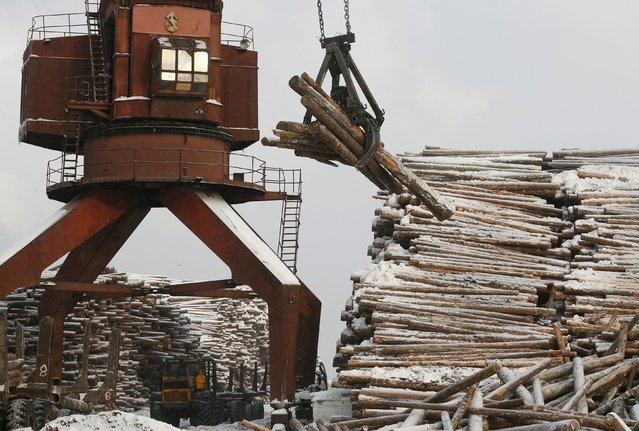
A crane loads logs at the Novoyeniseisk wood processing plant, with the air temperature at about minus 20 degrees Celsius (minus 4 degrees Fahrenheit), in the town of Lesosibirsk in Krasnoyarsk Region, Siberia, Russia, February 16, 2016. The plant exports timber to Europe, Northern Africa and Asia. The Taiga, also known as the boreal forest, on the coast of the Angara River and Yenisei River is one of the main areas for the industrial cutting of wood thanks to the high quality of the Angara pine. (Photo by Ilya Naymushin/Reuters)

A crane loads logs at the Novoyeniseisk wood processing plant, with the air temperature at about minus 20 degrees Celsius (minus 4 degrees Fahrenheit), in the town of Lesosibirsk in Krasnoyarsk Region, Siberia, Russia, February 16, 2016. The plant exports timber to Europe, Northern Africa and Asia. The Taiga, also known as the boreal forest, on the coast of the Angara River and Yenisei River is one of the main areas for the industrial cutting of wood thanks to the high quality of the Angara pine. Open air work continues all year around regardless to temperatures which can drop to minus 52 degrees Celsius (minus 61.6 degrees Fahrenheit), according to employees. (Photo by Ilya Naymushin/Reuters)
Details
18 Feb 2016 13:10:00
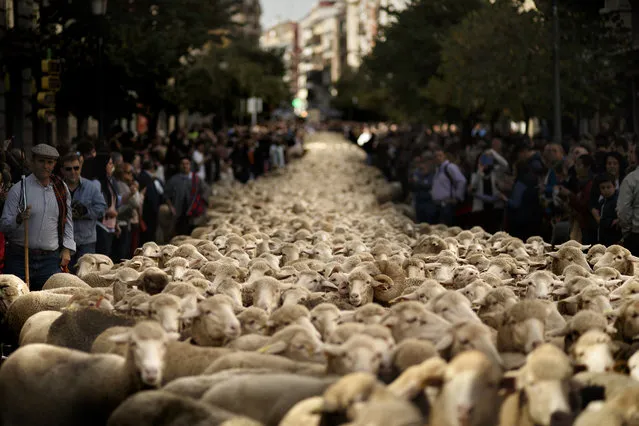
Shepherds lead their sheep through the centre of Madrid, Spain, Sunday, October 25, 2015. Shepherds have guided a flock of 2,000 sheep through Madrid streets in defense of ancient grazing, droving and migration rights increasingly threatened by urban sprawl and modern agricultural practices. Photo by Daniel Ochoa de Olza/AP Photo)

Shepherds lead their sheep through the centre of Madrid, Spain, Sunday, October 25, 2015. Shepherds have guided a flock of 2,000 sheep through Madrid streets in defense of ancient grazing, droving and migration rights increasingly threatened by urban sprawl and modern agricultural practices. Tourists and city-dwellers were surprised to see the capital's traffic cut to permit the ovine parade to bleat bells clanking its way past the city's most emblematic locations. (Photo by Daniel Ochoa de Olza/AP Photo)
Details
28 Oct 2015 08:02:00
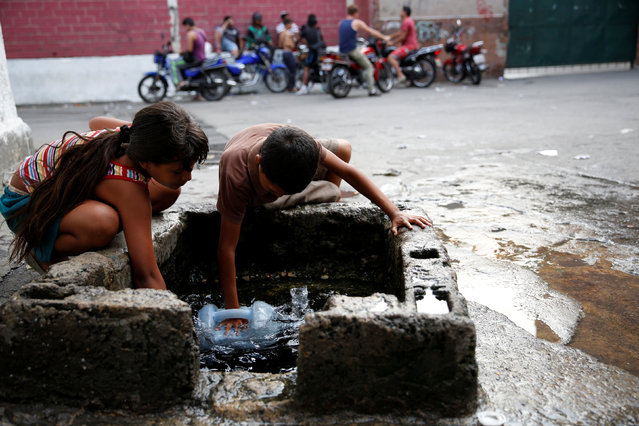
Children fill plastic containers with water from a well on a street, close to a neighbourhood called “The Tank” in the slum of Petare in Caracas, Venezuela, March 17, 2016. (Photo by Carlos Garcia Rawlins/Reuters)

Children fill plastic containers with water from a well on a street, close to a neighbourhood called “The Tank” in the slum of Petare in Caracas, Venezuela, March 17, 2016. Although their nation has one of the world's biggest hydroelectric dams and vast rivers like the fabled Orinoco, Venezuelans are still suffering water and power cuts most days. The problems with stuttering services have escalated in the last few weeks: yet another headache for the OPEC nation's 30 million people already reeling from recession, the world's highest inflation rate, and scarcities of basic goods. President Nicolas Maduro blames a drought, while the opposition blames government incompetence. (Photo by Carlos Garcia Rawlins/Reuters)
Details
08 May 2016 11:15:00
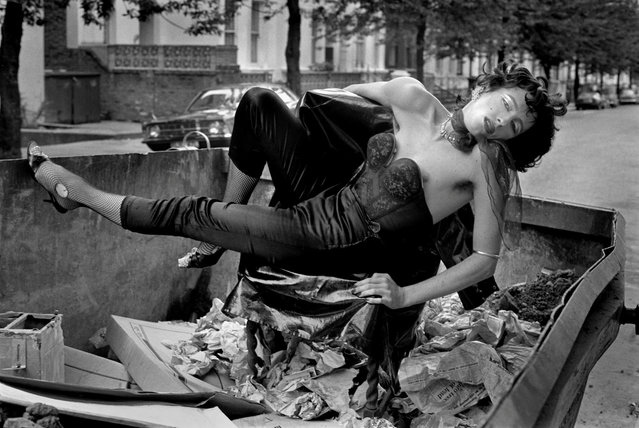
“A very delicate person, beneath the flamboyance”. Jasper, Ladbroke Grove, 1977. “In the 1970s, Australia was rather cut off. I’d always wanted to live abroad, so I moved to Rome and then London. I was an art historian, but started studying photography part-time. I was interested in the demi-monde culture and began mixing in all sorts of circles. Jasper was a rather wonderful character. He was from Sydney, but he was living downstairs from me in Ladbroke Grove, in a flat rented to some gay friends. It was fairly eclectic. Jasper was always playing around with clothes and makeup. If he was looking particularly wonderful, I might get out my lights and take a shot. Or he might put makeup on me. He wasn’t always in drag, but he was permanently in diva mode, dependably louche, funny and naughty. I think all that comes across in the image. He was actually a very delicate person, though, beneath the wit and flamboyance. Jasper floated through London all too briefly. His real name was Peter MacMahon, but to us he was only ever Jasper Havoc, an alter ego he’d created while part of a transvestite troupe called Sylvia and the Synthetics. They were legendary in Sydney gay culture. On this day, we’d been taking some pictures inside and had gone out into the streets to fool around some more. Jasper was wearing a corset and fishnets ensemble, with other bits and pieces, and we joked about him being trashy as he lay in the skip. We just took the shot for ourselves. It wasn’t done with any publication in mind, or anything else. This was way before the internet and people didn’t share images. If you dressed up, it was just for that moment”. (Photo by Jane England)

“A very delicate person, beneath the flamboyance”. Jasper, Ladbroke Grove, 1977. “In the 1970s, Australia was rather cut off. I’d always wanted to live abroad, so I moved to Rome and then London. I was an art historian, but started studying photography part-time. I was interested in the demi-monde culture and began mixing in all sorts of circles. Jasper was a rather wonderful character...”. (Photo by Jane England)
Details
26 Jun 2017 09:04:00
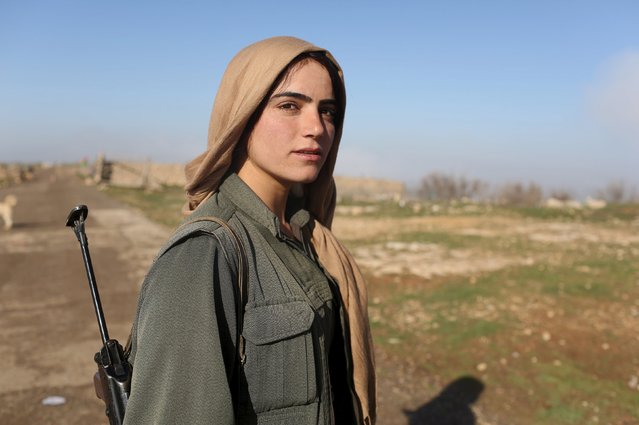
A female Kurdistan Workers Party (PKK) fighter stands near a security position in Sinjar, March 13, 2015. (Photo by Asmaa Waguih /Reuters)

A female Kurdistan Workers Party (PKK) fighter stands near a security position in Sinjar, March 13, 2015. Women fighters at a Kurdistan Workers Party (PKK) base on Mount Sinjar in northwest Iraq, just like their male counterparts, have to be ready for action at any time. Smoke from the front line, marking their battle against Islamic State, which launched an assault on northern Iraq last summer, is visible from the base. Many of the women have cut links with their families back home; the fighters come from all corners of the Kurdish region. (Photo by Asmaa Waguih /Reuters)
Details
02 May 2015 14:44:00
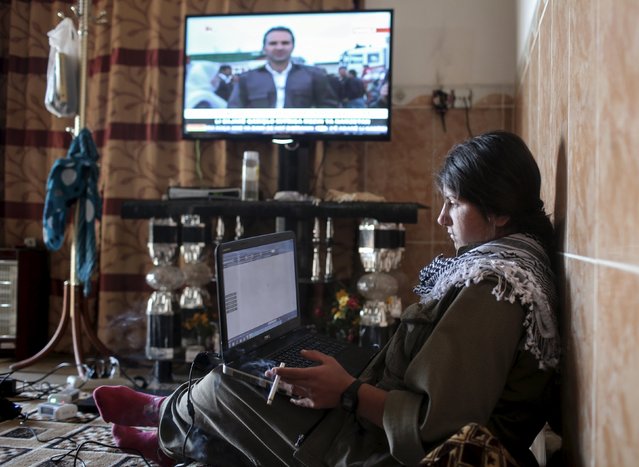
A female Kurdistan Workers Party (PKK) fighter works on her laptop while watching a Kurdish TV station at a base in the Sinjar mountains, March 11, 2015. (Photo by Asmaa Waguih/Reuters)

A female Kurdistan Workers Party (PKK) fighter works on her laptop while watching a Kurdish TV station at a base in the Sinjar mountains, March 11, 2015. Women fighters at a Kurdistan Workers Party (PKK) base on Mount Sinjar in northwest Iraq, just like their male counterparts, have to be ready for action at any time. Smoke from the front line, marking their battle against Islamic State, which launched an assault on northern Iraq last summer, is visible from the base. Many of the women have cut links with their families back home; the fighters come from all corners of the Kurdish region. (Photo by Asmaa Waguih/Reuters)
Details
04 May 2015 09:44:00
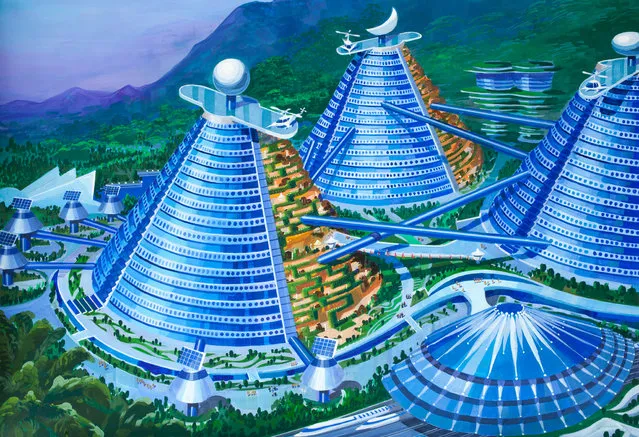
The following “Utopian Tours” drawings are conceptual images of what tourism in North Korea might one day look like, created by North Korean architects. The images, curated by Nick Bonner, are on view as part of the exhibition at the Venice Architecture Biennale in the Korean Pavilion. Bonner runs the Beijing-based Koryo Tours – a company that organizes tours of outsiders into North Korea. (Photo by Nick Bonner/Kyle Vanhemert/Venice Architecture Biennale)

At this year’s Venice Bienniale in Italy, the Korean pavilion has a curious exhibit called “Commissions for Utopia”. It includes renderings from North Korea’s top architects and artists (all anonymous), many of whom studied at the Paekho Institute of Architecture, North Korea’s state-run architectural college, and none of whom have ever left the country. They were asked to create a vision of North Korea’s future sustainable architecture for its expanding tourism industry. Their final products are a glimpse into what it would be like to envision the future after being entirely cut off from the present for almost 70 years. (Photo by Nick Bonner/Kyle Vanhemert/Venice Architecture Biennale)
Details
08 Aug 2014 11:03:00