Loading...
Done
Sikorsky H-5 helicopters

“Igor Sikorsky (May 25, 1889 – October 26, 1972), born Igor Ivanovich Sikorsky was a Russian American pioneer of aviation in both helicopters and fixed-wing aircraft. He designed and flew the world's first multi-engine fixed-wing aircraft, the Russky Vityaz in 1913, and the first airliner, Ilya Muromets, in 1914. After immigrating to the United States in 1919, Sikorsky founded the Sikorsky Aircraft Corporation in 1923, and developed the first of Pan American Airways' ocean-conquering flying boats in the 1930s. In 1939 Sikorsky designed and flew the Vought-Sikorsky VS-300, the first viable American helicopter, which pioneered the rotor configuration used by most helicopters today. Sikorsky would modify the design into the Sikorsky R-4, which became the world's first mass-produced helicopter in 1942”. – Wikipedia

Photo: Westland Sikorsky H-5's, used by British European Airways Helicopters, which fly between London and Birmingham. The Sikorsky H-5, (aka R-5, S-51, HO3S-1, or Horse) (R-5 until 1948; company designation VS-327) is a helicopter built by Sikorsky Aircraft Corporation, formerly used by the United States Air Force, and its predecessor, the United States Army Air Forces, as well as the United States Navy and United States Coast Guard (with the designations HO2S and HO3S). (Photo by Harrison /Topical Press Agency/Getty Images). 22nd May 1951
Details
06 Sep 2011 10:18:00
Ocean voyage

Do you think that history is a science? Well, not exactly. First, and foremost, history is the state's “legend of wars”, it’s official regalia. Of course, public historians are not interested in scientific truth – quite the opposite. In this respect, any attempt to present a state’s history as altruistic and benevolent as possible is welcomed and encouraged – as opposed to any revisionism attempts that may be more accurate. In this matter, Chinese have surpassed us all – they revised in highly creative manner (but rather shamelessly) the technology already invented by Europeans, a process that resulted in oldest state on the planet. Here is an interesting paradox: ask any sinologist about the Middle Kingdom during second century B.C., and he will describe it to you in such a vivid manner as if he has been living there all his life – but as soon as you will ask him to describe Chinese history in the 19-20th centuries… let's say, his eagerness will be greatly diminished. However, we will discuss China in a different article, and in the meantime we will try to understand how exactly historic “legend of wars” is formed and functions – based on a specific and well-known example. A great example is Ferdinand Magellan's first voyage around the world.
Details
14 Nov 2011 09:11:00
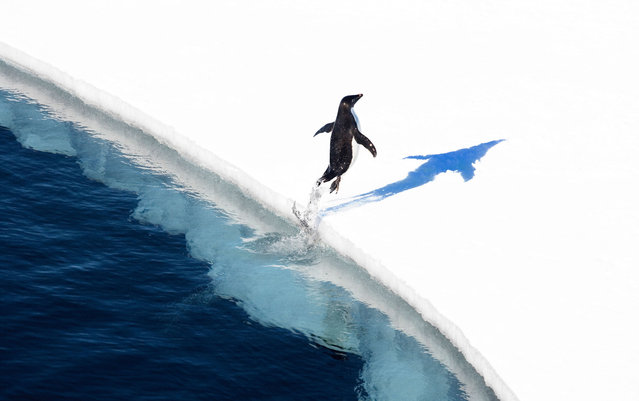
This undated handout photo received from the Antarctic Ocean Alliance on October 28, 2016 shows a adelie penguin jumping onto the ice in the Ross Sea in Antarctica. The world's largest marine reserve aimed at protecting the pristine wilderness of Antarctica will be created after a “momentous” agreement was finally reached on October 28, 2016 with Russia dropping its long-held opposition. A remote and largely pristine stretch of ocean off Antarctica received international protection on Friday, becoming the world's largest marine reserve as a broad coalition of countries came together to protect 598,000 square miles of water. The new marine protected area in the Ross Sea was created by a unanimous decision of the international body that oversees the waters around Antarctica – the Commission for the Conservation of Antarctic Marine Living Resources – and was announced at the commission's annual meeting in Tasmania. The commission comprises 24 countries, including the United States, and the European Union. (Photo by John Weller/AFP Photo/Antarctic Ocean Alliance)

This undated handout photo received from the Antarctic Ocean Alliance on October 28, 2016 shows a adelie penguin jumping onto the ice in the Ross Sea in Antarctica. The world's largest marine reserve aimed at protecting the pristine wilderness of Antarctica will be created after a “momentous” agreement was finally reached on October 28, 2016 with Russia dropping its long-held opposition. (Photo by John Weller/AFP Photo/Antarctic Ocean Alliance)
Details
29 Oct 2016 11:43:00
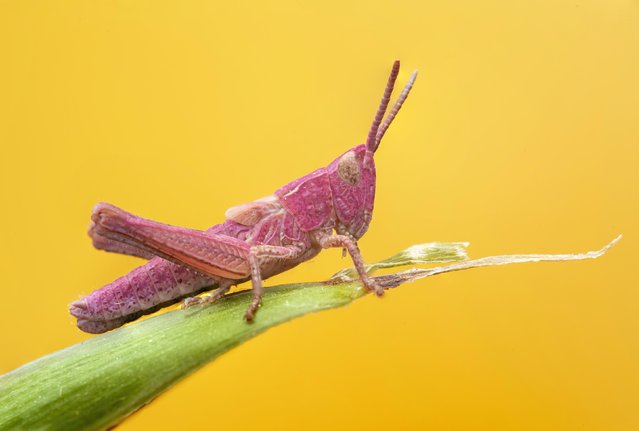
A pink grasshopper is spotted at the Messingham Sand Quarry in Scunthorpe, Lincolnshire, UK in the second decade of July 2023. The dazzling creature is incredibly rare, with experts estimating that a person has a chance of about 1 per cent of seeing one in their lifetime. (Photo by Calvin Taylor Lee/Animal News Agency)

A pink grasshopper is spotted at the Messingham Sand Quarry in Scunthorpe, Lincolnshire, UK in the second decade of July 2023. The dazzling creature is incredibly rare, with experts estimating that a person has a chance of about 1 per cent of seeing one in their lifetime. (Photo by Calvin Taylor Lee/Animal News Agency)
Details
05 Sep 2023 03:43:00
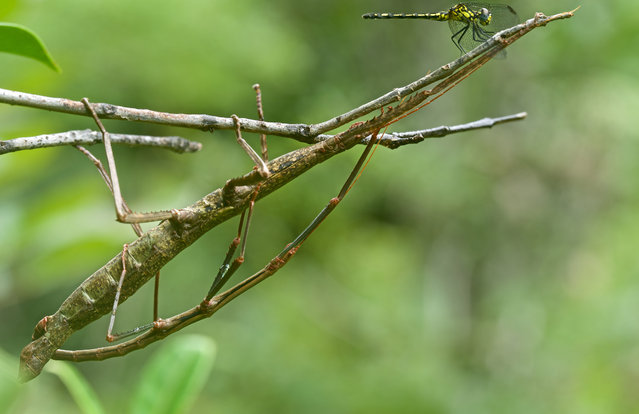
Stick insects. (Photo by Paul Bertner/Caters News)

These tiny insects are so well camouflaged it is nearly impossible to make out their cleverly disguised forms. Canadian photographer and adventurer Paul Bertner attempted to catch the bugs in their natural habitats as part of a hide-and-seek game to show biodiversity in nature. Here: Stick insects. (Photo by Paul Bertner/Caters News)
Details
02 Apr 2016 09:20:00
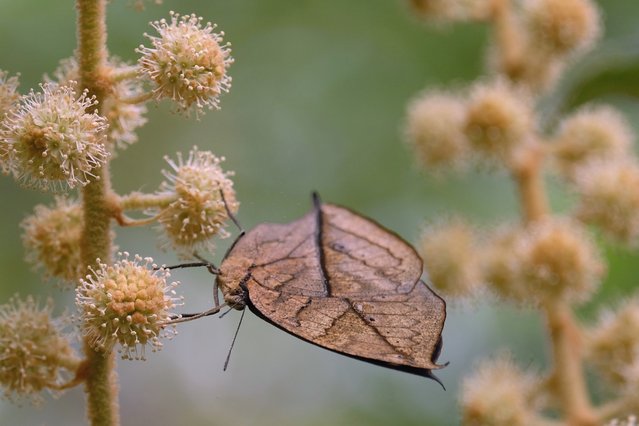
An orange oakleaf rests on a plant at the Taipei Zoo on November 26, 2020. (Photo by Sam Yeh/AFP Photo)

An orange oakleaf rests on a plant at the Taipei Zoo on November 26, 2020. (Photo by Sam Yeh/AFP Photo)
Details
10 Sep 2022 04:08:00
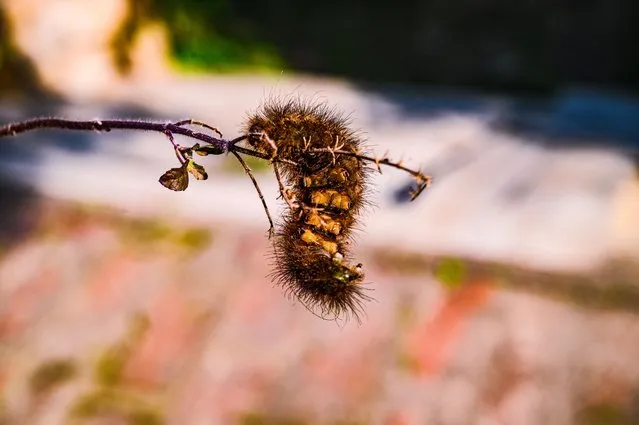
A fuzzy caterpillar on a basil plant in west Bengal, India on December 25, 2023. The caterpillar’s defence system is its hair, which has microscopic barbs that break off easily in the skin of would-be predators. (Photo by Soumyabrata Roy/NurPhoto/Rex Features/Shutterstock)

A fuzzy caterpillar on a basil plant in west Bengal, India on December 25, 2023. The caterpillar’s defence system is its hair, which has microscopic barbs that break off easily in the skin of would-be predators. (Photo by Soumyabrata Roy/NurPhoto/Rex Features/Shutterstock)
Details
09 Feb 2024 10:47:00
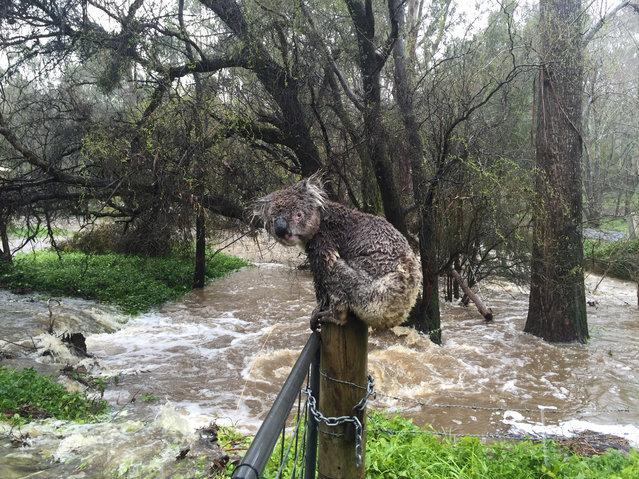
A koala soaked by floodwaters sits atop a fence post to escape the deluge in the town of Stirling in the Adelaide Hills of South Australia in this picture taken September 14, 2016. (Photo by Russell Latter/Reuters)

A koala soaked by floodwaters sits atop a fence post to escape the deluge in the town of Stirling in the Adelaide Hills of South Australia in this picture taken September 14, 2016. (Photo by Russell Latter/Reuters)
Details
18 Sep 2016 07:36:00