Loading...
Done
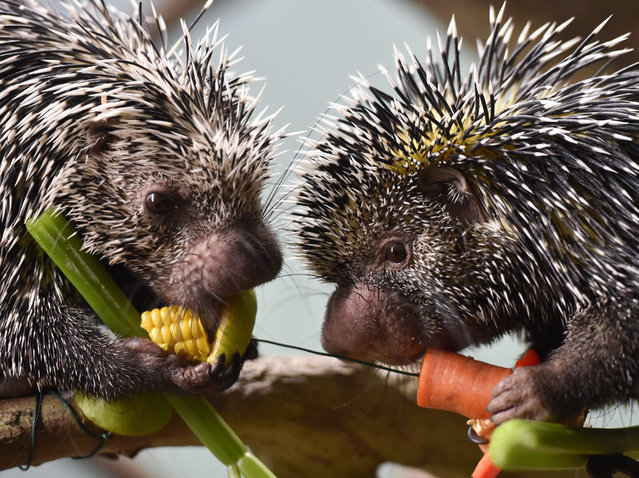
The coendou porcupine couple 'Joppi' (L) and 'Fletcher' nibble at a vegetables in their enclosure at the zoo in Frankfurt am Main, Germany, 03 December 2015. Coendou porcupines are nocturnal rodents related to porcupines and guinea pigs and native to the rain forests of Central and South America as well as Trinidad. (Photo by Arne Dedert/EPA)

The coendou porcupine couple 'Joppi' (L) and 'Fletcher' nibble at a vegetables in their enclosure at the zoo in Frankfurt am Main, Germany, 03 December 2015. Coendou porcupines are nocturnal rodents related to porcupines and guinea pigs and native to the rain forests of Central and South America as well as Trinidad. (Photo by Arne Dedert/EPA)
Details
05 Dec 2015 08:03:00
Visitors were able to pick their own flowers on this sunflower trail at Gloagburn Farm near Perth, in Scotland on September 13, 2021. Crawford Niven, a farmer, said he was inspired to make the trail, which is made up of nearly 200,000 plants, after seeing similar ones in America and Australia. (Photo by South West News Service)

Visitors were able to pick their own flowers on this sunflower trail at Gloagburn Farm near Perth, in Scotland on September 13, 2021. Crawford Niven, a farmer, said he was inspired to make the trail, which is made up of nearly 200,000 plants, after seeing similar ones in America and Australia. (Photo by South West News Service)
Details
07 Jun 2022 05:21:00
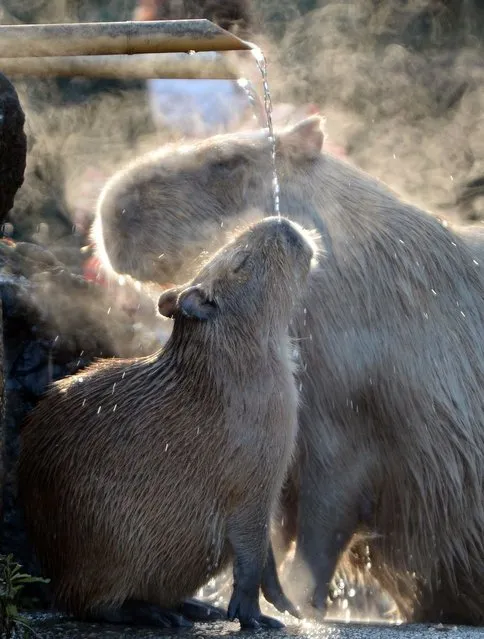
Capybaras bathe in the hot spring water at the Saitama Children's zoo in Higashi Matsuyama city, Saitama prefecture on December 25, 2013. 13 capybaras in the zoo, originally from South America, enjoyed the hot spring water. (Photo by Toshifumi Kitamura/AFP Photo)

Capybaras bathe in the hot spring water at the Saitama Children's zoo in Higashi Matsuyama city, Saitama prefecture on December 25, 2013. 13 capybaras in the zoo, originally from South America, enjoyed the hot spring water. (Photo by Toshifumi Kitamura/AFP Photo)
Details
28 Dec 2013 12:46:00
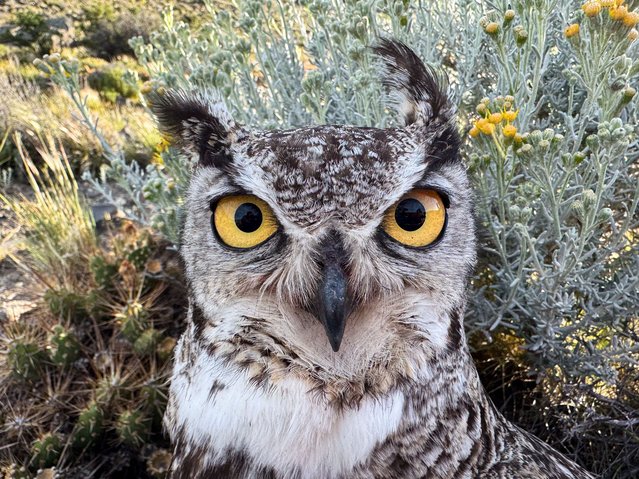
Lesser Horned Owl (Bubo magellanicus) is seen at the meadows of Patagonian valley in Santa Cruz, Argentina on December 21, 2024. Lesser Horned Owl is a large owl of the genus Bubo found in southern South America, with its distinctive “horns”, black-rimmed face and heavily striped abdomen. (Photo by Mehmet Emin Yogurtcuoglu/Anadolu via Getty Images)

Lesser Horned Owl (Bubo magellanicus) is seen at the meadows of Patagonian valley in Santa Cruz, Argentina on December 21, 2024. Lesser Horned Owl is a large owl of the genus Bubo found in southern South America, with its distinctive “horns”, black-rimmed face and heavily striped abdomen. (Photo by Mehmet Emin Yogurtcuoglu/Anadolu via Getty Images)
Details
12 Jan 2025 04:39:00
Children walk behind their Morrocoye, a terrestrial tortoise native to South America, before a tortoise race held to celebrate the upcoming feast day of Saint Francis of Assisi, the patron saint of animals, in the town of San Francisco de Asis, Venezuela, on October 3, 2025. (Photo by /Juan Carlos Hernandez/Reuters)

Children walk behind their Morrocoye, a terrestrial tortoise native to South America, before a tortoise race held to celebrate the upcoming feast day of Saint Francis of Assisi, the patron saint of animals, in the town of San Francisco de Asis, Venezuela, on October 3, 2025. (Photo by /Juan Carlos Hernandez/Reuters)
Details
18 Oct 2025 04:07:00
Lake Titicaca

Titicaca or Titiqaqa is a large, deep lake in the Andes on the border of Peru and Bolivia. By volume of water, it is the largest lake in South America. Lake Maracaibo has a larger surface area, though some consider it to be a large brackish bay due to its direct connection with the sea.
Details
22 Jul 2015 12:20:00


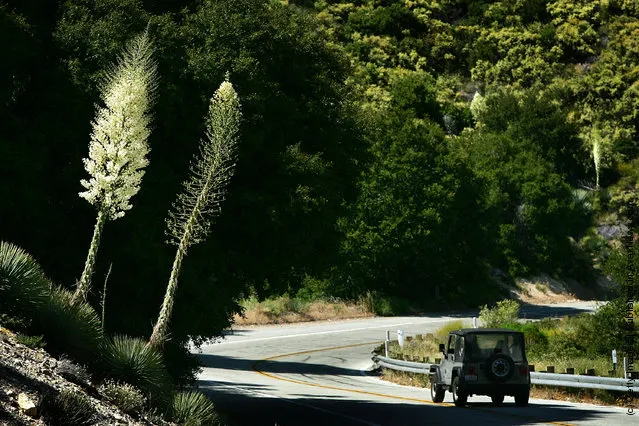
“Yucca is a genus of perennial shrubs and trees in the agave family, Agavaceae. Its 40-50 species are notable for their rosettes of evergreen, tough, sword-shaped leaves and large terminal panicles of white or whitish flowers. They are native to the hot and dry (arid) parts of North America, Central America, South America, and the Caribbean. Early reports of the species were confused with the cassava (Manihot esculenta). Consequently, Linnaeus mistakenly derived the generic name from the Carib word for the latter, yuca. It is also colloquially known in the midwest United States as “Ghosts in the graveyard”, as it is commonly found growing in rural graveyards and when in bloom the flowers appear as an apparition floating.” – Wikipedia

Photo: A yucca standing among flowers bursts forth a very large stalk of flowers as a heavy wildflower bloom on June 21, 2005 in the Angeles National Forest northwest of La Canada, California. (Photo by David McNew/Getty Images)

Details
29 Mar 2011 07:31:00
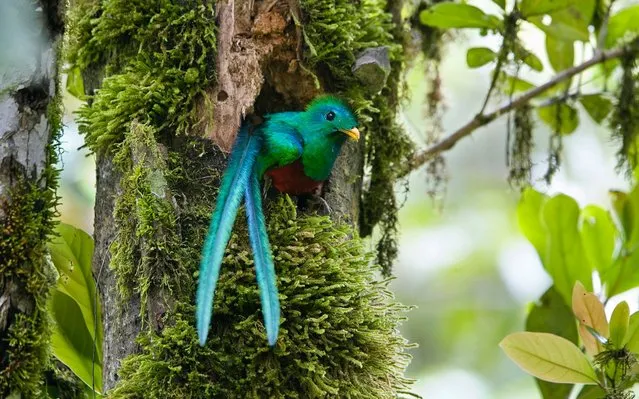
Resplendent Quetzal

The Resplendent Quetzal (Pharomachrus mocinno) is a bird in the trogon family. It is found from southern Mexico to western Panama (unlike the other quetzals of the genus Pharomachrus, which are found in South America and eastern Panama). It is well known for its colorful plumage.
Details
28 Oct 2013 10:52:00