Loading...
Done
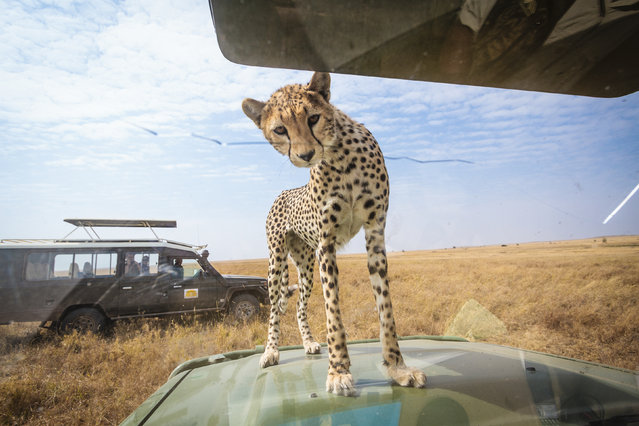
The cheetah peers inside the car to see who is inside. (Photo by Bobby-Jo Clow/Caters News)

“This is the heart-stopping moment a photographer came within inches of a young cheetah when it stuck its head through her sun roof. Australian Bobby-Jo Clow, 31, was on safari in Tanzania when the juvenile started heading towards her Landrover with his sibling. She snapped away as the young male dangled its paws in front of her face and smelt her hair before its mother called it away into the wilds of the Serengeti National Park. But not until Bobby-Jo, a full-time elephant keeper at a Tanzanian Zoo, had leaned forward enough to capture the perfect shot, causing the cheetah to hiss and bare its teeth”. – Caters News. (Photo by Bobby-Jo Clow/Caters News)
Details
16 Mar 2014 08:22:00
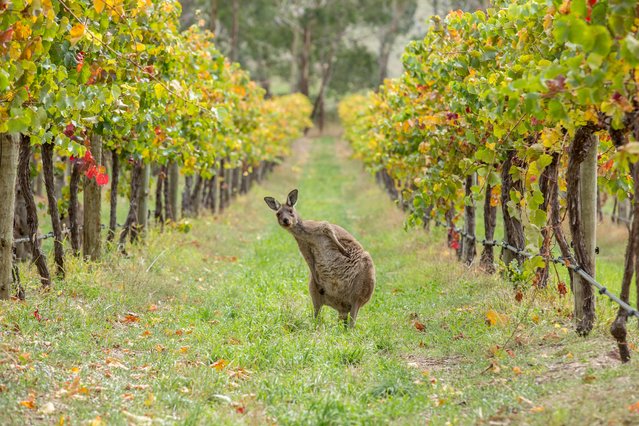
“Are you here for the Winery Tour?” This is a Western Grey Kangaroo caught lounging in the wineries of the Adelaide Hills in South Australia. This past Autumn has been a spectacular time for wildlife viewing and I got lucky to spot this guy while mountain biking in the hills. Such a funny stance it just begs the question... Have you been drinking? ...and or... Are you here for the Winery Tour? Photo location: Adelaide Hills, South Australia, Australia. (Photo and caption by Greg Snell/National Geographic Photo Contest)

“Are you here for the Winery Tour?” This is a Western Grey Kangaroo caught lounging in the wineries of the Adelaide Hills in South Australia. This past Autumn has been a spectacular time for wildlife viewing and I got lucky to spot this guy while mountain biking in the hills. Such a funny stance it just begs the question... Have you been drinking? ...and or... Are you here for the Winery Tour? Such a spontaneous moment I figured it would be perfect for an entry. I hope you like it! Cheers. Photo location: Adelaide Hills, South Australia, Australia. (Photo and caption by Greg Snell/National Geographic Photo Contest)
Details
19 Jun 2014 09:28:00
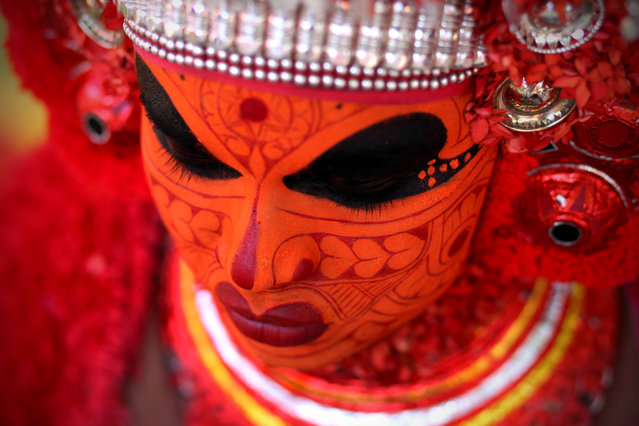
“Theyyam”. Preparation for the Theyyam performance in the surroundings of Kasaragod city. Theyyam is a popular ritual dance form of North Kerala, particularly in Kannur and Kasargod districts. The Theyyam represents a mythological, divine or heroic character. Make up of Theyyams is done by specialist. There are different types of face painting for which primarily and secondary colours are used. Photo location:  Kasaragod, India. (Photo and caption by Rafal Ziejewski/National Geographic Photo Contest)

“Theyyam”. Preparation for the Theyyam performance in the surroundings of Kasaragod city. Theyyam is a popular ritual dance form of North Kerala, particularly in Kannur and Kasargod districts. The Theyyam represents a mythological, divine or heroic character. Make up of Theyyams is done by specialist. There are different types of face painting for which primarily and secondary colours are used. Therefore it is essential that the makeup man should have perfect knowledge of primary and secondary colour combinations. Sometimes, it takes several hours to paint each face. Photo location: Kasaragod, India. (Photo and caption by Rafal Ziejewski/National Geographic Photo Contest)
Details
02 Jul 2014 10:42:00
Runner-up. “The heavens opened and the streets around Shibuya, Tokyo, were suddenly drenched in even more colour and movement. I was taking photos (my friend was holding the umbrella) when I noticed this woman at the crossing. I’m pleased with the futuristic feel of the image”. MICK RYAN, JUDGE: “A rich spectrum of colour, neon lights, a glistening street and a woman with an umbrella all combine with great composition to make this a very appealing photograph. Quite nearly perfection, if it wasn’t for the slightly distracting objects top left and bottom right”. (Photo by Katherine Bridgestock/The Guardian)

Runner-up. “The heavens opened and the streets around Shibuya, Tokyo, were suddenly drenched in even more colour and movement. I was taking photos (my friend was holding the umbrella) when I noticed this woman at the crossing. I’m pleased with the futuristic feel of the image”. (Photo by Katherine Bridgestock/The Guardian)
Details
08 Mar 2018 00:01:00
Senji Nakajima sleeps with his Love Doll “Saori” at Love Hotel on June 4, 2016 in Nagano, Japan. Senji Nakajima, 61 years old, lives with his life-size 'love doll' named “Saori” in his apartment in Tokyo, Japan. Nakajima, married with two children, who lives away from home for work, first started his life with Saori six years ago. At first, he used to imagine as if the doll was his first girl friend, and used it only for sexual purposes to fill the loneliness, but months later, he started to find Saori actually has an original personality. “She never betrays, not after only money. I'm tired of modern rational humans. They are heartless”, Nakajima says, “for me, she is more than a doll. Not just a silicon rubber. She needs much help, but still is my perfect partner who shares precious moments with me and enriches my life”. (Photo by Taro Karibe/Getty Images)

Senji Nakajima sleeps with his Love Doll “Saori” at Love Hotel on June 4, 2016 in Nagano, Japan. Senji Nakajima, 61 years old, lives with his life-size “love doll” named “Saori” in his apartment in Tokyo, Japan. Nakajima, married with two children, who lives away from home for work, first started his life with Saori six years ago. (Photo by Taro Karibe/Getty Images)
Details
07 Aug 2016 09:21:00
Photo taken on September 19, 2015 shows a baby Brazilian opossum at the “Parque Estoril” zoo in Sao Bernardo do Campo of Sao Paulo, Brazil. According to local press, the “Parque Estoril” zoo houses currently 23 orphan cubs of wild animals rescued in the south region of Sao Paulo, victims of illegal wildlife trade or problems caused by urban growth. (Photo by Rahel Patrasso/Xinhua via ZUMA Wire)

Photo taken on September 19, 2015 shows a baby Brazilian opossum at the “Parque Estoril” zoo in Sao Bernardo do Campo of Sao Paulo, Brazil. According to local press, the “Parque Estoril” zoo houses currently 23 orphan cubs of wild animals rescued in the south region of Sao Paulo, victims of illegal wildlife trade or problems caused by urban growth. According to the zoo, all the animals arrived in the last three months, and many of them, not being able to be reintroduced to their natural habitat, will be used as examples in environmental education classes. (Photo by Rahel Patrasso/Xinhua via ZUMA Wire)
Details
26 Sep 2015 08:00:00
Wax figures with torture instrument named “torture-rack” are seen on October 25, 2014 in Huai'an, Jiangsu province of China. The exhibition, which opened last year at an educational center in the eastern city of Huai'an, includes reenactments of prisoners being hung over a fire, flayed and being tortured on what is known as a “Tiger Bench” – pictured above – a Qing dynasty (1644-1912) device that contorted victims' legs and arms in high pressure positions that could break bones or tear apart joints. (Photo by ChinaFotoPress)

Organizers of an exhibition of ancient instruments of torture in Huai'an, Jiangsu province, have suggested that children, heart disease patients and people with high blood pressure stay away because of the vivid depictions of shocking cruelty. The exhibition has more than 200 instruments of torture on display in the 50,000-square-meter exhibition halls of a restored ancient building. Wax figures, along with sound and light techniques, are incorporated for scary effect. The local government said the exhibition is for tourists and historians to research ancient torture practices. (Photo by ChinaFotoPress)
Details
29 Oct 2014 12:22:00
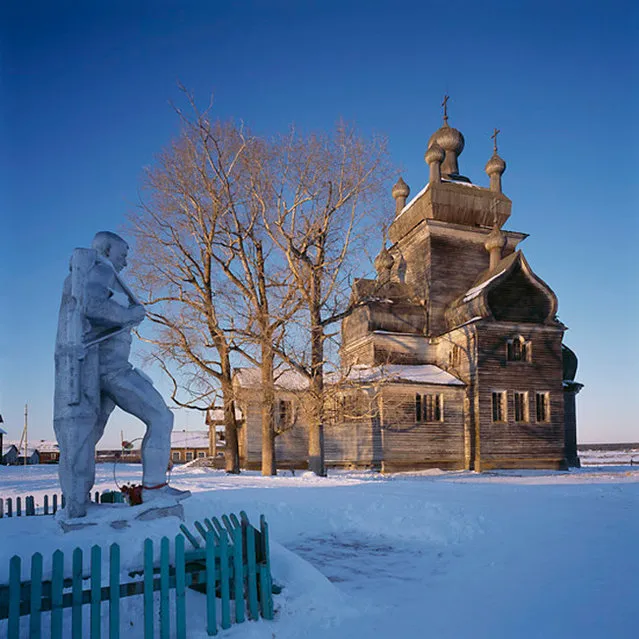
Wooden Churches - Travelling In The Russian North By Richard Davies Part 2

While communism, collectivism, worms, dry rot and casual looting failed to destroy the majestic wooden churches of Russia, it may be ordinary neglect that finally does them in. Dwindled now to several hundred remaining examples, these glories of vernacular architecture lie scattered amid the vastness of the world’s largest country. Just over a decade ago, Richard Davies, a British architectural photographer, struck out on a mission to record the fragile and poetic structures. Austerely beautiful and haunting, “Wooden Churches: Traveling in the Russian North” (White Sea Publishing; $132) is the result. Covering thousands of miles, Mr. Davies described how he and the writer Matilda Moreton tracked down the survivors from among the thousands of onion-domed structures built after Prince Vladimir converted to Christianity in 988.

See also: Wooden Churches Part1
Details
28 Nov 2013 12:13:00