Loading...
Done
Dunnottar Castle In Scottish

Dunnottar Castleis a ruined medieval fortress located upon a rocky headland on the north-east coast of Scotland, about 3 kilometres (1.9 mi) south of Stonehaven. The surviving buildings are largely of the 15th and 16th centuries, but the site is believed to have been fortified in the Early Middle Ages. Dunnottar has played a prominent role in the history of Scotland through to the 18th-century Jacobite risings because of its strategic location and the strength of its situation. Dunnottar is best known as the place where the Honours of Scotland, the Scottish crown jewels, were hidden from Oliver Cromwell's invading army in the 17th century. The property of the Keiths from the 14th century, and the seat of the Earl Marischal, Dunnottar declined after the last Earl forfeited his titles by taking part in the Jacobite rebellion of 1715. The castle was restored in the 20th century and is now open to the public.
Details
13 Jan 2014 11:31:00


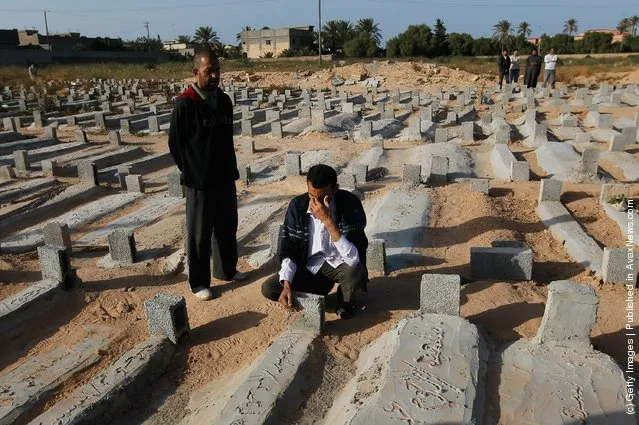
A man cries in a graveyard during the funeral of Nasser Ali Afglio, a young Libyan rebel killed during battle with government troops loyal to Libyan ruler Moammar Gaddafi April 19, 2011 in Misrata, Libya. The graveyard where Nasser was buried has hundreds of simple concrete graves; many dozens are those that have been killed during the last two months of fighting in the besieged town. Thousands of civilians are trapped in Misrata as fighting continues between Libyan government forces that have surrounded the city and anti-government rebels there. (Photo by Chris Hondros/Getty Images)
Details
22 Apr 2011 08:22:00
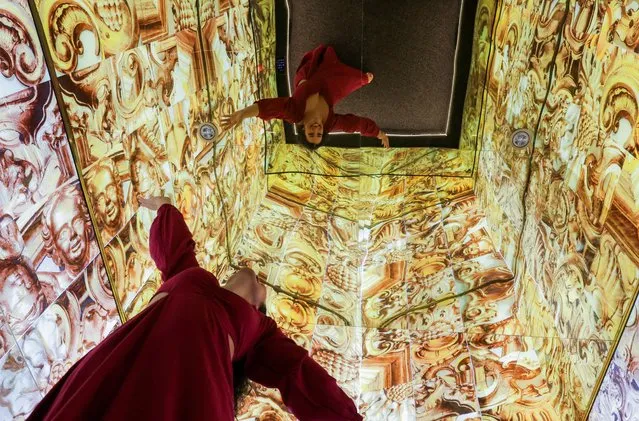
A woman visits the mirror installation “Mar de Espelhos” (Sea of Mirrors) ahead of its opening in Rio de Janeiro, Brazil on June 13, 2023. (Photo by Ricardo Moraes/Reuters)

A woman visits the mirror installation “Mar de Espelhos” (Sea of Mirrors) ahead of its opening in Rio de Janeiro, Brazil on June 13, 2023. (Photo by Ricardo Moraes/Reuters)
Details
21 Jul 2023 03:26:00
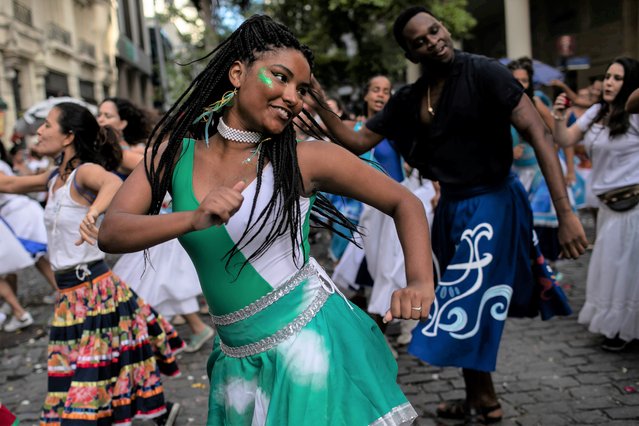
A woman dances during a rehearsal by the group “Tambores de Olokun” in Rio de Janeiro, Brazil, Sunday, April 17, 2022. The Brazilian municipalities of Rio de Janeiro and Sao Paulo postponed the traditional parades of the carnival samba schools to April 22 - 23, as a result of the COVID-19 pandemic. (Photo by Bruna Prado/AP Photo)

A woman dances during a rehearsal by the group “Tambores de Olokun” in Rio de Janeiro, Brazil, Sunday, April 17, 2022. The Brazilian municipalities of Rio de Janeiro and Sao Paulo postponed the traditional parades of the carnival samba schools to April 22 - 23, as a result of the COVID-19 pandemic. (Photo by Bruna Prado/AP Photo)
Details
19 Apr 2022 05:56:00
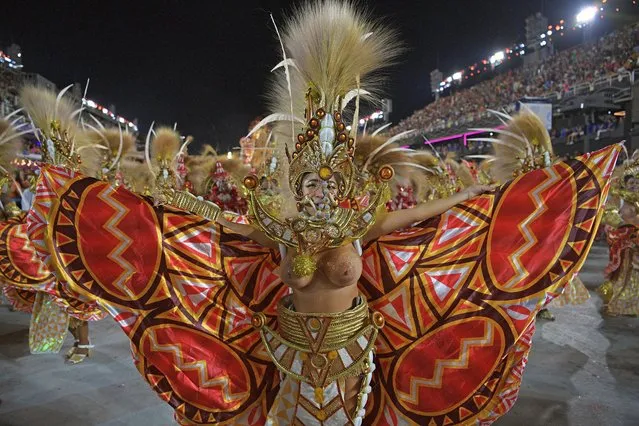
A member of Viradouro samba school performs during the first night of Rio's Carnival parade at the Sambadrome Marques de Sapucai in Rio de Janeiro, Brazil on April 22, 2022. (Photo by Carl de Souza/AFP Photo)

A member of Viradouro samba school performs during the first night of Rio's Carnival parade at the Sambadrome Marques de Sapucai in Rio de Janeiro, Brazil on April 22, 2022. (Photo by Carl de Souza/AFP Photo)
Details
29 May 2022 04:12:00
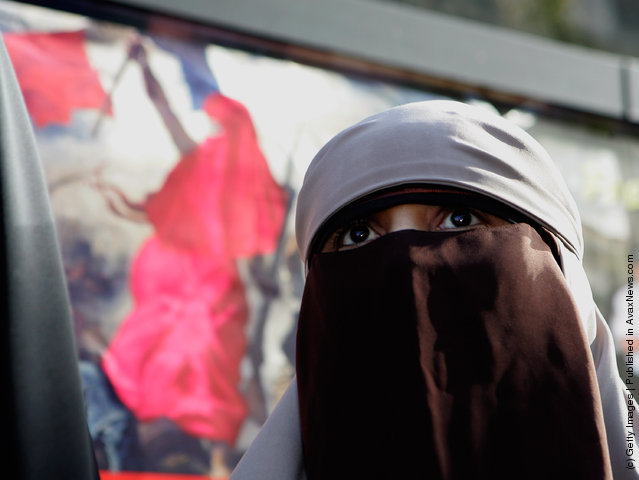
Kenza Drider, 32, announces her candidacy for France's 2012 Presidential election

Kenza Drider, 32, announces her candidacy for France's 2012 Presidential election on September 22, 2011 in Meaux, France. Drider is the first French Muslim woman to wear a niqab and run for President despite France's nationwide ban on the face veil, which today saw 32-year-old mother of three Hind Ahmas and Najate Nait Ali both being fined after being caught wearing the niqab in public in the Parsisan district of Meaux back in May when the law first came into force. (Photo by Franck Prevel/Getty Images)
Details
23 Sep 2011 10:00:00
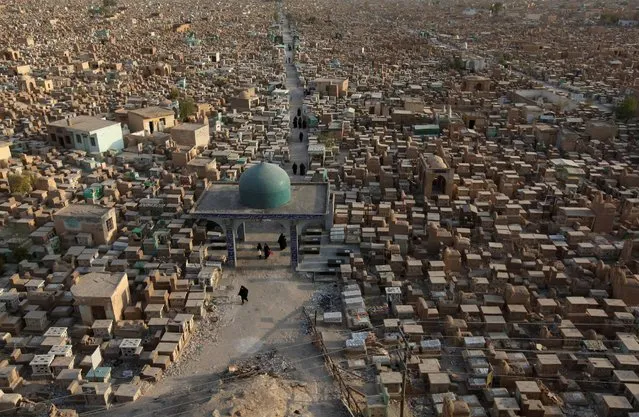
The Wadi al-Salam cemetery, Arabic for “Peace Valley”, is seen in Najaf, south of Baghdad, Iraq August 3, 2016. The world's largest cemetery, in Iraq's Shi'ite holy city of Najaf, is expanding at double its usual rate as Shi'ite militias bury their dead from the war against Islamic State. The Wadi al-Salam cemetery, Arabic for “Peace Valley” has a special place in the hearts of Shi'ite Muslims as it surrounds the Mausoleum of their first imam, Ali Bin Abi Talib, a cousin and son-in-law of Prophet Mohammad. (Photo by Alaa Al-Marjani/Reuters)

The Wadi al-Salam cemetery, Arabic for “Peace Valley”, is seen in Najaf, south of Baghdad, Iraq August 3, 2016. The world's largest cemetery, in Iraq's Shi'ite holy city of Najaf, is expanding at double its usual rate as Shi'ite militias bury their dead from the war against Islamic State. The Wadi al-Salam cemetery, Arabic for “Peace Valley” has a special place in the hearts of Shi'ite Muslims as it surrounds the Mausoleum of their first imam, Ali Bin Abi Talib, a cousin and son-in-law of Prophet Mohammad. (Photo by Alaa Al-Marjani/Reuters)
Details
24 Aug 2016 11:38:00
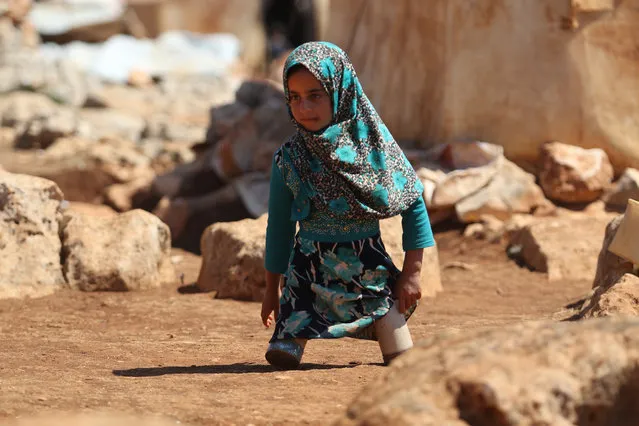
Eight year-old Maya Mohammad Ali Merhi walks using prosthetic legs made by her father from tin cans in a camp for displaced people, in the northern Syrian province of Idlib on June 20, 2018. Maya and her father were both born without lower limbs. Unable to afford real prosthetic limbs, her father made her a pair out of tin cans filled with cotton and scrap pieces of cloth. Maya's family had to leave their home in the Aleppo province to flee battles. (Photo by Aaref Watad/AFP Photo)

Eight year-old Maya Mohammad Ali Merhi walks using prosthetic legs made by her father from tin cans in a camp for displaced people, in the northern Syrian province of Idlib on June 20, 2018. Maya and her father were both born without lower limbs. Unable to afford real prosthetic limbs, her father made her a pair out of tin cans filled with cotton and scrap pieces of cloth. Maya's family had to leave their home in the Aleppo province to flee battles. (Photo by Aaref Watad/AFP Photo)
Details
09 Aug 2018 00:01:00