Loading...
Done
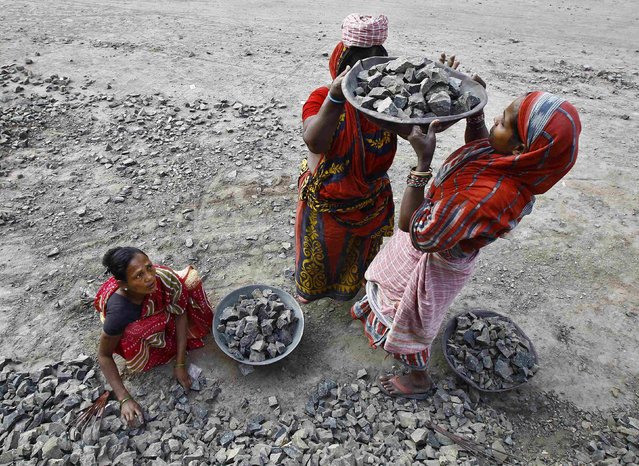
Women labourers work at the construction site of a road in Kolkata January 8, 2015. Across towns and cities in India, it is not uncommon to see women cleaning building sites, carrying bricks and or shoveling gravel - helping construct the infrastructure necessary for the country's economic and social development. (Photo by Rupak De Chowdhuri/Reuters)

Women labourers work at the construction site of a road in Kolkata January 8, 2015. Across towns and cities in India, it is not uncommon to see women cleaning building sites, carrying bricks and or shoveling gravel – helping construct the infrastructure necessary for the country's economic and social development. They help build roads, railway tracks, airports, and offices. They lay pipes for clean water supplies, cables for telecommunications, and dig the drains for sewage systems. But although women make up at least 20 percent of India's 40 million construction workers, they are less recognized than male workers with lower pay and often prone to safety hazards and sexual harassment. They are often unaware of their rights or scared to complain, say activists now trying to campaign for better treatment of women in the construction industry. (Photo by Rupak De Chowdhuri/Reuters)
Details
15 Jan 2015 13:47:00


“Echus Chasma is a chasma in the Lunae Planum high plateau north of the Valles Marineris canyon system of Mars. Clay has been found in Echus Chasma that means that water once sat there for a time. Echus Chasma is approximately 100 km long and 10 km wide, with valleys ranging in depth from around 1 km to 4 km”. – Wikipedia

Photo: In this handout image supplied by the European Space Agency (ESA) on July 16, 2008, The Echus Chasma, one of the largest water source regions on Mars, is pictured from ESA's Mars Express. The data was acquired on September 25, 2005. The dark material shows a network of light-coloured, incised valleys that look similar to drainage networks known on Earth. It is still debated whether the valleys originate from precipitation, groundwater springs or liquid or magma flows on the surface. (Photo by ESA via Getty Images)
Details
18 Jul 2011 11:47:00
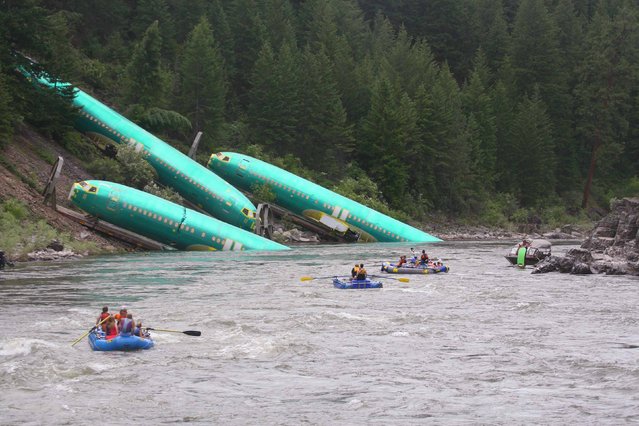
Three Boeing 737 fuselages lie on an embankment on the Clark Fork River after a BNSF Railway Co train derailed Thursday near Rivulet, Montana in this picture taken July 4, 2014. A train derailment in Montana this week damaged a shipment of jetliner fuselages and other large parts on its way to Boeing Co factories in Washington state from Spirit Aerosystems, Boeing said on Saturday. (Photo by Kyle Massick/Reuters)

Three Boeing 737 fuselages lie on an embankment on the Clark Fork River after a BNSF Railway Co train derailed Thursday near Rivulet, Montana in this picture taken July 4, 2014. A train derailment in Montana this week damaged a shipment of jetliner fuselages and other large parts on its way to Boeing Co factories in Washington state from Spirit Aerosystems, Boeing said on Saturday. (Photo by Kyle Massick/Reuters)
Details
08 Jul 2014 13:51:00
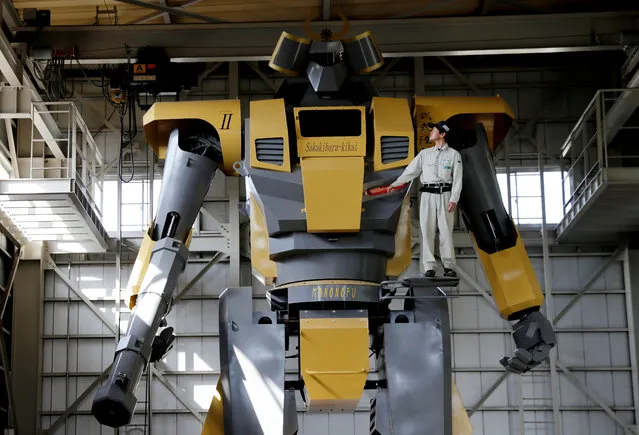
Sakakibara Kikai's engineer Go Sakakibara poses with the bipedal robot Mononofu during its demonstration at its factory in Shinto Village, Gunma Prefecture, Japan on April 12, 2018. Developed at Sakakibara Kikai, a maker of farming machinery, LW-Mononofu is a 28-feet tall, two-legged robot weighing in at more than 7 tonnes. It contains a cockpit with monitors and levers for the pilot to control the robot's arms and legs. (Photo by Kim Kyung-Hoon/Reuters)

Sakakibara Kikai's engineer Go Sakakibara poses with the bipedal robot Mononofu during its demonstration at its factory in Shinto Village, Gunma Prefecture, Japan on April 12, 2018. Developed at Sakakibara Kikai, a maker of farming machinery, LW-Mononofu is a 28-feet tall, two-legged robot weighing in at more than 7 tonnes. It contains a cockpit with monitors and levers for the pilot to control the robot's arms and legs. (Photo by Kim Kyung-Hoon/Reuters)
Details
17 Apr 2018 00:01:00
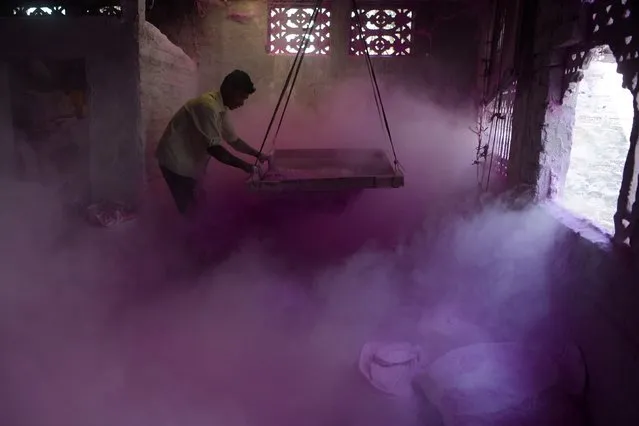
An Indian labourer sifts coloured powder, known as “gulal”, to be used during the forthcoming spring festival of Holi, inside a factory at Fulbari village on the outskirts of Siliguri on March 6, 2017. Holi, the popular Hindu spring festival of colours is observed in India at the end of the winter season on the last full moon of the lunar month, and will be celebrated on March 13 this year. (Photo by Diptendu Dutta/AFP Photo)

An Indian labourer sifts coloured powder, known as “gulal”, to be used during the forthcoming spring festival of Holi, inside a factory at Fulbari village on the outskirts of Siliguri on March 6, 2017. Holi, the popular Hindu spring festival of colours is observed in India at the end of the winter season on the last full moon of the lunar month, and will be celebrated on March 13 this year. (Photo by Diptendu Dutta/AFP Photo)
Details
08 Mar 2017 00:04:00
Takeoka Chisaka, Hiroshima, Japan. “One morning in August 1945, I was walking home from the night shift at a factory in Hiroshima. As I reached my door, there was a huge explosion. When I came to, my head was bleeding and I had been blasted 30m away”. (Photo and caption by Sasha Maslov)

Takeoka Chisaka, Hiroshima, Japan. “One morning in August 1945, I was walking home from the night shift at a factory in Hiroshima. As I reached my door, there was a huge explosion. When I came to, my head was bleeding and I had been blasted 30m away. The atomic bomb had detonated. When I found my mother, her eyes were badly burned. A doctor said they had to come out, but he didn’t have the proper tools so used a knife instead. It was hellish. I became a peace-worker after the war. In the 1960s, at a meeting at the UN, I met one of the people who created the atomic bomb. He apologised”. (Photo and caption by Sasha Maslov)
Details
11 May 2015 11:56:00
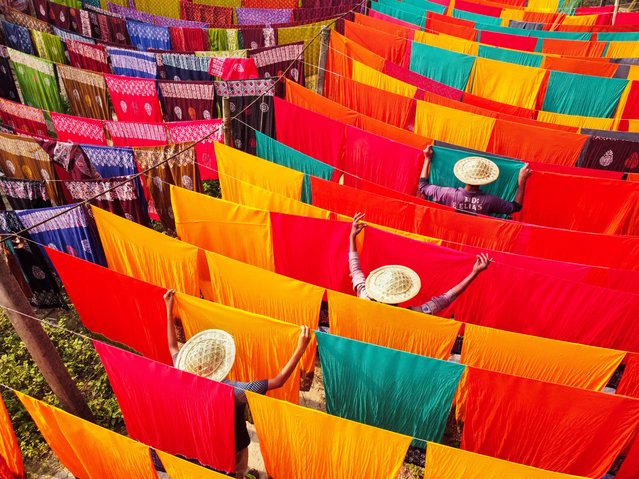
Workers hang hundreds of color-dyed sheets of cloth on a bamboo framework to dry in a dyeing factory in Narayanganj, Bangladesh on May 23, 2023. The drying process usually takes 4 hours, with each set of 200 pieces at a time to dry in temperatures over 42 degrees Celsius. Workers use hats for protection from the scorching heat because they have to constantly turn the colorful fabrics so that they dry perfectly in the sunlight. (Photo by Joy Saha/ZUMA Press Wire/Rex Features/Shutterstock)

Workers hang hundreds of color-dyed sheets of cloth on a bamboo framework to dry in a dyeing factory in Narayanganj, Bangladesh on May 23, 2023. The drying process usually takes 4 hours, with each set of 200 pieces at a time to dry in temperatures over 42 degrees Celsius. Workers use hats for protection from the scorching heat because they have to constantly turn the colorful fabrics so that they dry perfectly in the sunlight. (Photo by Joy Saha/ZUMA Press Wire/Rex Features/Shutterstock)
Details
14 Jun 2023 02:39:00
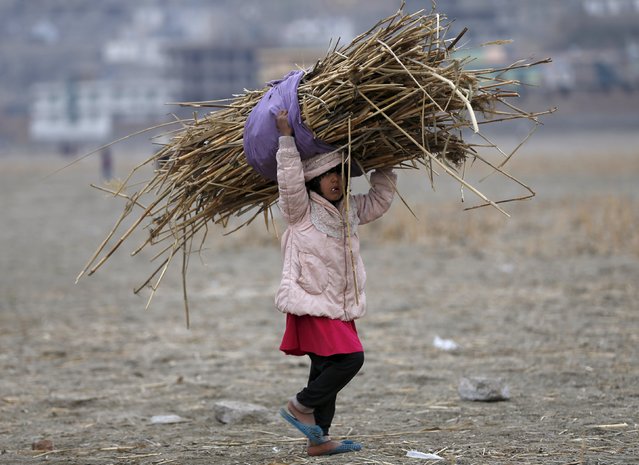
A girl carries on her head a pile of dried shrubs she gathered for cooking and heating, in Kabul, Afghanistan November 18, 2015. (Photo by Omar Sobhani/Reuters)

A girl carries on her head a pile of dried shrubs she gathered for cooking and heating, in Kabul, Afghanistan November 18, 2015. (Photo by Omar Sobhani/Reuters)
Details
05 Dec 2015 08:04:00