Loading...
Done
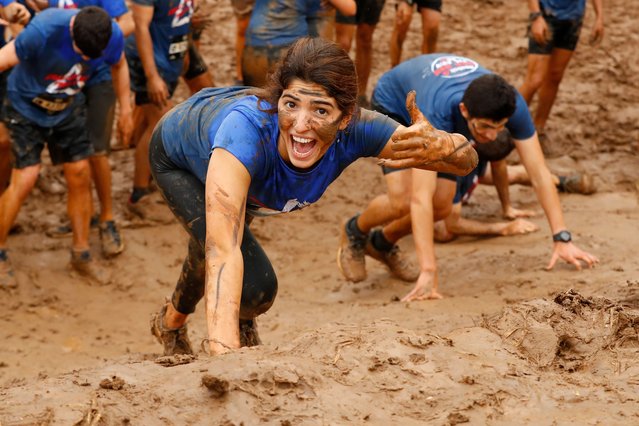
Participants climb a 10km muddy obstacle course during the “Run Mud” race, on March 29, 2019 in the Israeli mediterranean coastal city of Tel Aviv. (Photo by Jack Guez/AFP Photo)

Participants climb a 10km muddy obstacle course during the “Run Mud” race, on March 29, 2019 in the Israeli mediterranean coastal city of Tel Aviv. Over 6,000 participants took part in the obstacle race, with up to 18 artificial obstacles on three tracks (10 km, five km or two km). (Photo by Jack Guez/AFP Photo)
Details
01 Apr 2019 00:05:00
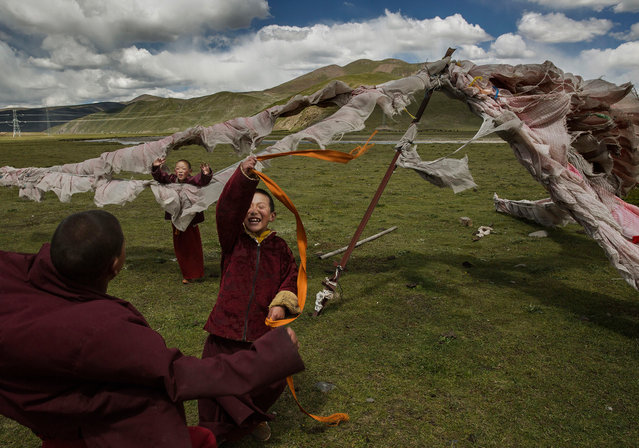
Young Buddhist novice monks play at a Tibetan nomadic summer grazing area on July 24, 2015 on the Tibetan Plateau in Yushu County, Qinghai, China. (Photo by Kevin Frayer/Getty Images)

Young Buddhist novice monks play at a Tibetan nomadic summer grazing area on July 24, 2015 on the Tibetan Plateau in Yushu County, Qinghai, China. Tibetan nomads face many challenges to their traditional way of life including political pressures, forced resettlement by China's government, climate change and rapid modernization. The Tibetan Plateau, often called “The Roof of the World”, is the world's highest and largest plateau. (Photo by Kevin Frayer/Getty Images)
Details
12 Aug 2015 13:16:00
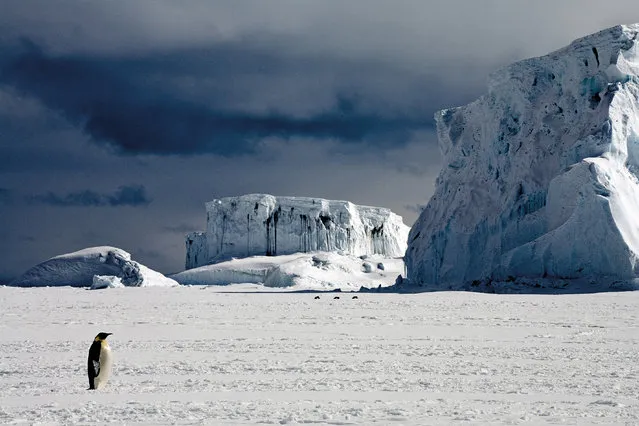
Image from Camille Seamans new book, “Melting Away”. (Photo by Camille Seaman/Barcroft Media)

Documenting the effects of climate change first hand over the past eight years, Camille Seaman fears we may be on the road to the last iceberg. Photographing the enormous frozen floats at both poles for the past eight years, the Californian adventurer has seen the receding ice shelves and experienced the changing warmer weather. Feeling that her intimate and emotional work documents a snapshot of history, Camille presents her series “The Last Iceberg” as a study of what she sees as the personality of each huge iceberg. Drawing parallels with the famous novel, “The Last of the Mohicans”, Camille, 42, wonders whether these unique, almost alien natural features will become a thing of the past or part of nature's renewal process. (Photo by Camille Seaman/Barcroft Media)
Details
02 Dec 2014 12:10:00
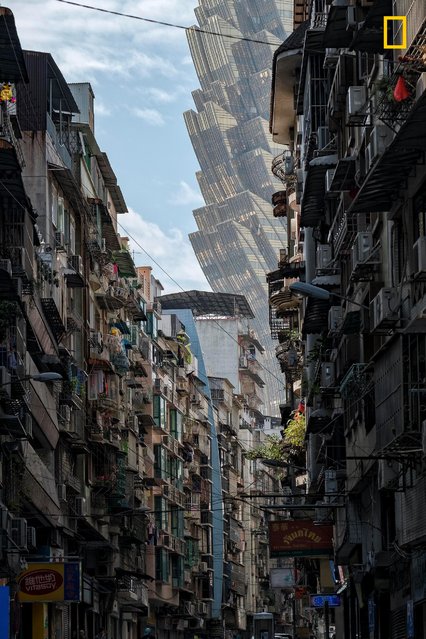
The Invasion. A quiet street in Macau. Modernization around is quickly changing the city, as documented by Paul Tsui. (Photo by Paul Tsui/National Geographic Travel Photographer of the Year Contest)

The Invasion. A quiet street in Macau. Modernization around is quickly changing the city, as documented by Paul Tsui. (Photo by Paul Tsui/National Geographic Travel Photographer of the Year Contest)
Details
30 Jun 2018 00:03:00
In this February 22, 2021, file photo, climate activist Disha Ravi, 22, travels in a car as she is taken to a court in New Delhi, India. To her friends, Ravi, was most concerned about her future in a world where temperatures are rising. But her life changed last month as she became a household name in the country, dominating news coverage after police charged her with sedition, a colonial-era law which carries a sentence up to life. Her alleged crime: sharing an online document to help amplify months-long farmer protests in India on Twitter. She was released after 10 days in custody. (Photo by Dinesh Joshi/AP Photo/File)

In this February 22, 2021, file photo, climate activist Disha Ravi, 22, travels in a car as she is taken to a court in New Delhi, India. To her friends, Ravi, was most concerned about her future in a world where temperatures are rising. But her life changed last month as she became a household name in the country, dominating news coverage after police charged her with sedition, a colonial-era law which carries a sentence up to life. Her alleged crime: sharing an online document to help amplify months-long farmer protests in India on Twitter. She was released after 10 days in custody. (Photo by Dinesh Joshi/AP Photo/File)
Details
12 Mar 2021 09:56:00
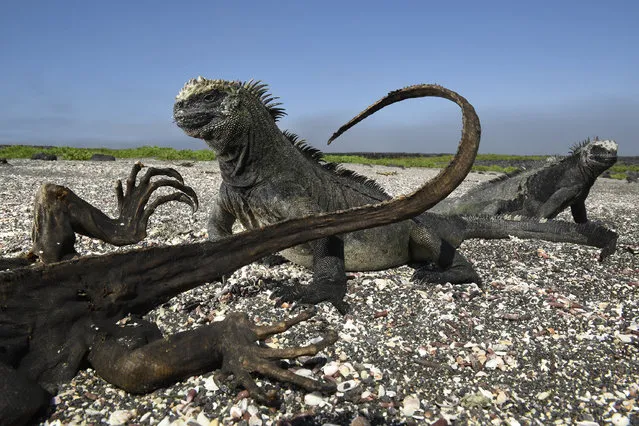
Galapagos – Rocking the Cradle: Four major ocean currents converge along the Galapagos archipelago, creating the conditions for an extraordinary diversity of animal life, April 25, 2016. The islands are home to at least 7,000 flora and fauna species, of which 97 percent of the reptiles, 80 percent of the land birds, 50 percent of the insects and 30 percent of the plants are endemic. The local ecosystem is highly sensitive to the changes in temperature, rainfall and ocean currents that characterize the climatic events known as El Niño and La Niña. These changes cause marked fluctuations in weather and food availability. Many scientists expect the frequency of El Niño and La Niña to increase as a result of climate change, making the Galapagos a possible early-warning location for its effects. (Photo by Thomas P. Peschak for National Geographic/World Press Photo)

Galapagos – Rocking the Cradle: Four major ocean currents converge along the Galapagos archipelago, creating the conditions for an extraordinary diversity of animal life, April 25, 2016. The islands are home to at least 7,000 flora and fauna species, of which 97 percent of the reptiles, 80 percent of the land birds, 50 percent of the insects and 30 percent of the plants are endemic. (Photo by Thomas P. Peschak for National Geographic/World Press Photo)
Details
16 Apr 2018 00:01:00
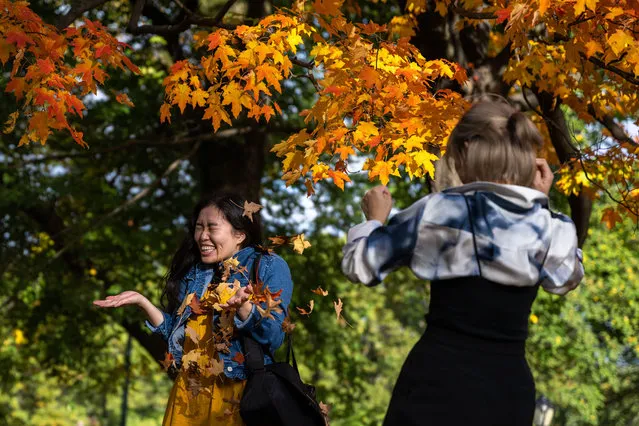
A woman reacts to having leaves thrown on her, while taking a photo, in Central Park as leaves begin to change colors on October 26, 2022 in New York City. Leaves around parts of Central Park have begun changing colors while much of Long Island and Upstate New York have already peaked. (Photo by Alexi Rosenfeld/Getty Images)

A woman reacts to having leaves thrown on her, while taking a photo, in Central Park as leaves begin to change colors on October 26, 2022 in New York City. Leaves around parts of Central Park have begun changing colors while much of Long Island and Upstate New York have already peaked. (Photo by Alexi Rosenfeld/Getty Images)
Details
01 Nov 2022 05:28:00
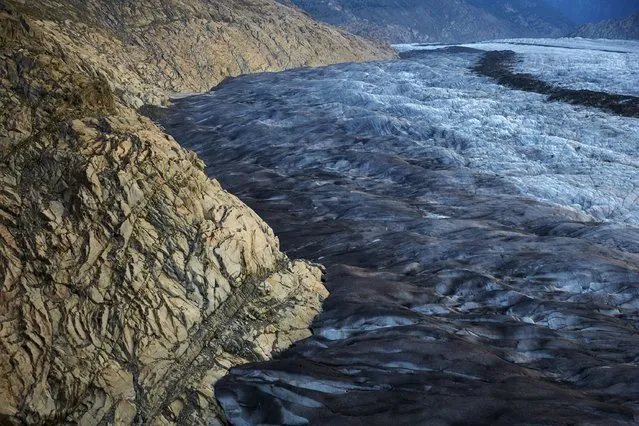
The Aletsch Glacier is pictured at dusk in Fiesch, Switzerland, August 11, 2015. (Photo by Denis Balibouse/Reuters)

The Aletsch Glacier is pictured at dusk in Fiesch, Switzerland, August 11, 2015. One of Europe's biggest glaciers, the Great Aletsch coils 23 km (14 miles) through the Swiss Alps – and yet this mighty river of ice could almost vanish in the lifetimes of people born today because of climate change. The glacier, 900 metres (2,950 feet) thick at one point, has retreated about 3 km (1.9 miles) since 1870 and that pace is quickening. (Photo by Denis Balibouse/Reuters)
Details
18 Oct 2015 08:05:00