Loading...
Done
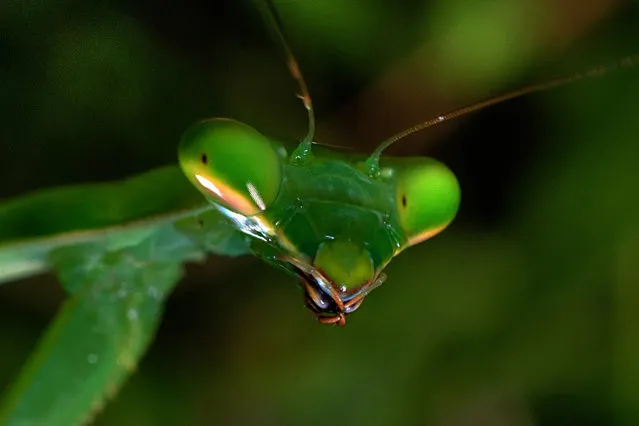
Close Encounter of the Insect Kind: Check out the awesome face on this praying mantis. I can't get over the mouth, it's like something from a science fiction movie. Of all photographic styles macro is definitely my favorite. I am constantly amazed, in every photo that I take, by the intricate level of detail that exists on even the smallest of creatures. It's a stark reminder that a very complex and infinitely beautiful world exists just beyond our human-sized level of perception. Photo taken in Donnybrook, Queensland, Australia. (Photo by Andrew Young/National Geographic Photo Contest

Close Encounter of the Insect Kind: “Check out the awesome face on this praying mantis. I can't get over the mouth, it's like something from a science fiction movie. Of all photographic styles macro is definitely my favorite. I am constantly amazed, in every photo that I take, by the intricate level of detail that exists on even the smallest of creatures. It's a stark reminder that a very complex and infinitely beautiful world exists just beyond our human-sized level of perception. Photo taken in Donnybrook, Queensland, Australia” – Andrew Young. (Photo by Andrew Young/National Geographic Photo Contest via The Atlantic)
Details
24 Sep 2012 09:18:00
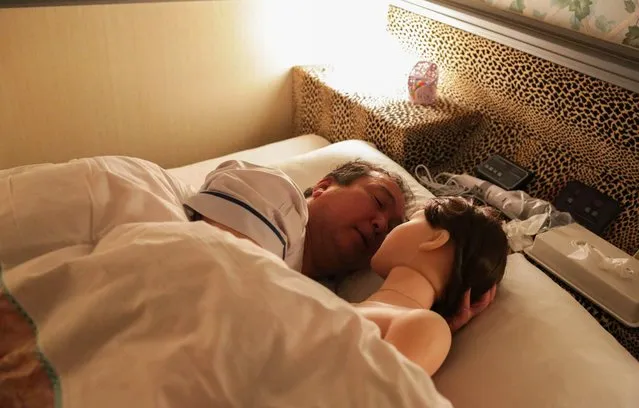
Senji Nakajima sleeps with his Love Doll “Saori” at Love Hotel on June 4, 2016 in Nagano, Japan. Senji Nakajima, 61 years old, lives with his life-size 'love doll' named “Saori” in his apartment in Tokyo, Japan. Nakajima, married with two children, who lives away from home for work, first started his life with Saori six years ago. At first, he used to imagine as if the doll was his first girl friend, and used it only for sexual purposes to fill the loneliness, but months later, he started to find Saori actually has an original personality. “She never betrays, not after only money. I'm tired of modern rational humans. They are heartless”, Nakajima says, “for me, she is more than a doll. Not just a silicon rubber. She needs much help, but still is my perfect partner who shares precious moments with me and enriches my life”. (Photo by Taro Karibe/Getty Images)

Senji Nakajima sleeps with his Love Doll “Saori” at Love Hotel on June 4, 2016 in Nagano, Japan. Senji Nakajima, 61 years old, lives with his life-size “love doll” named “Saori” in his apartment in Tokyo, Japan. Nakajima, married with two children, who lives away from home for work, first started his life with Saori six years ago. (Photo by Taro Karibe/Getty Images)
Details
07 Aug 2016 09:21:00
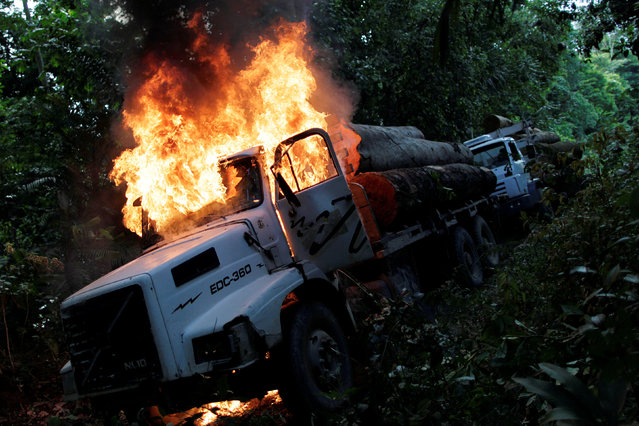
Trucks loaded with tree trunks are burned by agents of the Brazilian Institute for the Environment and Renewable Natural Resources, or Ibama, during an operation to combat illegal mining and logging, in the municipality of Novo Progresso, Para State, northern Brazil, November 11, 2016. When able to do their job, agents of the Brazilian Institute for the Environment and Renewable Natural Resources, or Ibama, are decisive, punishing illegal loggers on the spot. Nearly twice the size of India, the Amazon absorbs an estimated 2 billion tonnes of carbon dioxide per year, making its preservation vital in the fight to halt global warming. Ibama, responsible for preserving Brazil's 65 percent share of the world's largest rainforest, is one of the most important groups in that fight. But after years of surprising success, the rate of deforestation is on the rise again. Over the past four years it has risen 35 percent, as Ibama suffered from a lack of funding amid Brazil's worst recession in a century. (Photo by Ueslei Marcelino/Reuters)

Trucks loaded with tree trunks are burned by agents of the Brazilian Institute for the Environment and Renewable Natural Resources, or Ibama, during an operation to combat illegal mining and logging, in the municipality of Novo Progresso, Para State, northern Brazil, November 11, 2016. When able to do their job, agents of the Brazilian Institute for the Environment and Renewable Natural Resources, or Ibama, are decisive, punishing illegal loggers on the spot. Nearly twice the size of India, the Amazon absorbs an estimated 2 billion tonnes of carbon dioxide per year, making its preservation vital in the fight to halt global warming. (Photo by Ueslei Marcelino/Reuters)
Details
30 Nov 2016 12:36:00
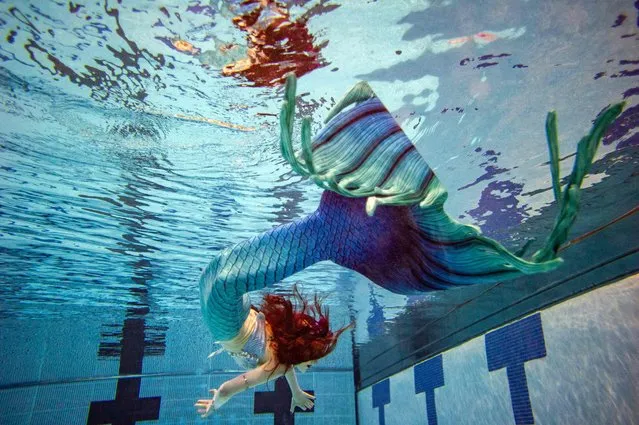
A mermaid poses under water during a shoot with photographer Brett Stanley during MerMagic Con at the Freedom Aquatic Center in Manassas, Virginia on August 7, 2021. MerMagic Con is advertised as the largest Mermaid convention in the world. Some parts of the convention are based on modeling and looks like the Miss Mermaid USA Pageant. The Society of Fat Mermaids looks to bring together plus size people and promote the idea that anyone can become a mermaid. Becoming a mermaid is not cheap, most merfolk spend thousands of dollars on their tail and outfit. Most tails are custom made out of silicone and others are foam and fabric. (Photo by Joseph Prezioso/AFP Photo)

A mermaid poses under water during a shoot with photographer Brett Stanley during MerMagic Con at the Freedom Aquatic Center in Manassas, Virginia on August 7, 2021. MerMagic Con is advertised as the largest Mermaid convention in the world. Some parts of the convention are based on modeling and looks like the Miss Mermaid USA Pageant. The Society of Fat Mermaids looks to bring together plus size people and promote the idea that anyone can become a mermaid. Becoming a mermaid is not cheap, most merfolk spend thousands of dollars on their tail and outfit. Most tails are custom made out of silicone and others are foam and fabric. (Photo by Joseph Prezioso/AFP Photo)
Details
23 Apr 2022 05:07:00
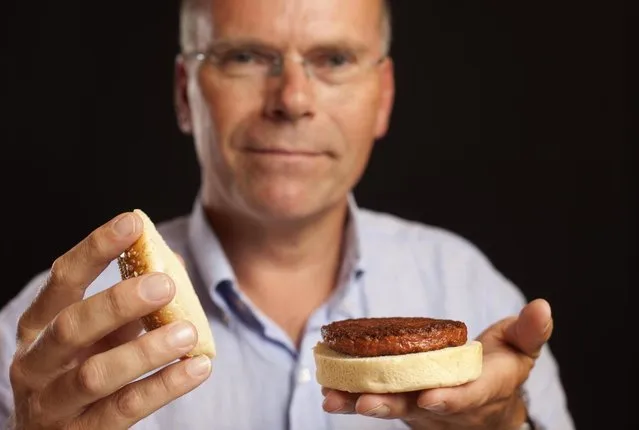
In this handout image provided by Ogilvy, a burger made from cultured beef, which has been developed by Professor Mark Post of Maastricht University in the Netherlands (pictured) is shown to the media during a press conference on August 5, 2013 in London, England. Cultured Beef could help solve the coming food crisis and combat climate change with commercial production of Cultured Beef beginning within ten to twenty years. (Photo by David Parry via Getty Images)

In this handout image provided by Ogilvy, a burger made from cultured beef, which has been developed by Professor Mark Post of Maastricht University in the Netherlands (pictured) is shown to the media during a press conference on August 5, 2013 in London, England. The in-vitro burger, cultured from cattle stem cells, the first example of what its creator says could provide an answer to global food shortages and help combat climate change, was fried in a pan and tasted by two volunteers. The burger is the result of years of research by Dutch scientist Mark Post, a vascular biologist at the University of Maastricht, who is working to show how meat grown in petri dishes might one day be a true alternative to meat from livestock.The meat in the burger has been made by knitting together around 20,000 strands of protein that has been cultured from cattle stem cells in Post's lab. (Photo by David Parry)
Details
06 Aug 2013 08:48:00
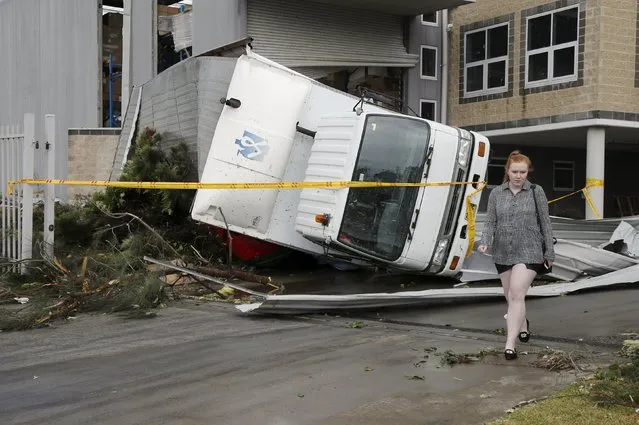
A truck lays overturned onto a car following strong winds at a Kurnell industrial park after a rare tornado hit the Sydney suburb December 16, 2015. (Photo by Jason Reed/Reuters)

A truck lays overturned onto a car following strong winds at a Kurnell industrial park after a rare tornado hit the Sydney suburb December 16, 2015. The tornado hit Sydney on Wednesday with destructive winds above 200 km an hour (125 mph) and cricket ball-sized hail, bringing down trees and power lines, tearing off roofs, overturning vehicles and causing flash flooding. (Photo by Jason Reed/Reuters)
Details
18 Dec 2015 08:06:00
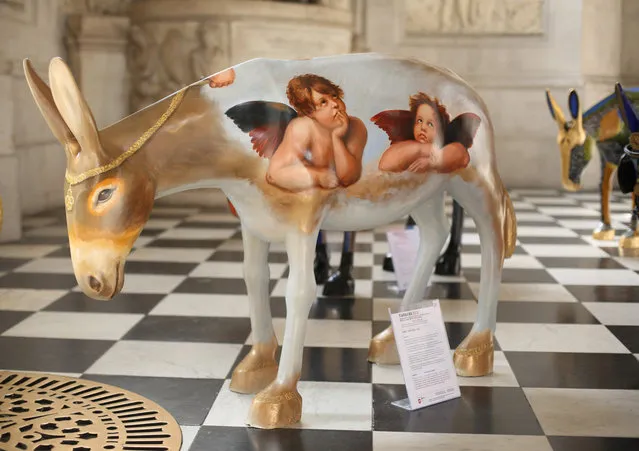
Artist painted donkey statues are displayed in the “Caravan” exhibition on August 30, 2013 in London, England. (Photo by Peter Macdiarmid/Getty Images)

Twenty five life-size donkeys have been given pride of place in St Paul's Cathedral as part of an interfaith exhibition. They've been painted by Egyptian and Western artists, to show solidarity for the people of Egypt. Photo: Artist painted donkey statues are displayed in the “Caravan” exhibition on August 30, 2013 in London, England. (Photo by Peter Macdiarmid)
Details
01 Sep 2013 09:39:00
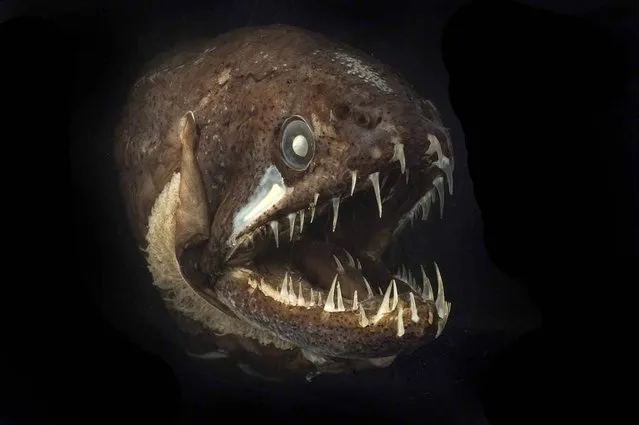
Imagine living in the sea where it is permanently dark, cold, and food is hard to find. For many animals at depth, it may be weeks to months between meals. If you find something to eat, you have to hang on to it

Imagine living in the sea where it is permanently dark, cold, and food is hard to find. For many animals at depth, it may be weeks to months between meals. If you find something to eat, you have to hang on to it. This is why so many deep-sea fishes have lots of big teeth. This dragonfish, spotted off the coast of Australia, even has teeth on its tongue. They would be terrifying animals ... if they weren’t the size of a banana. (Photo by Julian Finn/Museum Victoria)
Details
21 May 2012 12:14:00