Loading...
Done
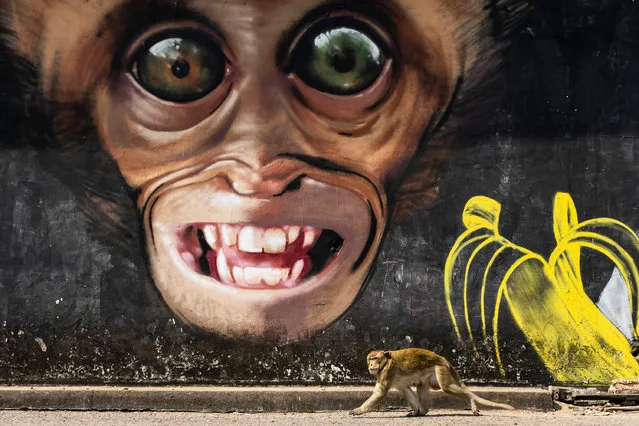
Natural world and wildlife shortlist. Lop Buri in Thailand is home to hundreds of macaques, which local residents consider to be disciples of the Hindu god Hanuman. While some people love them, others fear or even hate them. Despite the inconvenience they often cause, the macaques are generally respected and considered sacred. (Photo by Joan de la Malla/Sony World Photography Awards)

Natural world and wildlife shortlist. Lop Buri in Thailand is home to hundreds of macaques, which local residents consider to be disciples of the Hindu god Hanuman. While some people love them, others fear or even hate them. Despite the inconvenience they often cause, the macaques are generally respected and considered sacred. (Photo by Joan de la Malla/Sony World Photography Awards)
Details
15 Feb 2020 00:05:00
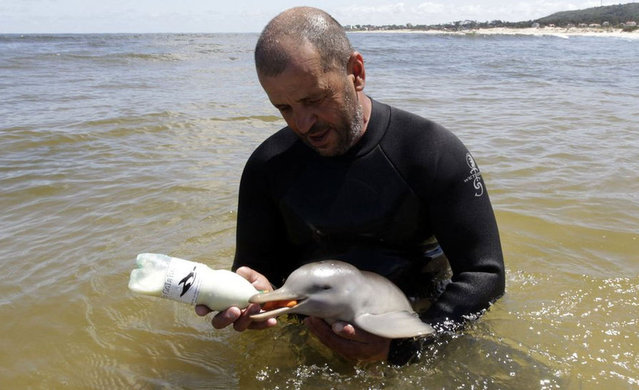
Rescued Baby Dolphin

A South American marine animal rescue group “S.O.S Rescate de Fauna Marina” is raising a baby La Plata Dolphin (Pontoporia blainvillei) found beached near Montevideo city with its umbilical cord still attached. The group is headed by Richard Tesore who is shown swimming with the baby female dolphin near the seaside resort of Piriapolis in Uruguay.
Details
27 Jun 2014 11:56:00
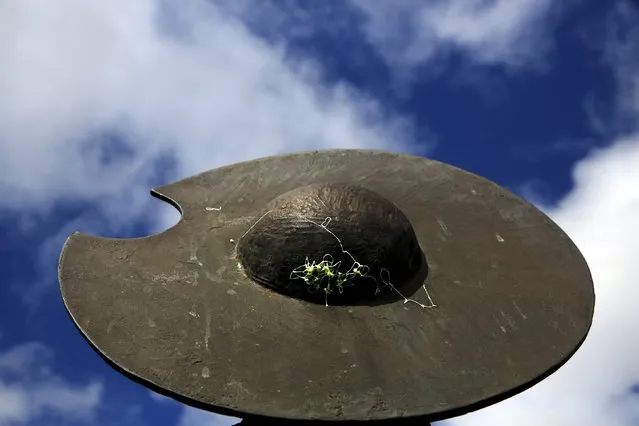
A sculpture of Don Quixote shows him wearing the basin he mistook for the enchanted helmet of the fictional Moorish king Mambrino in Alcazar de San Juan, Spain, April 5, 2016. (Photo by Susana Vera/Reuters)

A sculpture of Don Quixote shows him wearing the basin he mistook for the enchanted helmet of the fictional Moorish king Mambrino in Alcazar de San Juan, Spain, April 5, 2016. The arid central Spanish region of La Mancha is the setting for “Don Quixote”, the seventeenth-century novel by Miguel de Cervantes. Four hundred years after his death, references to the characters of Don Quixote, his loyal squire Sancho Panza and his beautiful lady Dulcinea abound in the surrounding villages from sweet treats to theatre productions involving livestock. Cervantes did not give away the name of the birthplace of Don Quixote, a middle-aged gentleman who becomes obsessed with chivalrous ideals. But many identify the village of Argamasilla de Alba as his hometown. The anniversary of Cervantes’ death is marked on the 23 April. (Photo by Susana Vera/Reuters)
Details
21 Apr 2016 12:32:00
People take part in the “The Burial of the Sardine” funeral procession, which marks the end of carnival festivities, in Madrid, Spain, February 10, 2016. (Photo by Juan Medina/Reuters)

People take part in the “The Burial of the Sardine” funeral procession, which marks the end of carnival festivities, in Madrid, Spain, February 10, 2016. “Mourners” carry a coffin with a mock sardine through the streets to celebrate the countdown to Lent. Spanish painter Francisco de Goya's painting “El entierro de la sardina” (The Burial of the Sardine) was inspired by this tradition, which started in Madrid in the 18th century, around the time of Spanish King Carlos III. (Photo by Juan Medina/Reuters)
Details
11 Feb 2016 12:29:00
Filipinos cross a swelling river in Las Pinas city, south of Manila, Philippines, 09 July 2015. According to the Philippines State weather forecast, heavy rainfall is expected in Metro Manila and nearby provinces due to an enhanced Southwest Monsoon and Tropical Storm Linfa, Typhoon Chan-hom and Typhoon Nangka which are lining up across the Pacific Ocean. (Photo by Francis R. Malasig/EPA)

Filipinos cross a swelling river in Las Pinas city, south of Manila, Philippines, 09 July 2015. According to the Philippines State weather forecast, heavy rainfall is expected in Metro Manila and nearby provinces due to an enhanced Southwest Monsoon and Tropical Storm Linfa, Typhoon Chan-hom and Typhoon Nangka which are lining up across the Pacific Ocean. (Photo by Francis R. Malasig/EPA)
Details
10 Jul 2015 12:52:00
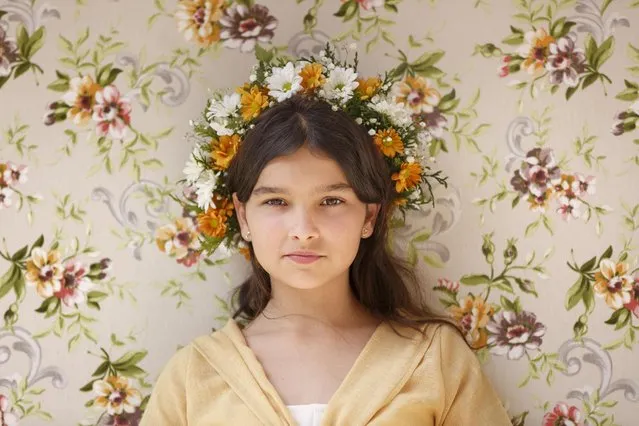
A “Maya” girl sits in an altar during the traditional celebration of “Las Mayas” on the streets in Madrid, Spain Sunday, May 10, 2015. The festivity of the Maya comes from pagan rites and dates from the medieval age, appearing in ancient documents. It takes place every year in the beginning of May and celebrates the beginning of the spring. (Photo by Daniel Ochoa de Olza/AP Photo)

A “Maya” girl sits in an altar during the traditional celebration of “Las Mayas” on the streets in Madrid, Spain Sunday, May 10, 2015. The festivity of the Maya comes from pagan rites and dates from the medieval age, appearing in ancient documents. It takes place every year in the beginning of May and celebrates the beginning of the spring. Girls between 7 and 11 years old are chosen as “Maya” and should sit still, serious and quiet for a couple of hours in altars on the street decorated with flowers and plants and afterwards they walk to the church with their family where they attend a ceremony. (Photo by Daniel Ochoa de Olza/AP Photo)
Details
14 May 2015 11:12:00
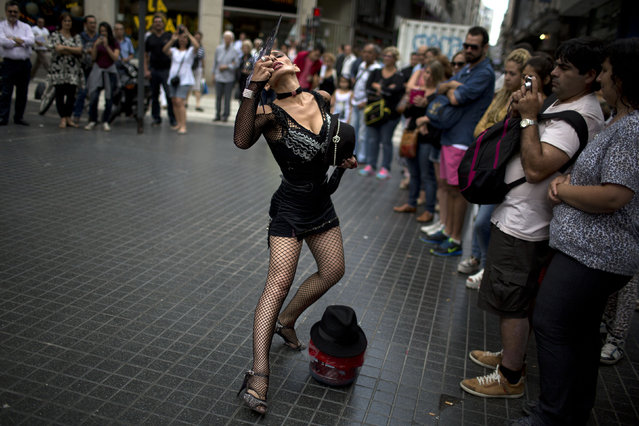
A street artist dances tango in Buenos Aires, Argentina, Tuesday, January 20, 2015. Tango is a partner dance that originated in the 1890's along the Rio de la Plata, the border between Uruguay and Argentina. UNESCO approved in 2009, a joint proposal by the two nations to include the dance in its Intangible Cultural Heritage List. (Photo by Rodrigo Abd/AP Photo)

A street artist dances tango in Buenos Aires, Argentina, Tuesday, January 20, 2015. Tango is a partner dance that originated in the 1890's along the Rio de la Plata, the border between Uruguay and Argentina. UNESCO approved in 2009, a joint proposal by the two nations to include the dance in its Intangible Cultural Heritage List. (Photo by Rodrigo Abd/AP Photo)
Details
23 Jan 2015 12:56:00
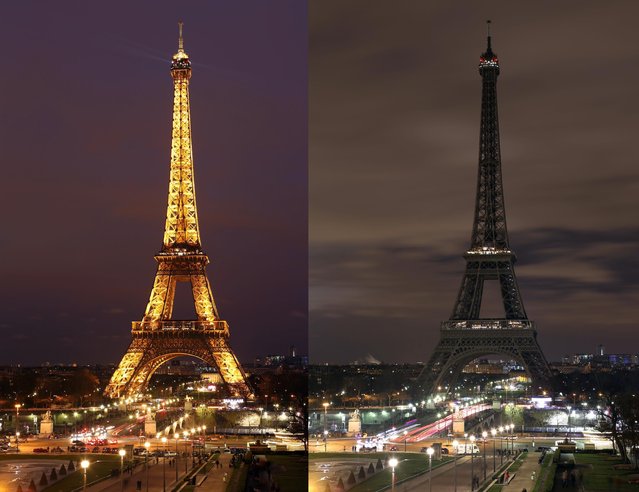
In this two photo combination picture, the Eiffel Tower with its usual lighting at left, and after the lighting was switched off at right, at the occasion of the Earth Hour, in Paris, France, Saturday March 28, 2015. This Saturday, 28 March 8:30 p.m. local time, individuals, businesses, cities and landmarks around the world are switching off their lights for one hour to focus attention on climate change. (Photo by Remy de la Mauviniere/AP Photo)

In this two photo combination picture, the Eiffel Tower with its usual lighting at left, and after the lighting was switched off at right, at the occasion of the Earth Hour, in Paris, France, Saturday March 28, 2015. This Saturday, 28 March 8:30 p.m. local time, individuals, businesses, cities and landmarks around the world are switching off their lights for one hour to focus attention on climate change. (Photo by Remy de la Mauviniere/AP Photo)
Details
29 Mar 2015 12:09:00