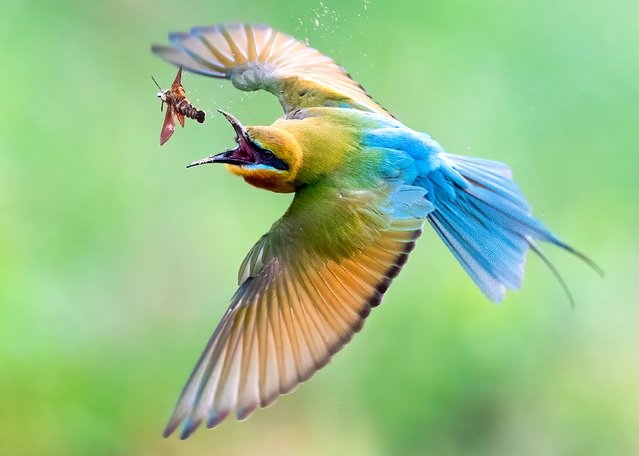
A blue-tailed bee-eater chases down its prey along the banks of the Kaveri River on the outskirts of the city of Mysore, India in the last decade of June 2025. (Photo by Nitin Jain/Solent News)
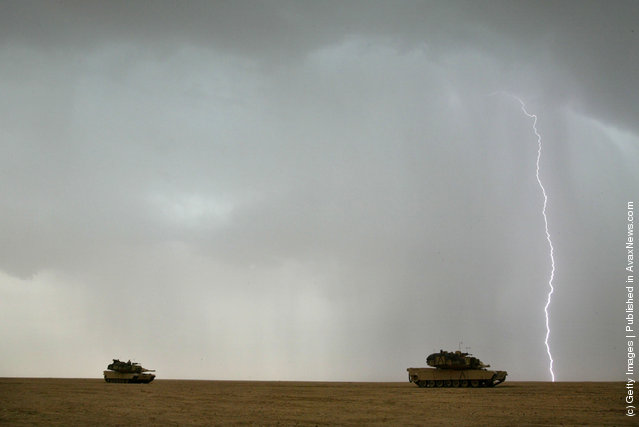
A lighting bolt flashes in the sky as U.S. Army M1A1 Abram tanks roll through the desert December 9, 2002 near the Iraqi border in Kuwait. (Photo by Joe Raedle/Getty Images)
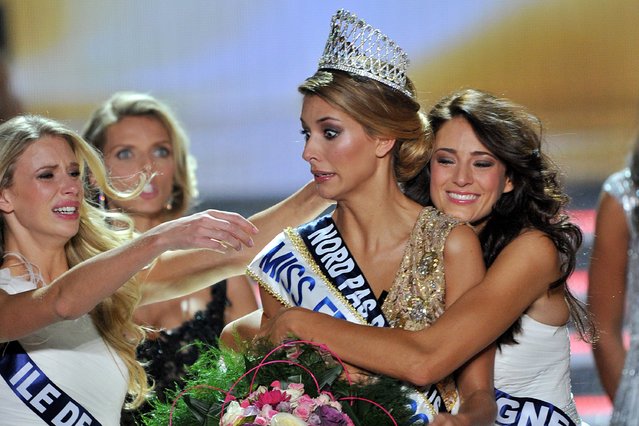
Miss Nord-Pas-de-Calais Camille Cerf (C) is congratulated by Miss Ile de France 2014 Margaux Savary (L) and Miss Auvergne 2014 Morgane Laporte after Cerf won the Miss France 2015 beauty contest on December 6, 2014 in Orleans. (Photo by Guillaume Souvant/AFP Photo)
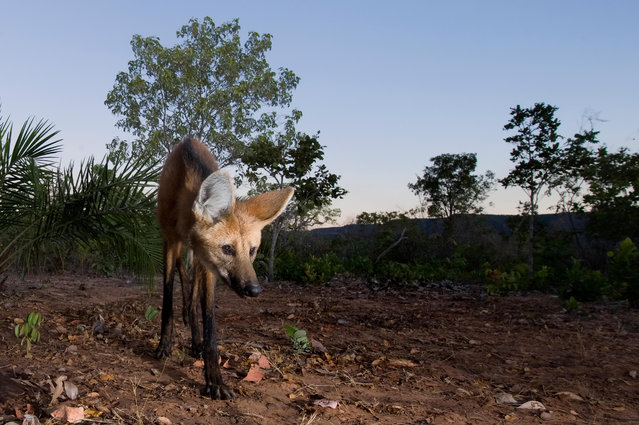
Global wildlife populations will decline by 67% by 2020 unless urgent action is taken to reduce human impact on species and ecosystems, warns the biennial Living Planet Index report from WWF (World Wide Fund for Nature) and ZSL (Zoological Society of London). From elephants to eels, here are some of the wildlife populations most affected by human activity. Here: The maned wolf is among the large mammals in the Brazilian Cerrado that are threatened by the increasing conversion of grasslands into farmland for grazing and growing crops. (Photo by Ben Cranke/Nature Picture Library/Alamy Stock Photo)
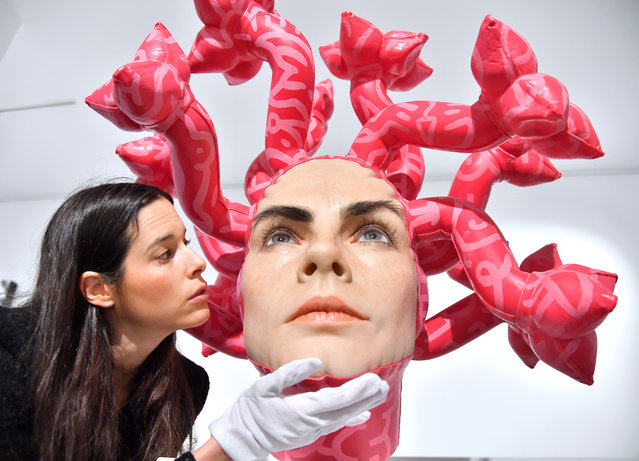
Olympe, the latest creation by artist Aspencrow, is unveiled at JD Malat gallery in London, England on March 27, 2019. It is a sculpture of Cara Delevingne based on the Greek mythological monster Medusa. (Photo by Anthony Harvey/Rex Features/Shutterstock)
A woman instructs a boy on how to pose for pictures in front of a mural depicting Soviet pilot Valery Chkalov – who took a non-stop flight over the Arctic and landed in the US state of Washington in 1937 – at Chkalovskaya metro station in Moscow on August 14, 2019. (Photo by Yuri Kadobnov/AFP Photo)
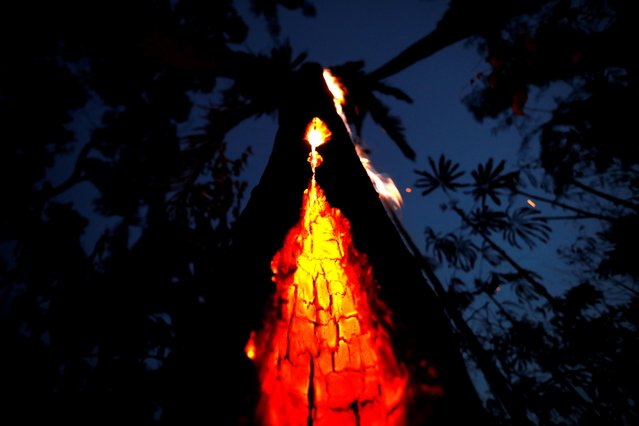
A burning tree is seen during a fire in an area of the Amazon rainforest in Itapua do Oeste, Rondonia State, Brazil, September 11, 2019. (Photo by Bruno Kelly/Reuters)