Loading...
Done
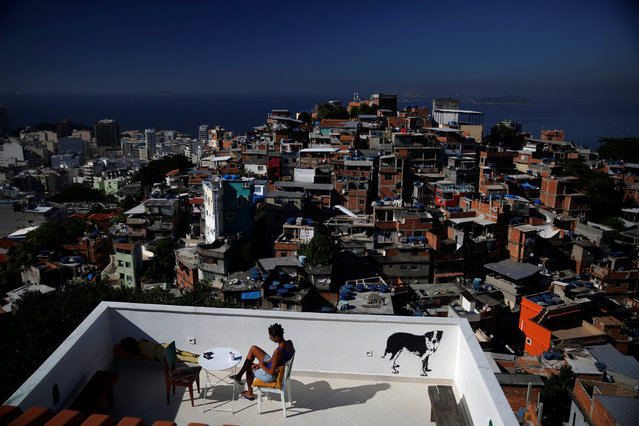
A woman sits on a terrace at Tiki hostel in Cantagalo favela, in Rio de Janeiro, Brazil, April 16, 2016. (Photo by Pilar Olivares/Reuters)

A woman sits on a terrace at Tiki hostel in Cantagalo favela, in Rio de Janeiro, Brazil, April 16, 2016. Hostels in a few of Rio's more than 1,000 slums serve not only as a cheap housing alternative for the more adventurous among the estimated 500,000 foreign tourists expected to arrive for the Olympics in August. The establishments also open up the rich culture of the city's shantytowns for travellers, giving them a glimpse into once “no-go” areas where about one-fifth of Rio's population lives. (Photo by Pilar Olivares/Reuters)
Details
04 May 2016 12:18:00
Elderly people attend an aquatic exercise at a private pool in Bangkok, Thailand, April 28, 2016. (Photo by Athit Perawongmetha/Reuters)

Elderly people attend an aquatic exercise at a private pool in Bangkok, Thailand, April 28, 2016. Many Thai families look after elderly relatives at a cost that countrywide adds up to just under a third of household income. The number of families facing this issue will balloon as the population ages at a rate among the fastest in Southeast Asia. (Photo by Athit Perawongmetha/Reuters)
Details
06 May 2016 13:21:00
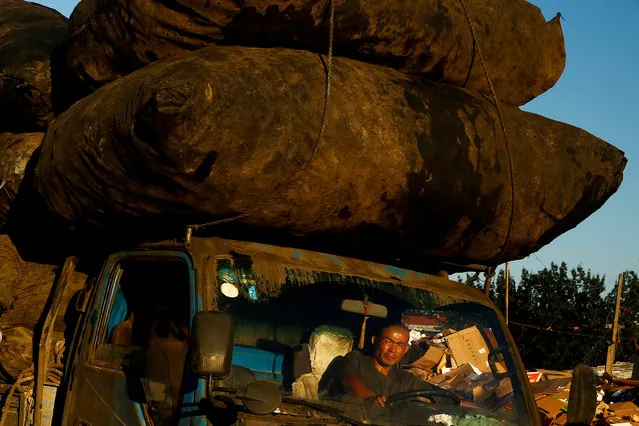
A driver steers a lorry laden with bags of plastic bottles across a recycling yard at the outskirts of Beijing, China, August 19, 2016. (Photo by Thomas Peter/Reuters)

A driver steers a lorry laden with bags of plastic bottles across a recycling yard at the outskirts of Beijing, China, August 19, 2016. As authorities try to control Beijing's burgeoning population and capitalize on skyrocketing land prices, scrap collectors say they are being pushed out despite playing a vital role in China's unique recycling ecosystem. (Photo by Thomas Peter/Reuters)
Details
26 Nov 2016 10:39:00
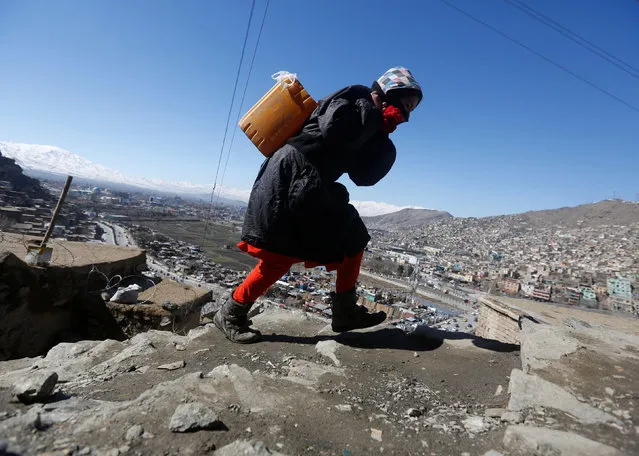
An Afghan girl carries water on her back as she climbs a hill in Kabul, Afghanistan February 20, 2017. (Photo by Omar Sobhani/Reuters)

An Afghan girl carries water on her back as she climbs a hill in Kabul, Afghanistan February 20, 2017. A growing population is straining water supplies in Afghanistan's capital, forcing those who can afford it to dig unregulated wells ever deeper to tap a falling water table. Finding water in arid Afghanistan is virtually always a challenge, but a drop in the groundwater level in Kabul caused by overuse and drought is making it even more difficult for residents, especially the poor. (Photo by Omar Sobhani/Reuters)
Details
02 Mar 2017 00:05:00
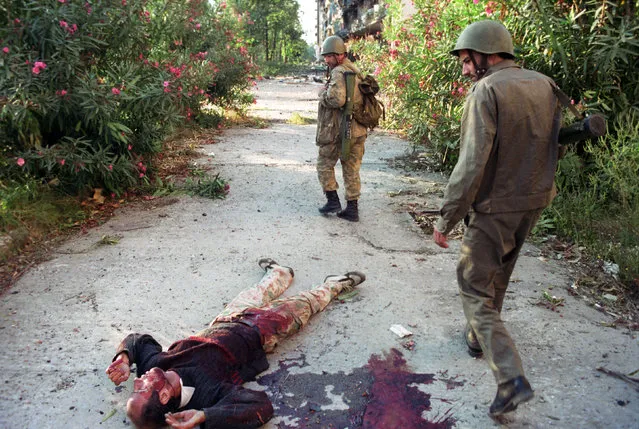
Abkhazia. Sukhumi, 1993. A house-to-house combat. (Photo by Andrei Solovyov/ITAR-TASS)

The War in Abkhazia from 1992 to 1993 was fought between Georgian government forces for the most part, and Abkhaz separatist forces, Russian armed forces and North Caucasian militants. Ethnic Georgians who lived in Abkhazia fought largely on the side of Georgian government forces. Ethnic Armenians and Russians within Abkhazia's population largely supported the Abkhazians, and many fought on their side. The separatists received support from thousands of North Caucasus and Cossack militants and from the Russian Federation forces stationed in and near Abkhazia. Here: Abkhazia. Sukhumi, 1993. A house-to-house combat. (Photo by Andrei Solovyov/ITAR-TASS)
Details
29 Sep 2017 07:31:00
This photo taken on February 1, 2018 shows a worker trimming the skin imperfections of a silicone doll at a factory of EXDOLL, a firm based in the northeastern Chinese port city of Dalian. (Photo by Fred Dufour/AFP Photo)

This photo taken on February 1, 2018 shows a worker trimming the skin imperfections of a silicone doll at a factory of EXDOLL, a firm based in the northeastern Chinese port city of Dalian. With China facing a massive gender gap and a greying population, a company wants to hook up lonely men and retirees with a new kind of companion: “Smart” sеx dolls that can talk, play music and turn on dishwashers. (Photo by Fred Dufour/AFP Photo)
Details
05 Feb 2018 06:41:00
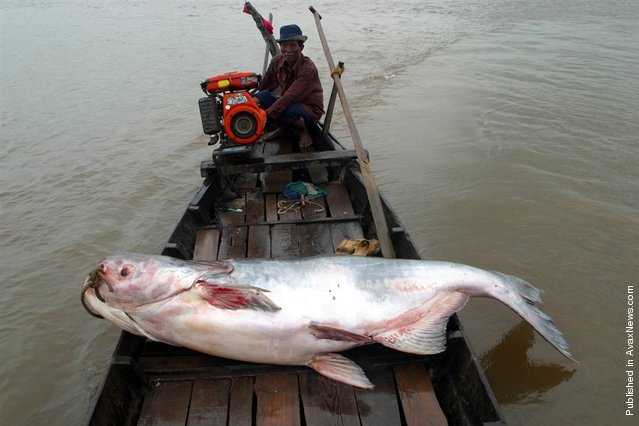
Among the fish populations that could be harmed by the Xayaburi dam in Laos is the critically endangered Mekong giant catfish, considered by the Guinness Book of World Records to be the world’s largest freshwater fish. The fish, which grows to 650 pounds and about 10 feet long, is only found in the Mekong River. It is migratory, moving between downstream habitats in Cambodia upstream to northern Thailand and Laos each year to spawn. Some experts fear the Xayaburi dam could block the migration and drive the giant catfish to extinction

Among the fish populations that could be harmed by the Xayaburi dam in Laos is the critically endangered Mekong giant catfish, considered by the Guinness Book of World Records to be the world’s largest freshwater fish. The fish, which grows to 650 pounds and about 10 feet long, is only found in the Mekong River. It is migratory, moving between downstream habitats in Cambodia upstream to northern Thailand and Laos each year to spawn. Some experts fear the Xayaburi dam could block the migration and drive the giant catfish to extinction. (Photo by Courtesy of Zeb Hogan/University of Nevada, Reno)
Details
20 Apr 2012 13:10:00
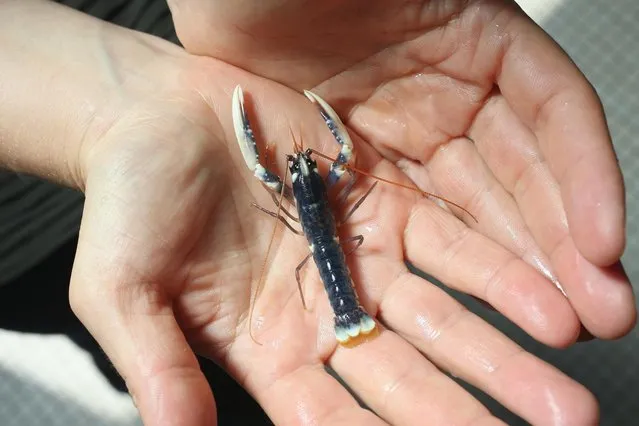
Isabel Schmalenbach, an environmental scientist with the Helgoland Biological Institute (Biologische Anstalt Helgoland), part of the Alfred Wegener Institute for Polar and Marine Research, holds a one-year old baby European lobster (Homarus gammarus) raised at the institute on August 3, 2013 on Helgoland Island, Germany. (Photo by Sean Gallup/Getty Images)

Isabel Schmalenbach, an environmental scientist with the Helgoland Biological Institute (Biologische Anstalt Helgoland), part of the Alfred Wegener Institute for Polar and Marine Research, holds a one-year old baby European lobster (Homarus gammarus) raised at the institute on August 3, 2013 on Helgoland Island, Germany. Later in the day Schmalenbach and her colleagues released a total of 415 one-year old lobsters into the North Sea as part of an effort to repopulate the lobster population around Helgoland (also called Heligoland). In the 19th century local fishermen caught up to 80,000 lobsters a year in the surrounding waters, combined with the heavy allied bombing of the island during and after World War II, as well as other environmental factors, decimated the lobster population. (Photo by Sean Gallup)
Details
05 Aug 2013 08:39:00