Loading...
Done
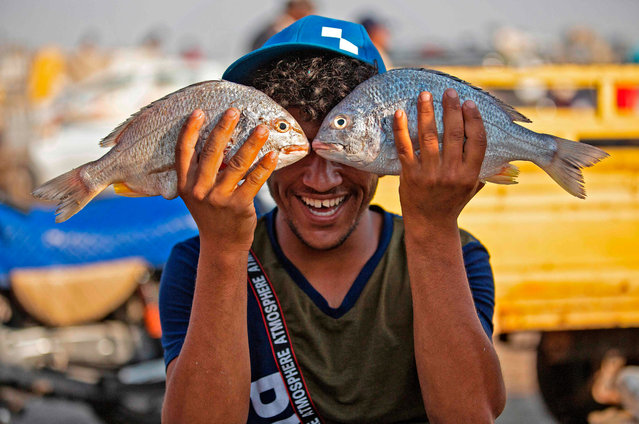
A youth poses while holding two fishes before his face in Iraq's southern port city of al-Faw, 90 kilometres south of Basra near the Shatt al-Arab and the Gulf, on May 18, 2020. In Iraq, a national lockdown to halt the COVID-19 coronavirus pandemic has found some unexpected fans: local businesses who no longer have to compete with Turkish, Iranian or Chinese imports. Those countries, as well as Saudi Arabia, Jordan and Kuwait, typically flood Iraqi markets with inexpensive products at prices local producers can't compete with. (Photo by Hussein Faleh/AFP Photo)

A youth poses while holding two fishes before his face in Iraq's southern port city of al-Faw, 90 kilometres south of Basra near the Shatt al-Arab and the Gulf, on May 18, 2020. In Iraq, a national lockdown to halt the COVID-19 coronavirus pandemic has found some unexpected fans: local businesses who no longer have to compete with Turkish, Iranian or Chinese imports. Those countries, as well as Saudi Arabia, Jordan and Kuwait, typically flood Iraqi markets with inexpensive products at prices local producers can't compete with. (Photo by Hussein Faleh/AFP Photo)
Details
02 Jul 2020 00:01:00
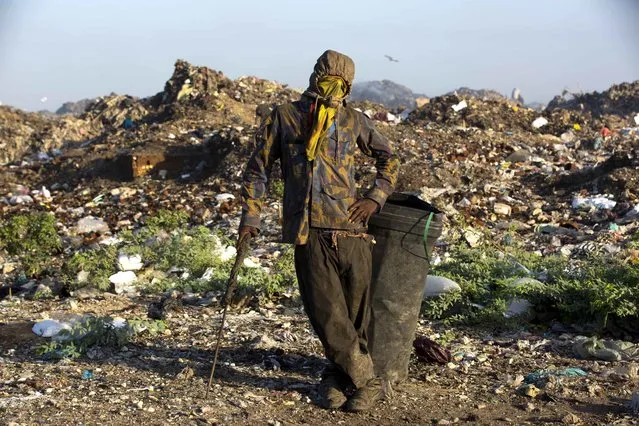
In this August 24, 2018 photo, Changlair Aristide pauses for a portrait, wearing his protective clothing, including an old U.N. peacekeeper's jacket he found in the trash, before scavenging the Truitier landfill in the Cite Soleil slum of Port-au-Prince, Haiti. Before 2004, Aristide recalled having enough money to splurge on shoes, T-shirts and pants, but this year he could not buy his kids anything new for the school year. “Life is like that, up and down”, Aristide said. “They'll go to school anyway, even if I have to sell my pig. I love them”. (Photo by Dieu Nalio Chery/AP Photo)

In this August 24, 2018 photo, Changlair Aristide pauses for a portrait, wearing his protective clothing, including an old U.N. peacekeeper's jacket he found in the trash, before scavenging the Truitier landfill in the Cite Soleil slum of Port-au-Prince, Haiti. Before 2004, Aristide recalled having enough money to splurge on shoes, T-shirts and pants, but this year he could not buy his kids anything new for the school year. “Life is like that, up and down”, Aristide said. “They'll go to school anyway, even if I have to sell my pig. I love them”. (Photo by Dieu Nalio Chery/AP Photo)
Details
03 Oct 2018 00:03:00
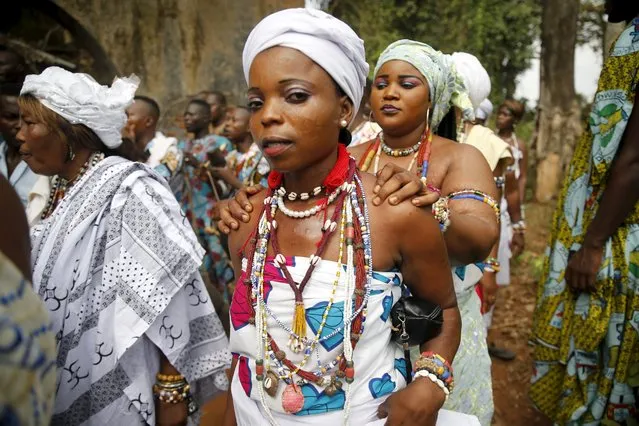
Devotees attend the annual voodoo festival in Ouidah January 10, 2016. (Photo by Akintunde Akinleye/Reuters)

Devotees attend the annual voodoo festival in Ouidah January 10, 2016. The national voodoo holiday in the West African country of Benin had a distinctively political accent this year as practitioners from Africa and the Americas gathered on Sunday to offer prayers and sacrifices for peace. Hundreds of followers of the traditional religion gathered in the Atlantic coast town of Ouidah, once an important port in the slave trade, to pray for calm during the tiny country's presidential election scheduled for February. (Photo by Akintunde Akinleye/Reuters)
Details
12 Jan 2016 08:05:00
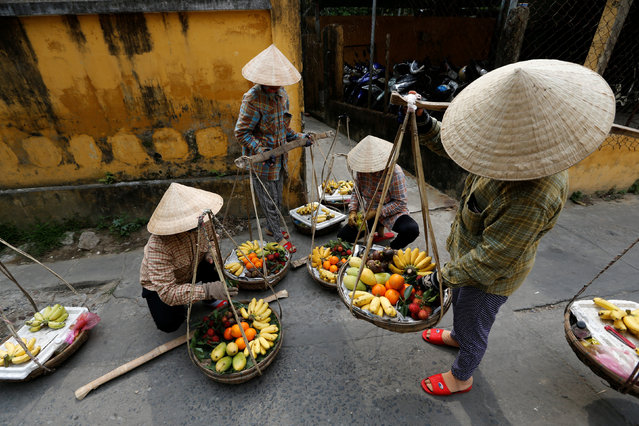
Women wearing traditional hats, known as a non la, sell fruits in Hoi An, Vietnam April 4, 2016. (Photo by Jorge Silva/Reuters)

Women wearing traditional hats, known as a non la, sell fruits in Hoi An, Vietnam April 4, 2016. The non la hats are made of readily available materials such as palm leaves, tree bark and bamboo and are visible everywhere in the city, a UNESCO World Heritage site. Hoi An's history as a busy trading port is evident throughout its architecture, a mix of eras and styles, with traditional wooden Vietnamese houses, Chinese temples and French colonial buildings. (Photo by Jorge Silva/Reuters)
Details
11 May 2016 11:32:00
Houthi followers perform the traditional Baraa dance ahead of a demonstration against the Saudi-led air strikes in Yemen's capital Sanaa August 24, 2015. (Photo by Khaled Abdullah/Reuters)

Houthi followers perform the traditional Baraa dance ahead of a demonstration against the Saudi-led air strikes in Yemen's capital Sanaa August 24, 2015. The nothern-based Houthis, a Shi'ite Muslim group, took control of Sanaa last September. Arab countries intervened in the conflict in March to halt a Houthi advance into the south which caused the Saudi-backed government to flee to Riyadh from its refuge in the southern port of Aden. (Photo by Khaled Abdullah/Reuters)
Details
25 Aug 2015 10:19:00


Libyan rebel soldiers watch as they fire rockets (background) toward Libyan government troops near front-line positions April 6, 2011 outside of Brega, Libya. Rebel militias fighting against Libyan government loyalist soldiers continued their stand-off in the eastern Libyan desert today, regaining ground toward a key oil port while awaiting further NATO airstrikes in their quest to unseat longtime Libyan ruler Muammar Gaddafi. (Photo by Chris Hondros/Getty Images)
Details
08 Apr 2011 10:27:00
The wreck of the Herald of Free Enterprise, which capsized near Zeebrugge on the 6th of March 1987

“MS Herald of Free Enterprise was a roll-on roll-off (RORO) car and passenger ferry owned by Townsend Thoresen. She was one of three ships commissioned by the company to operate on the Dover–Calais route across the English Channel. The ferry capsized on the night of 6 March 1987, moments after leaving the Belgian port of Zeebrugge, killing 193 passengers and crew. This was the deadliest maritime disaster involving a British ship in peacetime since the sinking of the Iolaire in 1919”. – Wikipedia

Photo: The wreck of the Herald of Free Enterprise, which capsized near Zeebrugge on the 6th of March 1987. (Photo by Hulton Archive/Getty Images). 1987
Details
06 Mar 2012 13:26:00
Mrs. Marie Graskamp of Milwaukee shows the different positions one might assume when entering the bomb shelter in Milwaukee  September 3, 1958. This circular entrance is about three feet in diameter. This is the entrance (according to the builders) that would connect to the cellar of a home assuming the shelter was in the ground for added protection. (Photo by AP Photo)

Mrs. Marie Graskamp of Milwaukee shows the different positions one might assume when entering the bomb shelter in Milwaukee September 3, 1958. This circular entrance is about three feet in diameter. This is the entrance (according to the builders) that would connect to the cellar of a home assuming the shelter was in the ground for added protection. If a bombing should occur, all members of family would proceed to the cellar and then through the circular port into the shelter. (Photo by AP Photo)
Details
04 Sep 2015 12:44:00