Loading...
Done
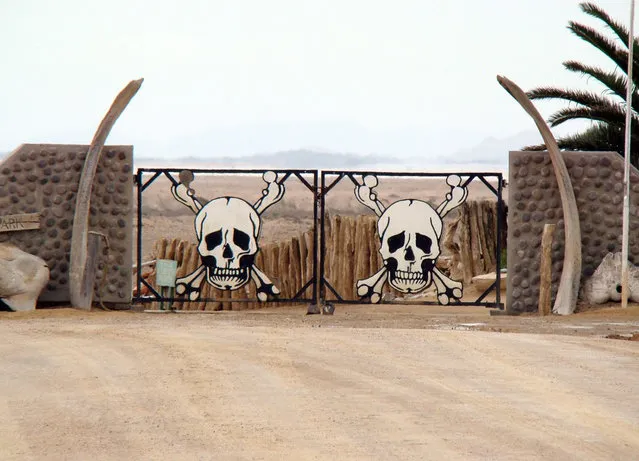
The Skeleton Coast, Namibia

The Skeleton Coast is the northern part of the Atlantic Ocean coast of Namibia and south of Angola from the Kunene River south to the Swakop River, although the name is sometimes used to describe the entire Namib Desert coast. The Bushmen of the Namibian interior called the region "The Land God Made in Anger", while Portuguese sailors once referred to it as "The Gates of Hell".
Details
23 Feb 2014 09:27:00
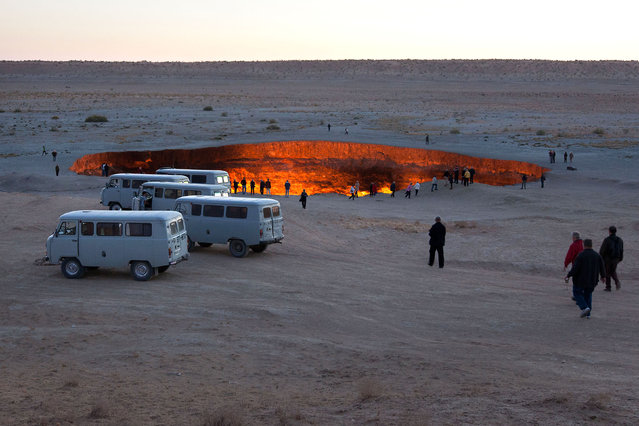
The door to hell. (Photo by William Keeping/Caters News)

“These are the astonishing images of the very aptly named door to hell, a fiery crater thats baffled scientist and has been flaming away for more than 40 years. The crater is 230-feet wide and situated near Derweze village in Turkmenistan”. – Caters News. (Photo by William Keeping/Caters News)
Details
07 Mar 2014 12:08:00
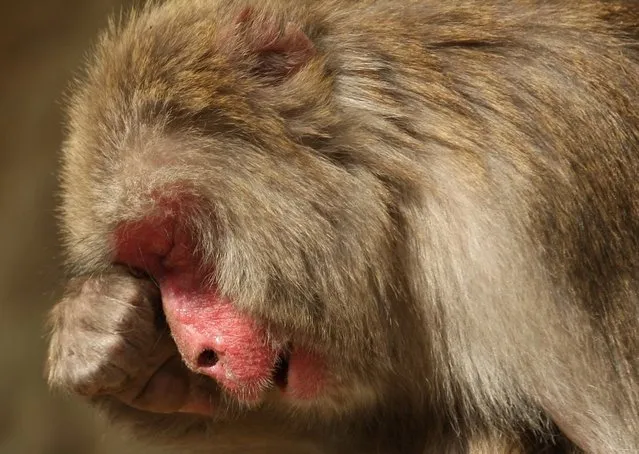
A 20-year-old Japanese macaque monkey named Monday scratches her eyes while suffering an allergy to pollen from the cedar tree at Awajishima Monkey Centre on March 17, 2013 in Sumoto, Japan. Many monkeys are suffering the effects of hay fever at this time of the year, with the typical symptoms being the same as with humans.  According to Awajishima Monkey center this year hay fever is higher than last year, the pollen season is from February to April.  (Photo by Buddhika Weerasinghe)

A 20-year-old Japanese macaque monkey named Monday scratches her eyes while suffering an allergy to pollen from the cedar tree at Awajishima Monkey Centre on March 17, 2013 in Sumoto, Japan. Many monkeys are suffering the effects of hay fever at this time of the year, with the typical symptoms being the same as with humans. According to Awajishima Monkey center this year hay fever is higher than last year, the pollen season is from February to April. (Photo by Buddhika Weerasinghe)
Details
18 Mar 2013 09:48:00
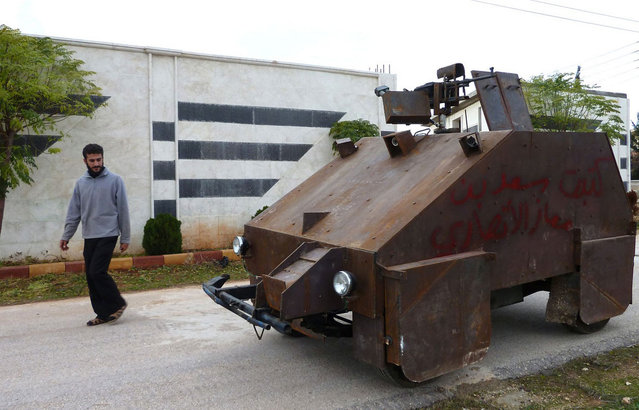
A Syrian rebel walks past Sham 2, a homemade armored vehicle, in Bishqatin, Syria, on December 8, 2012. From a distance it looks rather like a big rusty metal box but closer inspection reveals a homemade armored vehicle waiting to be deployed. Sham II, named after ancient Syria, is built from the chassis of a car and touted by rebels as “100 percent made in Syria”. (Photo by Herve Bar/AFP Photo)

A Syrian rebel walks past Sham 2, a homemade armored vehicle, in Bishqatin, Syria, on December 8, 2012. From a distance it looks rather like a big rusty metal box but closer inspection reveals a homemade armored vehicle waiting to be deployed. Sham II, named after ancient Syria, is built from the chassis of a car and touted by rebels as “100 percent made in Syria”. (Photo by Herve Bar/AFP Photo)
Details
03 Sep 2013 09:30:00
Boys walk home for lunch from school in the village of Kogelo, west of Kenya's capital Nairobi, July 16, 2015. (Photo by Thomas Mukoya/Reuters)

Boys walk home for lunch from school in the village of Kogelo, west of Kenya's capital Nairobi, July 16, 2015. U.S. President Barack Obama visits Kenya and Ethiopia later this month. His ancestral home of Kogelo is home to Sarah Hussein Obama, his step-grandmother. The Kenyan village, burial place of Obama's father, features an open-pit goldmine, a pork butcher's, a school named after their most famous son and outdoor market stalls. Villagers get around by motorbike taxi or on foot while a donkey-cart transports water. Children, some of them named Obama in honour of the President, walk to and from school together. (Photo by Thomas Mukoya/Reuters)
Details
24 Jul 2015 11:46:00
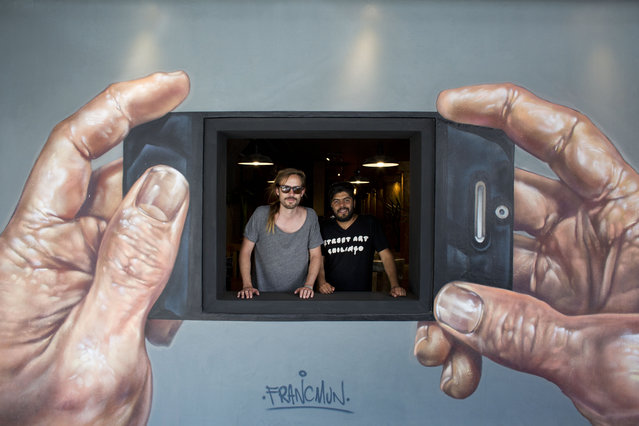
In this September 1, 2015 photo, street artists Jenaro de Rosenzweig, left, and Alejandro Revilla pose for a portrait behind a restaurant's window covered with a mural by artist Francisco Munoz, signed with his artist's name below, in the Roma Norte neighborhood of Mexico City. Rosenzweig and Revilla founded the “Street Art Chilango” cooperative in March 2013, which is filling neighborhoods with public art by local street artists. (Photo by Rebecca Blackwell/AP Photo)

In this September 1, 2015 photo, street artists Jenaro de Rosenzweig, left, and Alejandro Revilla pose for a portrait behind a restaurant's window covered with a mural by artist Francisco Munoz, signed with his artist's name below, in the Roma Norte neighborhood of Mexico City. Rosenzweig and Revilla founded the “Street Art Chilango” cooperative in March 2013, which is filling neighborhoods with public art by local street artists. (Photo by Rebecca Blackwell/AP Photo)
Details
08 Sep 2015 11:42:00
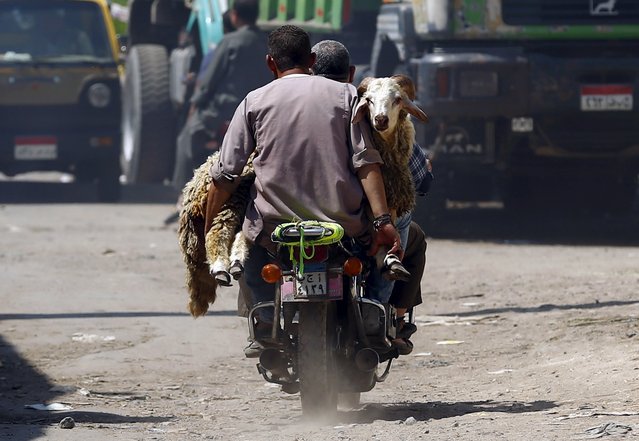
Men transport a sheep on their motorcycle after buying it at an old cattle market named “Al Emam Market” ahead of the Muslim festival Eid al-Adha in Cairo, Egypt, September 19, 2015. Muslims across the world are preparing to celebrate the annual festival of Eid al-Adha or the Festival of Sacrifice, which marks the end of the annual hajj pilgrimage, by slaughtering goats, sheep. (Photo by Amr Abdallah Dalsh/Reuters)

Men transport a sheep on their motorcycle after buying it at an old cattle market named “Al Emam Market” ahead of the Muslim festival Eid al-Adha in Cairo, Egypt, September 19, 2015. Muslims across the world are preparing to celebrate the annual festival of Eid al-Adha or the Festival of Sacrifice, which marks the end of the annual hajj pilgrimage, by slaughtering goats, sheep, cows and camels in commemoration of the Prophet Abraham's readiness to sacrifice his son to show obedience to Allah. (Photo by Amr Abdallah Dalsh/Reuters)
Details
22 Sep 2015 08:05:00
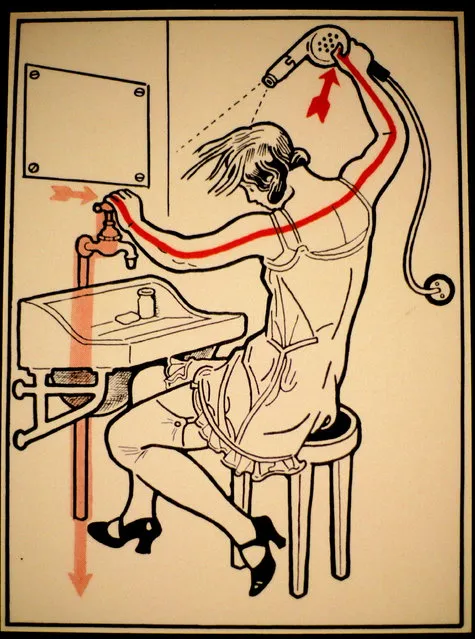
The book “Elektroschutz in 132 Bildern” (Electrical Protection in 132 Pictures) was published in Vienna in the early 1900s by a Viennese physician named Stefan Jellinek (1878-1968, a founder of the Electro-Pathological Museum). The pictures are nice and direct and unambiguous; they teach, graphically, that the surest way to kill yourself with electricity is to form a complete path from source (usually the bright red arrow) to ground (the screened back, pink arrow). Arrowheads provide the path for current flow. (Photo by The Vienna Technical Museum)

The book “Elektroschutz in 132 Bildern” (Electrical Protection in 132 Pictures) was published in Vienna in the early 1900s by a Viennese physician named Stefan Jellinek (1878-1968, a founder of the Electro-Pathological Museum). The pictures are nice and direct and unambiguous; they teach, graphically, that the surest way to kill yourself with electricity is to form a complete path from source (usually the bright red arrow) to ground (the screened back, pink arrow). Arrowheads provide the path for current flow. (Photo by The Vienna Technical Museum)
Details
11 Aug 2014 11:10:00