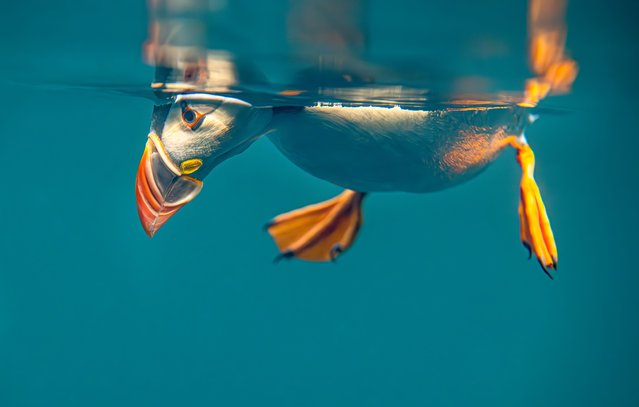
A puffin swims underwater in search for fish off the coast of the Farne Islands in Northumberland, North East England in the last decade of July 2025. (Photo by Brian Matthews/Solent News & Photo Agency)
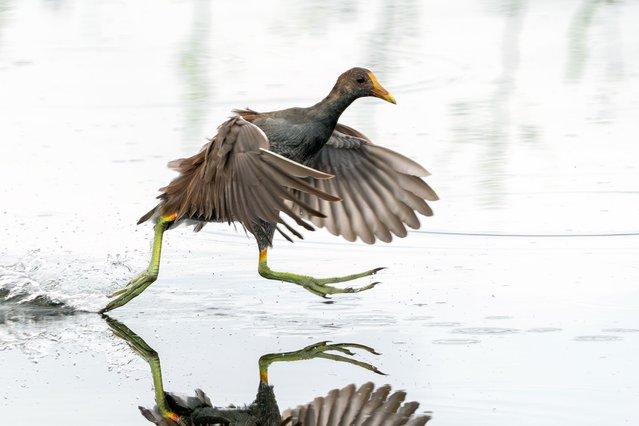
A common gallinule runs across the water to escape a nearby alligator at Green Cay Nature Center in Boynton Beach, Florida on September 4, 2025. Unlike most waterbirds, gallinules have long toes that allow them to walk on floating vegetation. The species is known for its loud, cackling calls that often echo through wetlands. (Photo by Ronen Tivony/NurPhoto/Rex Features/Shutterstock)
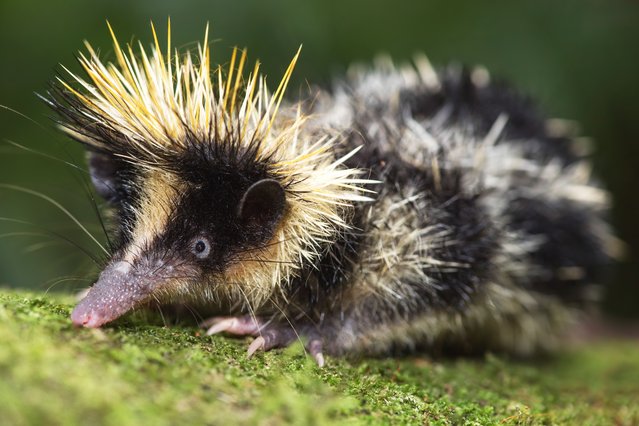
This spiky tenrec was spotted in Madagascar’s Mantadia National Park in the last decade of September 2025. Mostly nocturnal and rarely seen, it puffs out its spines when threatened. Spiky tenrecs are excellent swimmers — unlike most spiny mammals, some species of tenrec can forage in streams and rivers, using their spines for protection while hunting aquatic insects and small prey. (Photo by Dale Morris/Solent News & Photo Agency)
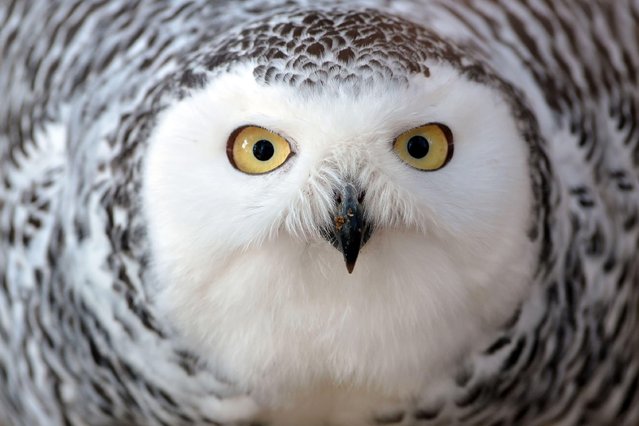
A snowy owl (Bubo scandiacus) raised by a falconer as part of a captive-breeding program, pictured in its enclosure in Vysocina, Czech Republic on October 22, 2025. (Photo by Slavek Ruta/ZUMA Press Wire via Alamy Live News)
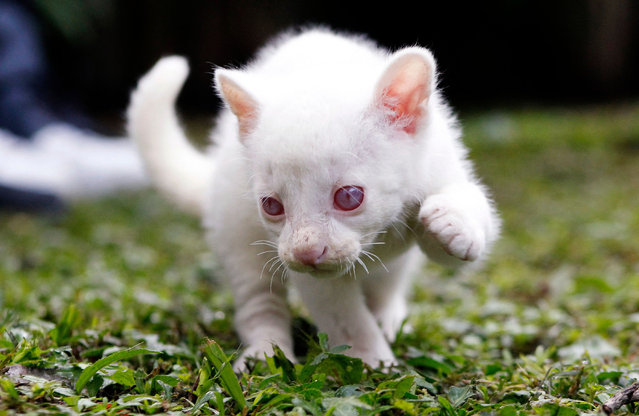
An alleged albino cub of Jaguarundi (Herpailurus yagouaroundi) plays at the Conservation Park in Medellin, Colombia, on December 23, 2021. According to environmentalists of the Conservation Park of Medellin, the little Jaguarundi will have to live in captivity as its albinism prevents it to hunt, camouflage, and protect itself from predators in the wild. (Photo by Fredy Builes/AFP Photo)
A girl carries sorghum stalks during the sorghum harvest season in Amran province, Yemen, October 24, 2020. (Photo by Xinhua News Agency/Rex Features/Shutterstock)
A woman clatters pans to make noise after calls for protest went out on social media in Yangon on February 3, 2021, as Myanmar's ousted leader Aung San Suu Kyi was formally charged on Wednesday two days after she was detained in a military coup. (Photo by AFP Photo/Stringer)
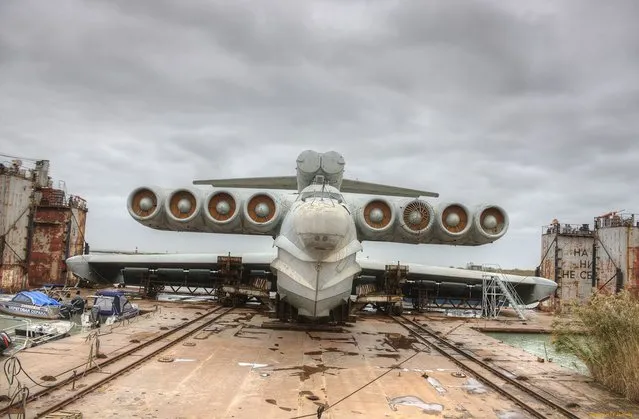
“The Lun-class ekranoplan (NATO reporting name Duck) was a ground effect vehicle (GEV) designed by Rostislav Evgenievich Alexeev and used by the Soviet and Russian navies from 1987 until sometime in the late 1990s. It “flew” using the lift generated by the ground effect of its large wings when close to the surface of the water – about four metres or less. Although they might look similar and/or have related technical characteristics, ekranoplans like the Lun are not aircraft, seaplanes, hovercraft, or hydrofoils – ground effect is a separate technology altogether. The International Maritime Organization classifies these vehicles as maritime ships. The name Lun comes from the Russian for harrier”. – Wikipedia (Photo by Igor113)