Loading...
Done


A broken picture frame is left in the tsunami-hit Arahama area, three months and two days after the magnitude 9.0 earthquake and subsequent tsunami on June 13, 2011 in Sendai, Miyagi, Japan. Japanese government has been struggling to deal with the earthquake and tsunami as well as the troubled Fukushima Daiichi Nuclear Power Plant. The fear on outbreak of virus infectious disease are mounting due to the humid rainy season on the corner and delay of the clearing the debris. (Photo by Kiyoshi Ota/Getty Images)
Details
14 Jun 2011 09:23:00
It’s Not What It Seems By Artist Hikaru Cho

Japanese artist Hikaru Cho is already well-known for her bizarre and realistic body paintings, but now the Tokyo-based artist has applied her talent to everyday food items as well. In her playful “It’s Not What It Seems” series, she turns common foods into other kinds of food using only acrylic paint and her extraordinary talent.
Details
22 Mar 2014 11:32:00


The name Danbo is a pun on the Japanese word for corrugated cardboard “danboru” (ダンボー). There’s also a company in Japan which makes cardboard boxes which has Danbooru in its name.
Details
08 May 2012 02:28:00
Floating Vases By ooDesign

This vase is simple as a piece of cake but it’s so special at the same time – it’s Floating Ripple vase by ooDesign. It’s a piece manufactured in glass that allows any transparent vase to look like ripples in water.
Long-stemmed flowers float vertically in the water and according to the movement of the air, they change their position within the container – so, what can I say? Japanese designers continue to create genially simple and natural-looking philosophic pieces that inspire everybody.
Details
14 Jun 2015 08:58:00


Rina Sawayama – XS (Official Video). Rina Sawayama is a Japanese-British singer, songwriter and model. Born in Niigata, she was raised from a young age in London, where she currently resides. Her debut extended play, Rina, was released in 2017, before her debut studio album, Sawayama, was released on 17 April 2020.
Details
28 Jul 2020 00:03:00
A performer wearing a lion mask performs the Ise Daikagura lion dance at the remote village of Yamanawa on February 08, 2021 in Ryuo, Japan. Ise Daikagura is a group of traditional Lion Dance performers who pray in front of farmers houses and businesses for good grain harvests and disease-free lives. Performers play sacred music using drums and flutes with two lion mask dancers. A lion mask is considered a symbol of God, who enters the house and performs in front of the Shinto God, a statue placed inside the house, mostly in the kitchen. These prayers are called “Kamodo Barai”. After the prayers, they are gifted with money, rice, sake and Japanese sweets from the householders. A group can travel for more than one hundred days to thousands of households and businesses throughout rural-villages in western Japan, and pray to those who are unable to visit the country’s most sacred shrine, the Grand Ise Shrine in Mie Prefecture. The group started its performance in the Edo era between 1603 to 1868 according to Japanese history. The Japanese government designated it as an important folk cultural national property in 1981. (Photo by Buddhika Weerasinghe/Getty Images)

A performer wearing a lion mask performs the Ise Daikagura lion dance at the remote village of Yamanawa on February 08, 2021 in Ryuo, Japan. Ise Daikagura is a group of traditional Lion Dance performers who pray in front of farmers houses and businesses for good grain harvests and disease-free lives. (Photo by Buddhika Weerasinghe/Getty Images)
Details
18 Feb 2021 09:27:00
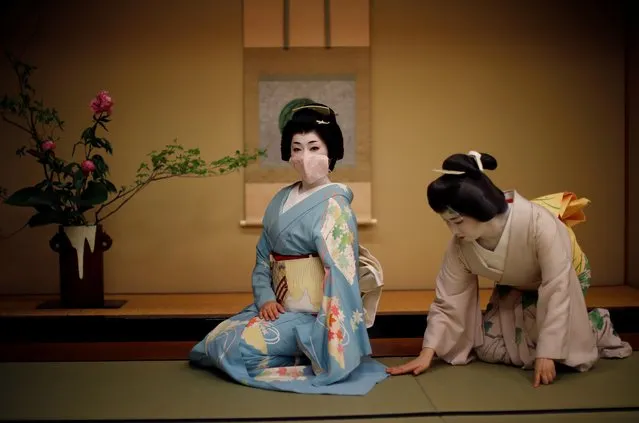
Mayu adjusts Koiku’s kimono, as Koiku wears a protective face mask while posing for a photograph, before they work at a party where they will entertain with other geisha at Japanese luxury restaurant Asada in Tokyo, Japan, June 23, 2020. The coronavirus pandemic has made Tokyo's geisha fear for their centuries-old profession as never before. Though the number of geisha - famed for their witty conversation, beauty and skill at traditional arts - has been falling for years, they were without work for months due to Japan's state of emergency and now operate under awkward social distancing rules. Engagements are down 95 percent, and come with new rules: no pouring drinks for customers or touching them even to shake hands, and sitting 2 meters apart. Masks are hard to wear with their elaborate wigs, so they mostly don't. “I was just full of anxiety”, said Mayu, 47. “I went through my photos, sorted my kimonos ... The thought of a second wave is terrifying”. (Photo by Kim Kyung-Hoon/Reuters)

Mayu adjusts Koiku’s kimono, as Koiku wears a protective face mask while posing for a photograph, before they work at a party where they will entertain with other geisha at Japanese luxury restaurant Asada in Tokyo, Japan, June 23, 2020. (Photo by Kim Kyung-Hoon/Reuters)
Details
23 Jul 2020 00:03:00
 Paper Anatomy By Lisa Nilsson

These pieces are made of Japanese mulberry paper and the gilded edges of old books. They are constructed by a technique of rolling and shaping narrow strips of paper called quilling or paper filigree. Quilling was first practiced by Renaissance nuns and monks who are said to have made artistic use of the gilded edges of worn out bibles, and later by 18th century ladies who made artistic use of lots of free time. I find quilling exquisitely satisfying for rendering the densely squished and lovely internal landscape of the human body in cross section.
Details
14 Apr 2013 11:07:00