Loading...
Done
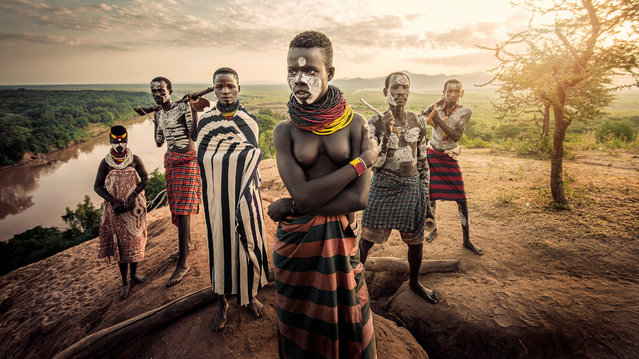
“People of the River”. This is a Karo tribe family; father, mother, two sisters and two brothers. The tribe, who live along the Omo River in east Africa, incorporate rich symbolism into their rituals by using ornate body art, headdresses and body scarification to express beauty and significance. (Photo by Jatenipat Ketpradit/International Portrait Photographer of the Year)

“People of the River”. This is a Karo tribe family; father, mother, two sisters and two brothers. The tribe, who live along the Omo River in east Africa, incorporate rich symbolism into their rituals by using ornate body art, headdresses and body scarification to express beauty and significance. (Photo by Jatenipat Ketpradit/International Portrait Photographer of the Year)
Details
04 Jul 2021 09:39:00
In this October 6, 2018, photo, a craftsman makes daggers or “Jambiyya” in Yemeni Arabic, made out of remains of missiles, at his workshop, in Hajjah, Yemen. (Photo by Hammadi Issa/AP Photo)

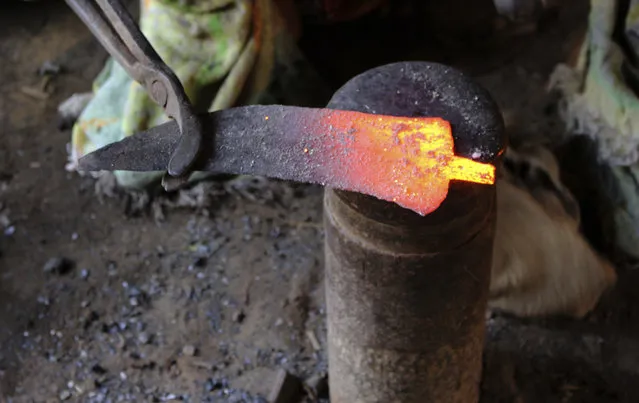
In this October 6, 2018, photo, a craftsman makes daggers or “Jambiyya” in Yemeni Arabic, made out of remains of missiles, at his workshop, in Hajjah, Yemen. Missiles raining on Yemen from the jets of the Saudi-led coalition fighting Houthi rebels are killing thousands of civilians and militiamen alike, but amid crashing economy, some Yemenis see the bright side of it: they make daggers out of the fragments of the missiles for ordinary men traditionally wear for prestige and a show of courage. (Photo by Hammadi Issa/AP Photo)
Details
10 Oct 2018 00:01:00
Pets get ready before running a mini-marathon for dogs in Bangkok, Thailand May 7, 2017. (Photo by Jorge Silva/Reuters)

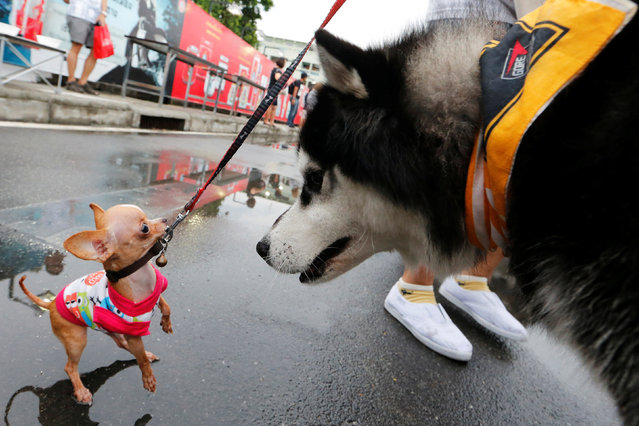
Pets get ready before running a mini-marathon for dogs in Bangkok, Thailand May 7, 2017. From tiny chihuahuas to 60 kg (130 lb) mastiffs, hundreds of dogs and their owners jogged through a Bangkok park on Sunday to raise money for charity. (Photo by Jorge Silva/Reuters)
Details
08 May 2017 08:23:00
This picture taken on May 23, 2017 shows visitors posing for photos along a path at an Indonesian hamlet dubbed “the rainbow village” in Semarang, central Java, that has become an internet sensation and attracting hordes of visitors. (Photo by Suryo Wibowo/AFP Photo)

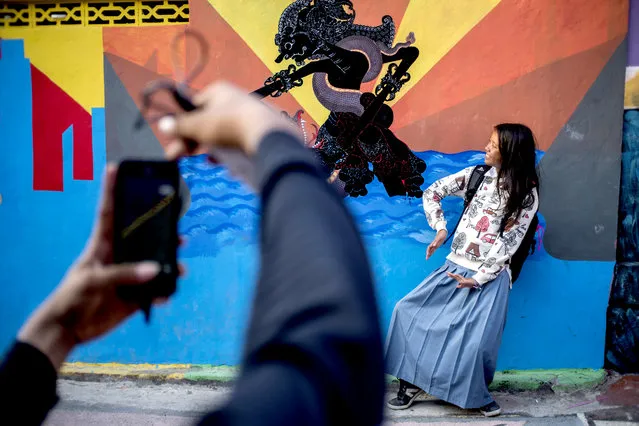
This picture taken on May 23, 2017 shows visitors posing for photos along a path at an Indonesian hamlet dubbed “the rainbow village” in Semarang, central Java, that has become an internet sensation and attracting hordes of visitors. (Photo by Suryo Wibowo/AFP Photo)
Details
03 Jun 2017 06:26:00


“Chameleons (family Chamaeleonidae) are a distinctive and highly specialized clade of lizards. They are distinguished by their parrot-like zygodactylous feet, their separately mobile and stereoscopic eyes, their very long, highly modified, and rapidly extrudable tongues, their swaying gait, the possession by many of a prehensile tail, crests or horns on their distinctively shaped heads, and the ability of some to change color. Uniquely adapted for climbing and visual hunting, the approximately 160 species of chameleon range from Africa, Madagascar, Spain and Portugal, across south Asia, to Sri Lanka, have been introduced to Hawaii, California and Florida, and are found in warm habitats that vary from rain forest to desert conditions”. – Wikipedia

Photo: A woman with the latest fashion accessory, a chameleon. (Photo by Fox Photos/Getty Images). Circa 1926

Details
20 Mar 2011 15:45:00
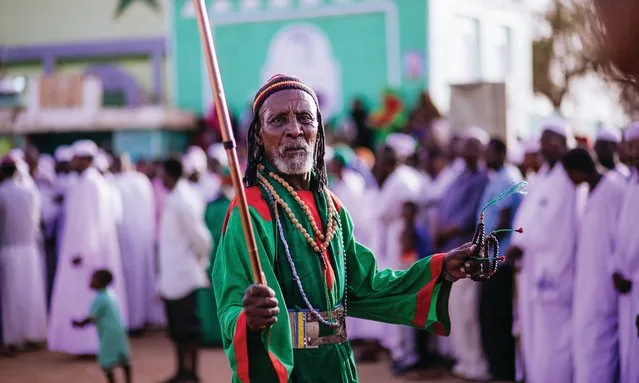
In Omdurman, the largest city in Sudan, the Qadiriyya Sufi order meets every Friday outside Sheikh Hamed Al Nil mosque, which houses the tomb of their 19th century Sufi leader. (Photo by Ala Kheir, John Burns and Ibrahim Algrefwi/Brownbook)

In Omdurman, the largest city in Sudan, the Qadiriyya Sufi order meets every Friday outside Sheikh Hamed Al Nil mosque, which houses the tomb of their 19th century Sufi leader. (Photo by Ala Kheir, John Burns and Ibrahim Algrefwi/Brownbook)
Details
21 Feb 2016 11:47:00
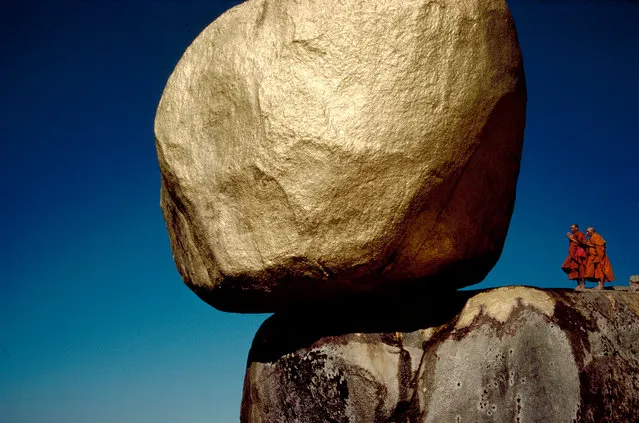
Kyaiktiyo, Burma, 1978. The Golden Rock at Shwe Pyi Daw (the Golden Country), the Buddhist holy place. Hiroji Kubota writes: “I was desperate to keep a distance from America for a while; luckily, I found Burma and its gentle and compassionate people. In the spring of 1978, on the top of the hill where I took this photo, I had two Leica bodies: the one with Tri-X and the other with Kodachrome 64. Soon after, I realised that the colour one looked very colourful and was more powerful. That was my decisive moment, to become a colour photographer”. (Photo by Hiroji Kubota/Magnum Photos)

Kyaiktiyo, Burma, 1978. The Golden Rock at Shwe Pyi Daw (the Golden Country), the Buddhist holy place. Hiroji Kubota writes: “I was desperate to keep a distance from America for a while; luckily, I found Burma and its gentle and compassionate people. In the spring of 1978, on the top of the hill where I took this photo, I had two Leica bodies: the one with Tri-X and the other with Kodachrome 64. Soon after, I realised that the colour one looked very colourful and was more powerful. That was my decisive moment, to become a colour photographer”. (Photo by Hiroji Kubota/Magnum Photos)
Details
10 Jun 2016 13:30:00
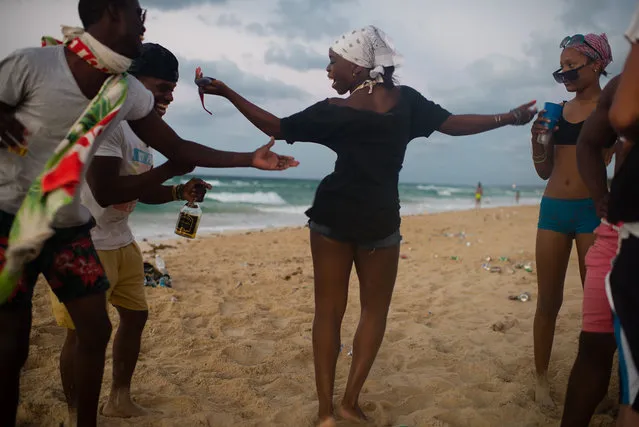
Yanelis Blanco, 24, center, dances with a group of friends at Santa Maria beach, about 15 miles from Havana. It is the closest beach to Havana. Others, from left to right are Jackson Miranda, 21, Dayan Suarez, 24, and Melisa Oliva, 15. The men in the group have a rap group together. The government is demolishing buildings all over the coast of East Havana and recovering and restoring beach dunes. (Photo by Sarah L. Voisin/The Washington Post)

Yanelis Blanco, 24, center, dances with a group of friends at Santa Maria beach, about 15 miles from Havana. It is the closest beach to Havana. Others, from left to right are Jackson Miranda, 21, Dayan Suarez, 24, and Melisa Oliva, 15. The men in the group have a rap group together. The government is demolishing buildings all over the coast of East Havana and recovering and restoring beach dunes. (Photo by Sarah L. Voisin/The Washington Post)
Details
04 Oct 2015 08:05:00