Loading...
Done
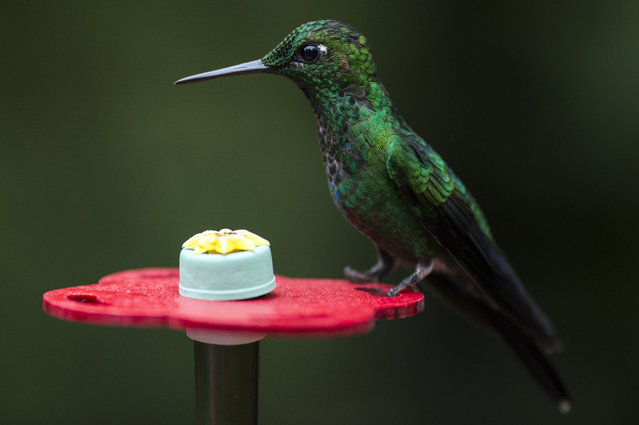
A Green Crowned Brilliant is pictured at a Hummingbird feeding station on January 15, 2016 in Alajuela Costa Rica. (Photo by Dan Kitwood/Getty Images)

A Green Crowned Brilliant is pictured at a Hummingbird feeding station on January 15, 2016 in Alajuela Costa Rica. Of the 338 known species of Hummingbird worldwide there are around 50 in Costa Rica. Hummingbirds are named for the distinctive sound made by their tiny beating wings, and are admired for their vibrantly coloured iridescent plumage. Their ability to hover, with wings beating between 12 and 90 times a second, and to fly backwards makes them different from all other birds. (Photo by Dan Kitwood/Getty Images)
Details
05 Feb 2016 10:45:00
A participant from Indonesia waits to perform a dance during the last day of World Culture Festival on the banks of the river Yamuna in New Delhi, India, March 13, 2016. (Photo by Adnan Abidi/Reuters)

A participant from Indonesia waits to perform a dance during the last day of World Culture Festival on the banks of the river Yamuna in New Delhi, India, March 13, 2016. The festival opened on the banks of the Yamuna River in the Indian capital Friday despite concerns the sprawling construction of roads, ramps and pontoon bridges would irreparably damage the river's floodplains. (Photo by Adnan Abidi/Reuters)
Details
14 Mar 2016 11:07:00
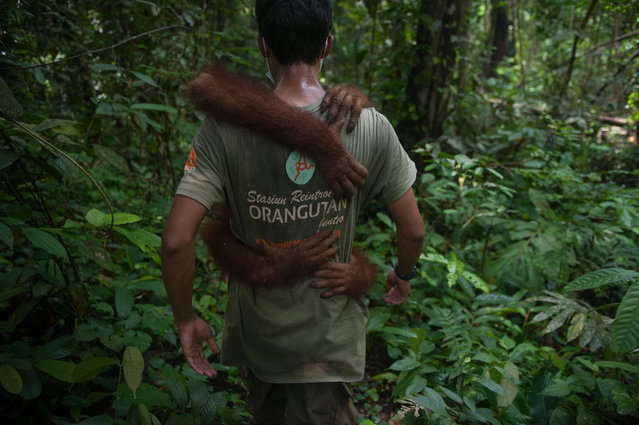
Leo, an orphaned Sumatran orangutan, is taken to the Sumatran Orangutan Conservation Programme rehabilitation centre. Leo will join other orangutans who have been reintroduced to the Pinus Jantho nature reserve. The SOCP has gradually formed a completely new wild population of species that have been threatened with extinction. (Photo by Sutanta Aditya/Barcroft Images)

Leo, an orphaned Sumatran orangutan, is taken to the Sumatran Orangutan Conservation Programme rehabilitation centre. Leo will join other orangutans who have been reintroduced to the Pinus Jantho nature reserve. The SOCP has gradually formed a completely new wild population of species that have been threatened with extinction. (Photo by Sutanta Aditya/Barcroft Images)
Details
10 Aug 2019 00:03:00
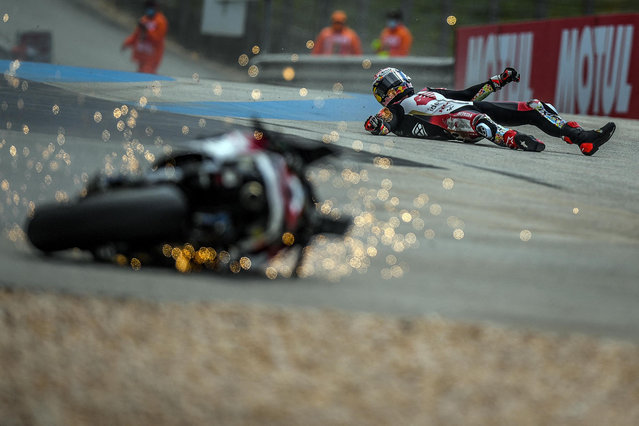
LCR Honda IDEMITSU's Japanese rider Takaaki Nakagami crashes in the second MotoGP free practice session of the Portuguese Grand Prix at the Algarve International Circuit in Portimao, on April 16, 2021. (Photo by Patricia de Melo Moreira/AFP Photo)

LCR Honda IDEMITSU's Japanese rider Takaaki Nakagami crashes in the second MotoGP free practice session of the Portuguese Grand Prix at the Algarve International Circuit in Portimao, on April 16, 2021. (Photo by Patricia de Melo Moreira/AFP Photo)
Details
26 Apr 2021 09:10:00


“Rudolf Khametovich Nureyev was a Russian Tatar dancer from the former Soviet Union, primarily known for his work in ballet. Nureyev's artistic skills explored expressive areas of the dance, providing a new role to the male ballet dancer who once served only as support to the women. He defected to the West, despite KGB efforts to stop him. According to KGB archives studied by Peter Watson, Nikita Khrushchev personally signed an order to have Nureyev killed”.

Photo: British ballerina Margot Fonteyn (Margaret Hookham) (1919 – 1991) and her professional partner during his tenure with the Royal Ballet Rudolf Nureyev. (Photo by Potter/Express/Getty Images). 12th December 1965. (Photo by Central Press/Getty Images)
Details
16 Mar 2011 09:10:00
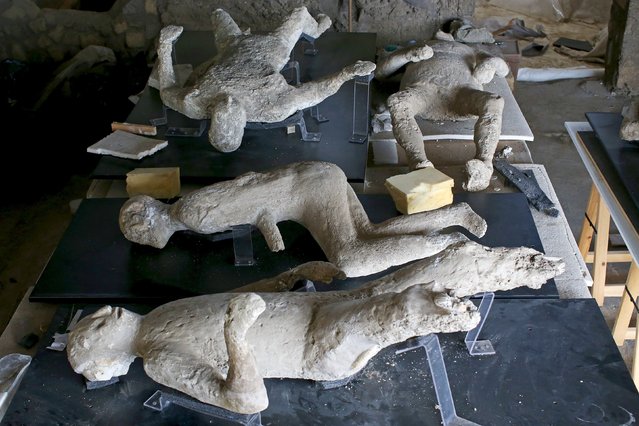
Plaster cast moulds of victims of the Mount Vesuvius eruption lie on a display table in a laboratory at Pompeii October 13, 2015. An expert team made up of archaeologists, radiologists, orthodontists and anthropologists began on September 2015 to use CAT scan technology (computerised axial tomography) to peer inside the plaster cast moulds of Pompeii's victims, in a study that has added more detail to previous findings. (Photo by Alessandro Bianchi/Reuters)

Plaster cast moulds of victims of the Mount Vesuvius eruption lie on a display table in a laboratory at Pompeii October 13, 2015. An expert team made up of archaeologists, radiologists, orthodontists and anthropologists began on September 2015 to use CAT scan technology (computerised axial tomography) to peer inside the plaster cast moulds of Pompeii's victims, in a study that has added more detail to previous findings. A 16-layer scan had to be used in order to penetrate the hardened plaster but the results showed up impressive skeletal remains and near perfect teeth. (Photo by Alessandro Bianchi/Reuters)
Details
22 Oct 2015 08:02:00
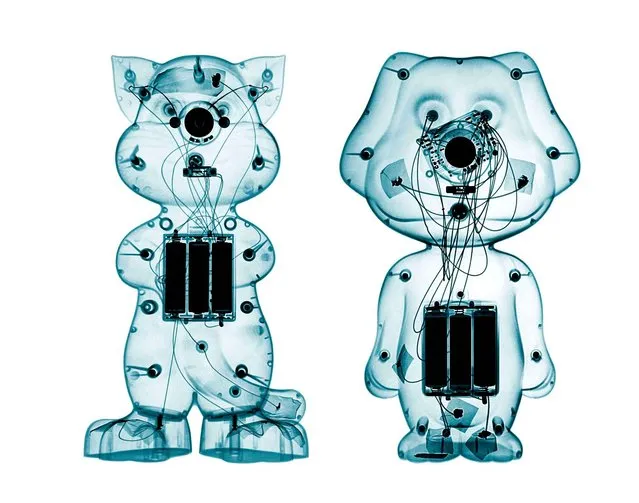
Australian photographer Brendan Fitzpatrick’s X-ray photographs expose the inner workings of toys. Fitzpatrick’s photographs are both whimsical and mechanical, evoking the curiosity of childhood and the desire to discover how things look and work from other perspectives. (Photo by Brendan Fitzpatrick)

Australian photographer Brendan Fitzpatrick’s X-ray photographs expose the inner workings of toys. Fitzpatrick’s photographs are both whimsical and mechanical, evoking the curiosity of childhood and the desire to discover how things look and work from other perspectives. The strategic placement of wires, batteries, and screws are revealed, the complexity of the inside contrasting with the seemingly simplistic design of the outside. Fitzpatrick uses chest X-ray and mammogram machines to photograph flowers, toys, and creatures, then enhances the color in the images in order to more effectively distinguish the various parts that have been exposed. This photographs are part of series he calls “Invisible Light”. (Photo by Brendan Fitzpatrick)
Details
08 Aug 2014 10:59:00
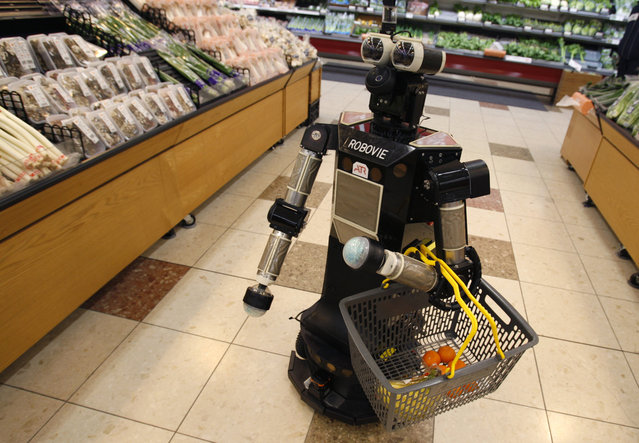
A robot named “Robovie-II”, developed by Japanese robotics research institution ATR, moves around at a grocery store during a shopping assisting experiment by utilizing the robot in an ubiquitous network technology platform in Kyoto, western Japan January 6, 2010. The robot greets the shopper at the entrance of the store, follows him to the shelves while holding a grocery basket and reminds him of the items on a shopping list, which the shopper would have entered beforehand in a specialized mobile device. The experiment is aimed to gather data in order to provide livelihood support for the elderly by using robots and network technologies, ATR's researcher Satoshi Koizumi said. (Photo by Yuriko Nakao/Reuters)

A robot named “Robovie-II”, developed by Japanese robotics research institution ATR, moves around at a grocery store during a shopping assisting experiment by utilizing the robot in an ubiquitous network technology platform in Kyoto, western Japan January 6, 2010. (Photo by Yuriko Nakao/Reuters)
Details
02 Feb 2018 06:54:00