Loading...
Done
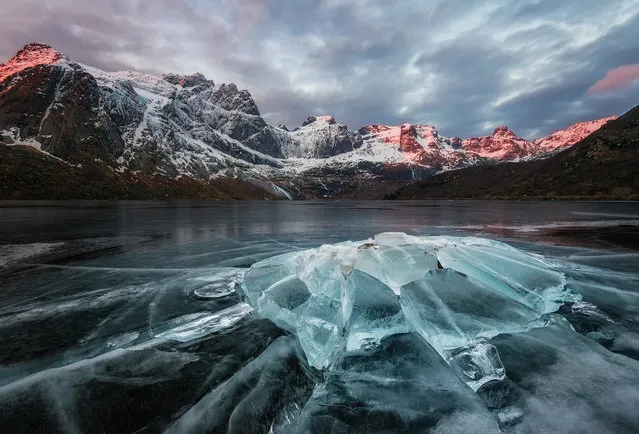
“Lofoten Glow”. I was desperately searching a good sunrise spot this particular morning. Normally Storvatnet Lake is completely covered in snow, so you can only imagine my surprise when I saw these crazy ice formations almost being shot out of the frozen lake. I put my crampons on and took a big risk walking out. Photo location: Storvatnet, Lofoten Islands in Northern Norway. (Photo and caption by Stian Klo/National Geographic Photo Contest)

“Lofoten Glow”. I was desperately searching a good sunrise spot this particular morning. Normally Storvatnet Lake is completely covered in snow, so you can only imagine my surprise when I saw these crazy ice formations almost being shot out of the frozen lake. I put my crampons on and took a big risk walking out. I could hear the ice cracking underneath my feet, and when you’re all alone in a fjord/canyon like this – the cracks are echoed and sound really frightening. Was it worth it? I sure think so! Photo location: Storvatnet, Lofoten Islands in Northern Norway. (Photo and caption by Stian Klo/National Geographic Photo Contest)
Details
08 Apr 2014 09:40:00
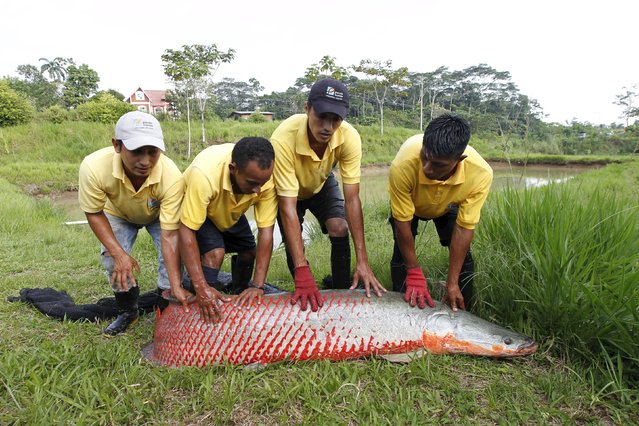
Workers hold an 80 Kg Paiche (Arapaima gigas) to return it to a pool at a breeding farm in Nueva Loja, Ecuador, March 25, 2016. (Photo by Guillermo Granja/Reuters)

Workers hold an 80 Kg Paiche (Arapaima gigas) to return it to a pool at a breeding farm in Nueva Loja, Ecuador, March 25, 2016. (Photo by Guillermo Granja/Reuters)
Details
27 Mar 2016 12:35:00
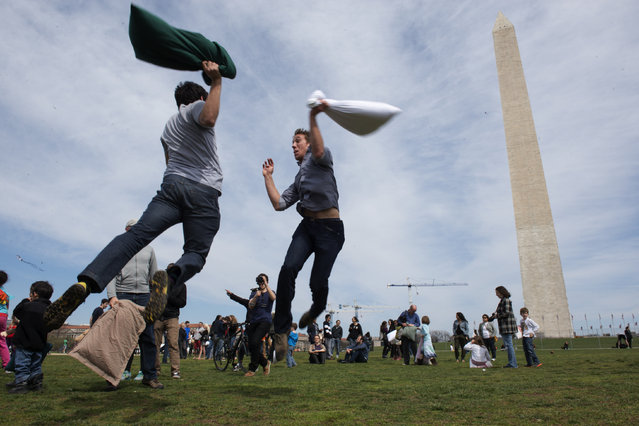
Alex Plunkett, left, and Sean Hart, both of Arlington, Va., join hundreds participating in the annual International Pillow Fight Day on April 5. Massive pillow fights broke out on the Mall in Washington and in cities around the world. (Photo by Marvin Joseph/The Washington Post)

Alex Plunkett, left, and Sean Hart, both of Arlington, Va., join hundreds participating in the annual International Pillow Fight Day on April 5. Massive pillow fights broke out on the Mall in Washington and in cities around the world. (Photo by Marvin Joseph/The Washington Post)
Details
28 Dec 2014 10:39:00
Model feebee poses as part of art installation “Dazzle room” made by artist Shigeki Matsuyama at Room 32 fashion and design exhibition in Tokyo, Friday, February 19, 2016. Matsuyama's installation features a strong contrast of black and white, which he learned from dazzle camouflage used mainly in World War I, in Tokyo, Friday, Feb. 19, 2016. (Photo by Shuji Kajiyama/AP Photo)

Model feebee poses as part of art installation “Dazzle room” made by artist Shigeki Matsuyama at Room 32 fashion and design exhibition in Tokyo, Friday, February 19, 2016. Matsuyama's installation features a strong contrast of black and white, which he learned from dazzle camouflage used mainly in World War I, in Tokyo, Friday, Feb. 19, 2016. (Photo by Shuji Kajiyama/AP Photo)
Details
20 Feb 2016 10:55:00
Artist Kong Ning wears a wedding dress made from respirators to highlight concerns about air quality and pollution in Beijing, China on December 1, 2015. (Photo by Luo Xiaoguang/Xinhua Press/Corbis)

Artist Kong Ning wears a wedding dress made from respirators to highlight concerns about air quality and pollution in Beijing, China on December 1, 2015. (Photo by Luo Xiaoguang/Xinhua Press/Corbis)
Details
03 Dec 2015 08:02:00
Galapagos – Rocking the Cradle: Four major ocean currents converge along the Galapagos archipelago, creating the conditions for an extraordinary diversity of animal life, April 25, 2016. The islands are home to at least 7,000 flora and fauna species, of which 97 percent of the reptiles, 80 percent of the land birds, 50 percent of the insects and 30 percent of the plants are endemic. The local ecosystem is highly sensitive to the changes in temperature, rainfall and ocean currents that characterize the climatic events known as El Niño and La Niña. These changes cause marked fluctuations in weather and food availability. Many scientists expect the frequency of El Niño and La Niña to increase as a result of climate change, making the Galapagos a possible early-warning location for its effects. (Photo by Thomas P. Peschak for National Geographic/World Press Photo)

Galapagos – Rocking the Cradle: Four major ocean currents converge along the Galapagos archipelago, creating the conditions for an extraordinary diversity of animal life, April 25, 2016. The islands are home to at least 7,000 flora and fauna species, of which 97 percent of the reptiles, 80 percent of the land birds, 50 percent of the insects and 30 percent of the plants are endemic. (Photo by Thomas P. Peschak for National Geographic/World Press Photo)
Details
16 Apr 2018 00:01:00
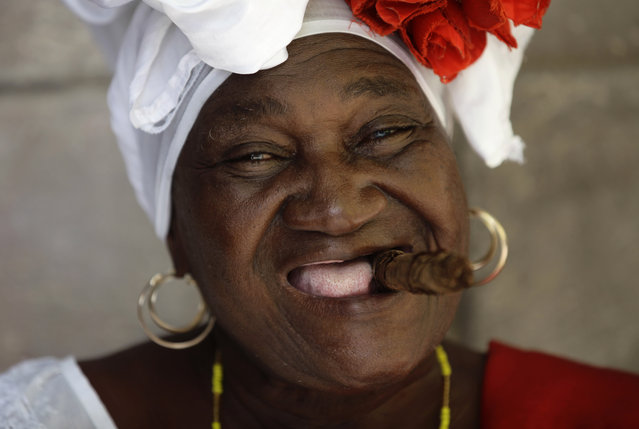
Street entertainer and fortune teller “Juana La Cubana” smiles holding a cigar in her mouth as she waits for tourists in Havana, Cuba, Sunday, May 24, 2015. Juana is 72 years old and has worked in the Cathedral square in Old Havana for 28 years. (Photo by Desmond Boylan/AP Photo)

Street entertainer and fortune teller “Juana La Cubana” smiles holding a cigar in her mouth as she waits for tourists in Havana, Cuba, Sunday, May 24, 2015. Juana is 72 years old and has worked in the Cathedral square in Old Havana for 28 years. (Photo by Desmond Boylan/AP Photo)
Details
07 Aug 2015 10:53:00
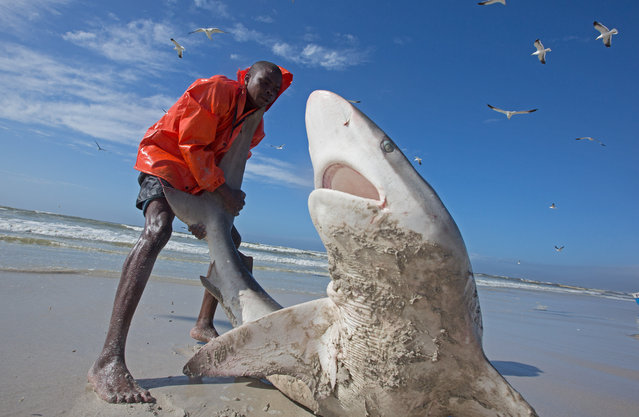
Bronze whaler shark (Carcharhinus brachyurus), caught in traditional seine net and released by fisherman, Muizenberg beach, Cape Town, South Africa on October 11, 2016. Action shots have captured fishermen trying to free a potentially deadly Bronze Whaler shark who was caught in their nets. The incredible images show the eight-foot-long 500-pound predator lunging its mouth towards the fishermen who are desperately trying to pull it back into the safety of the sea by its tail. Eventually they succeeded. (Photo by Chris and Monique Fallows/NPL)

Bronze whaler shark (Carcharhinus brachyurus), caught in traditional seine net and released by fisherman, Muizenberg beach, Cape Town, South Africa on October 11, 2016. Action shots have captured fishermen trying to free a potentially deadly Bronze Whaler shark who was caught in their nets. The incredible images show the eight-foot-long 500-pound predator lunging its mouth towards the fishermen who are desperately trying to pull it back into the safety of the sea by its tail. Eventually they succeeded. (Photo by Chris and Monique Fallows/NPL)
Details
13 Oct 2016 11:51:00