Loading...
Done
Javanese people pray before rituals night carnival “1st Suro” (Javanese calender) during  Islamic New Year celebrations at Kasunanan Palace on November 14, 2012 in Solo City, Central Java, Indonesia. Javanese will celebrate the national holiday with ceremonies and rituals marking the 1434th Islamic New Year's Eve or “1st Suro”. The parade started from Keraton Kasunanan and is headed by a group of albino buffaloes, known as Kebo Bule. Local people believe that the parade of Heirlooms and Kebo Bule will bring them a better life. (Photo by Ulet Ifansasti)

Javanese people pray before rituals night carnival “1st Suro” (Javanese calender) during Islamic New Year celebrations at Kasunanan Palace on November 14, 2012 in Solo City, Central Java, Indonesia. Javanese will celebrate the national holiday with ceremonies and rituals marking the 1434th Islamic New Year's Eve or “1st Suro”. The parade started from Keraton Kasunanan and is headed by a group of albino buffaloes, known as Kebo Bule. Local people believe that the parade of Heirlooms and Kebo Bule will bring them a better life. (Photo by Ulet Ifansasti)
Details
16 Nov 2012 07:37:00
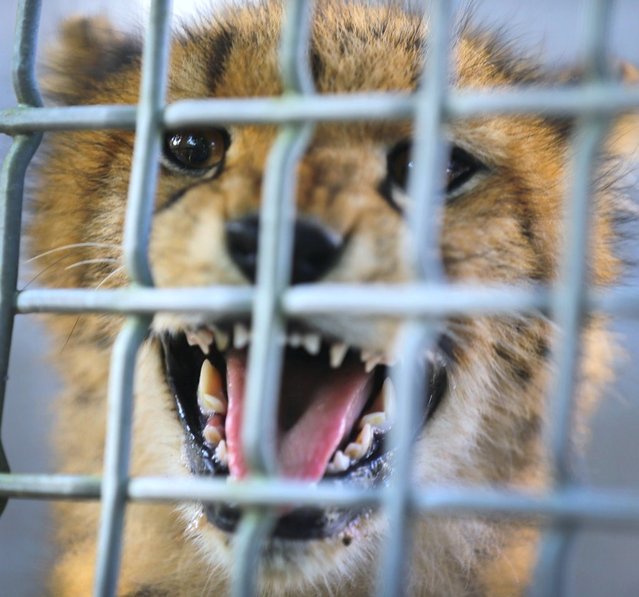
One of two 9-month old Cheetahs is seen after it was released into a quarantine facility at Zoo Miami on November 29, 2012 in Miami, Florida. The two sub-adult brothers who arrived today were captive-born on March 6th of this year at the Ann van Dyk Cheetah Centre just outside of Pretoria, South Africa. (Photo by Joe Raedle)

One of two 9-month old Cheetahs is seen after it was released into a quarantine facility at Zoo Miami on November 29, 2012 in Miami, Florida. The two sub-adult brothers who arrived today were captive-born on March 6th of this year at the Ann van Dyk Cheetah Centre just outside of Pretoria, South Africa. The Cheetahs, after being monitored and examined for a minimum of 30 days to insure that they are healthy and stable, will be featured in Zoo Miami's Wildlife Show at the newly constructed amphitheater and will continue the work of Zoo Miami's Cheetah Ambassador Program by making appearances off Zoo grounds at a variety of venues including schools and civic organizations. (Photo by Joe Raedle)
Details
30 Nov 2012 11:54:00


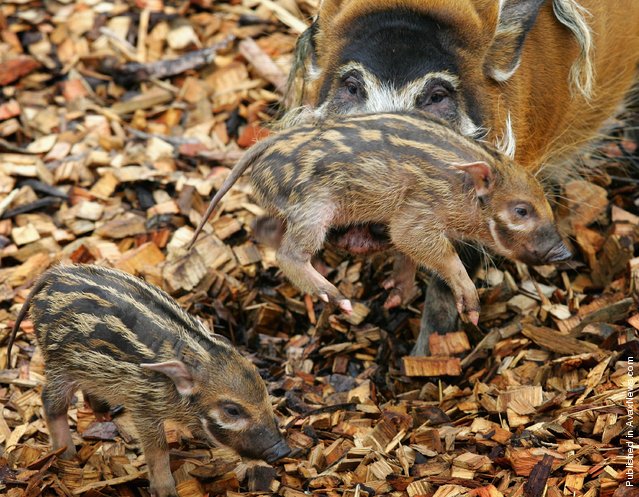
“The Red River Hog (Potamochoerus porcus), also known as the Bush Pig (but not to be confused with P. larvatus, common name “Bushpig”), is a wild member of the pig family living in Africa, with most of its distribution in the Guinean and Congolian forests. It is rarely seen away from rainforests, and generally prefers areas near rivers or swamps.

Red River Hogs eat grass, berries, roots, insects, molluscs, small vertebrates and carrion. They are capable of causing damage to plantations. Red River Hogs typically live in herds of 6-20 members led by a dominant boar. Sows rear 3-6 piglets at a time.”

Photo: Two 17 day old red river hoglet twins forage for food next to their mother Bahiti at London Zoo on August 23, 2007 in London, England. Red River hoglets inhabit the forests and swamps of West and Central Africa. The recent additions to the London Zoo pig pen have been eagerly awaited by zoo keepers. (Photo by Chris Jackson/Getty Images)
Details
18 Mar 2011 15:15:00


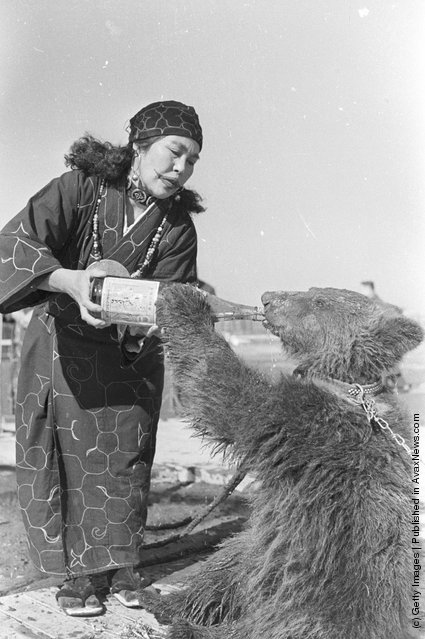
“The Ainu (アイヌ?), also called Aynu, Aino (アイノ), and in historical texts Ezo (蝦夷), are indigenous people or groups in Japan and Russia. Historically they spoke the Ainu language and related varieties and lived in Hokkaidō, the Kuril Islands, and much of Sakhalin. Most of those who identify themselves as Ainu still live in this same region, though the exact number of living Ainu is unknown. This is due to ethnic issues in Japan resulting in those with Ainu backgrounds hiding their identities and confusion over mixed heritages. In Japan, because of intermarriage over many years with Japanese, the concept of a 'pure Ainu' ethnic group is no longer feasible. Official estimates of the population are of around 25,000, while the unofficial number is upwards of 200,000 people”. – Wkipedia

Photo: A captive bear drinking from a large bottle held by an Ainu tribeswoman. (Photo by Evans/Three Lions/Getty Images). Circa 1955
Details
24 Mar 2011 14:01:00


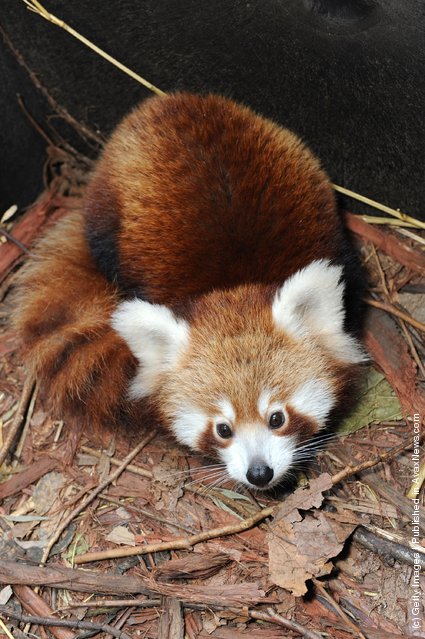
“The red panda (Ailurus fulgens, or shining-cat), is a small arboreal mammal native to the eastern Himalayas and southwestern China. It is the only species of the genus Ailurus. Slightly larger than a domestic cat, it has reddish-brown fur, a long, shaggy tail, and a waddling gait due to its shorter front legs. It feeds mainly on bamboo, but is omnivorous and may also eat eggs, birds, insects, and small mammals. It is a solitary animal, mainly active from dusk to dawn, and is largely sedentary during the day”. – Wikipedia

Photo: In this handout image provided by Taronga Zoo, Seba, a baby Red Panda, explores his new home at Taronga Zoo on April 7, 2011 in Sydney, Australia. The Red Panda cub was born at Christmas and is the 45th to be born at the zoo since 1977. (Photo by Peter Hardin/Taronga Zoo via Getty Images)
Details
07 Apr 2011 08:51:00


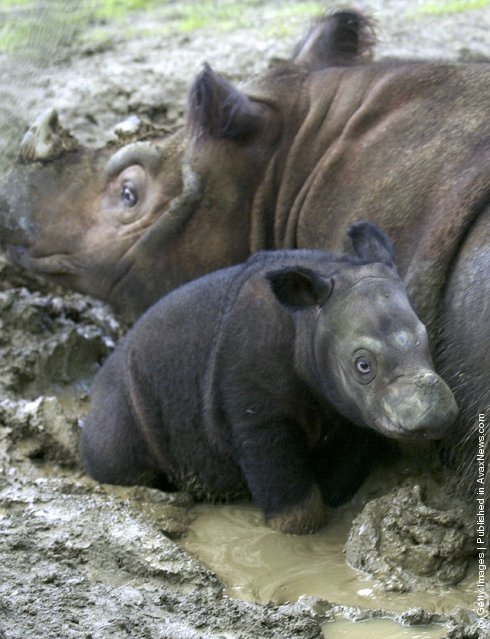
“The Sumatran Rhinoceros (Dicerorhinus sumatrensis) is a member of the family Rhinocerotidae and one of five extant rhinoceroses. It is the only extant species of the genus Dicerorhinus. It is the smallest rhinoceros, standing about 120–145 centimetres (3.9–4.76 ft) high at the shoulder, with a body length of 250 centimetres (8.2 ft) and weight of 500–800 kilograms (1,100–1,800 lb). Like the African species, it has two horns; the larger is the nasal horn, typically 15–25 centimetres (5.9–9.8 in), while the other horn is typically a stub. A coat of reddish-brown hair covers most of the Sumatran Rhino's body”. – Wikipedia

Photo: Emi, a Sumatran rhinoceros lies in the mud with her three-week-old female calf at the Cincinnati Zoo and Botanical Garden August 19, 2004 in Cincinnati, Ohio. Emi made history by becoming the first Sumatran rhino to produce two calves in captivity. (Photo by Mike Simons/Getty Images)
Details
22 Jun 2011 12:37:00


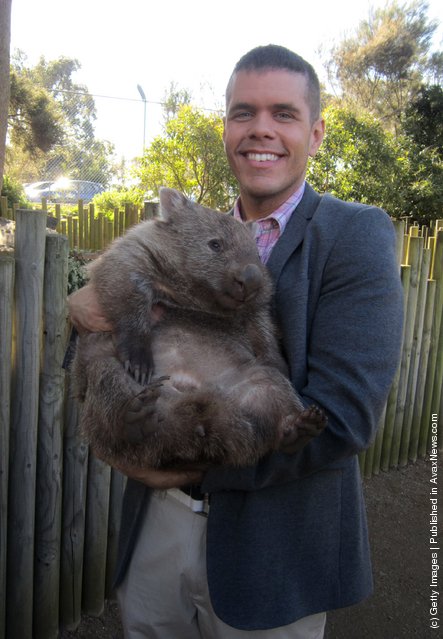
“Mario Armando Lavandeira, Jr. (born March 23, 1978), better known as Perez Hilton (a play on “Paris Hilton”), is an American blogger and television personality. His blog, Perezhilton.com (formerly PageSixSixSix.com), is known for posts covering gossip items about musicians, actors and celebrities. He is also known for posting tabloid photographs over which he has added his own captions or “doodles”. His blog has garnered negative attention for its attitude, its active “outing” of alleged closeted celebrities and its role in the increasing coverage of celebrities in all forms of media.” – Wikipedia

Photo: Blogger Perez Hilton poses with a wombat during a visit to Taronga Zoo on June 13, 2011 in Sydney, Australia. (Photo by Perezhilton.com via Getty Images)
Details
14 Jul 2011 09:44:00
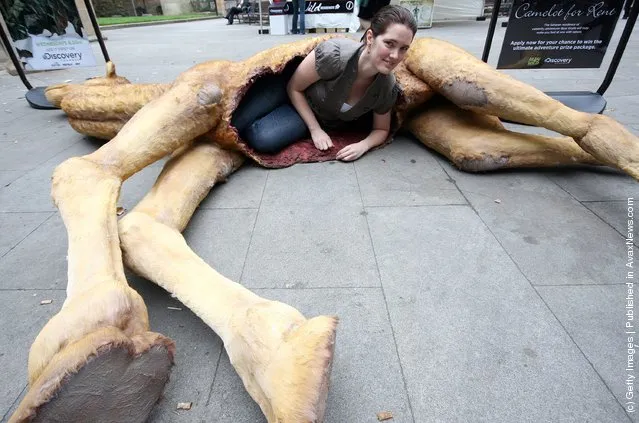
Passer inspects Camelot, a replica camel carcass simulating that used by adventurer Bear Grylls to shelter in the Sahara desert during an episode of the Discovery Channel's Man Vs. Wild

“Bear Grylls, (born Edward Michael Grylls, 7 June 1974) is an English adventurer, writer and television presenter. He is best known for his television series Man vs. Wild, known as Born Survivor in the United Kingdom. He was the youngest Briton to climb Mount Everest, doing so at age 23. In July 2009, Grylls was appointed the youngest ever Chief Scout at the age of 35”. – Wikipedia

Photos: Passer inspects “Camelot”, a replica camel carcass simulating that used by adventurer Bear Grylls to shelter in the Sahara desert during an episode of the Discovery Channel's “Man Vs. Wild”, in Wynyard Park on March 1, 2010 in Sydney, Australia. (Photo by Discovery Channel via Getty Images)
Details
04 Aug 2011 11:24:00