Loading...
Done
Giovan set out to capture the people’s resilience, during what Fidel Castro, with typical hyperbole, called the “special period”. (Photo by Tria Giovan/The Guardian)

As an American in 1990s Cuba, Tria Giovan risked being branded a traitor. But the photographer continued to visit and, from the dance hall to the hair salon, she captured the resilient spirit of the Cuban people. The 120 images in Tria Giovan’s “The Cuba Archive” are from the period in the 90s when, as an American, travel to Cuba could have seen her branded a traitor, as the country was subject to a US trade embargo. Her trip required lots of planning – and patience. (Photo by Tria Giovan/The Guardian)
Details
21 Sep 2017 09:04:00
Ocean voyage

Do you think that history is a science? Well, not exactly. First, and foremost, history is the state's “legend of wars”, it’s official regalia. Of course, public historians are not interested in scientific truth – quite the opposite. In this respect, any attempt to present a state’s history as altruistic and benevolent as possible is welcomed and encouraged – as opposed to any revisionism attempts that may be more accurate. In this matter, Chinese have surpassed us all – they revised in highly creative manner (but rather shamelessly) the technology already invented by Europeans, a process that resulted in oldest state on the planet. Here is an interesting paradox: ask any sinologist about the Middle Kingdom during second century B.C., and he will describe it to you in such a vivid manner as if he has been living there all his life – but as soon as you will ask him to describe Chinese history in the 19-20th centuries… let's say, his eagerness will be greatly diminished. However, we will discuss China in a different article, and in the meantime we will try to understand how exactly historic “legend of wars” is formed and functions – based on a specific and well-known example. A great example is Ferdinand Magellan's first voyage around the world.

Details
14 Nov 2011 09:11:00
A prototype battery-powered plane, called Greased Lightning or GL-10 is pictured flying at NASA's Langley Research Center in this undated handout photo obtained by Reuters May 1, 2015. The plane, which has 10 engines and can take off like a helicopter and fly efficiently like an aircraft, is currently in the design and testing phase. (Photo by Reuters/NASA)

A prototype battery-powered plane, called Greased Lightning or GL-10 is pictured flying at NASA's Langley Research Center in this undated handout photo obtained by Reuters May 1, 2015. The plane, which has 10 engines and can take off like a helicopter and fly efficiently like an aircraft, is currently in the design and testing phase. (Photo by Reuters/NASA)
Details
02 May 2015 14:56:00


Few guys? There will be more.
Details
17 Sep 2018 18:26:00
U.S. Army soldiers with the 1st Battalion, 501st Infantry Regiment deployed to Combat Outpost Sabari, Afghanistan scan their area as they begin a multi-day air assault mission near the Pakistani border of eastern Afghanistan's Khost province May 2, 2012. (Photo by Staff Sgt. Joshua L. DeMotts/U.S. Air Force)

U.S. Army soldiers with the 1st Battalion, 501st Infantry Regiment deployed to Combat Outpost Sabari, Afghanistan scan their area as they begin a multi-day air assault mission near the Pakistani border of eastern Afghanistan's Khost province May 2, 2012. (Photo by Staff Sgt. Joshua L. DeMotts/U.S. Air Force)
Details
08 Apr 2014 11:16:00
Things Cut in Half

HalfPics is a Twitter feed pointing to things cut in half like a bowl of ramen, a Mini Cooper, and toothpaste. Their tagline: “Ever wonder what stuff looks like when it’s cut in half?” Yes. We previously posted about “Cut Food,” a photo series of foods cut neatly in half by food photographer Beth Galton and food stylist Charlotte Omnès.

See also:Things Cut in Half Part1
Details
09 Sep 2013 10:05:00
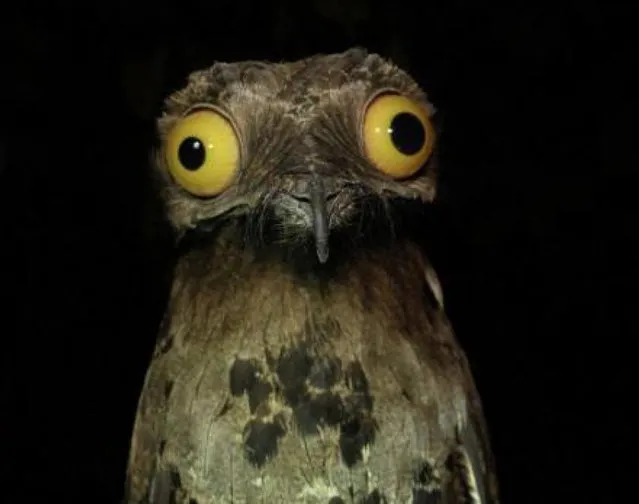
Nightjars And Pooto Bird

Potoos (family Nyctibiidae) are a group of near passerine birds related to the nightjars and frogmouths. They are sometimes called Poor-me-ones, after their haunting calls. There are seven species in one genus, Nyctibius, in tropical Central and South America.
These are nocturnal insectivores which lack the bristles around the mouth found in the true nightjars. They hunt from a perch like a shrike or flycatcher. During the day they perch upright on tree stumps, camouflaged to look like part of the stump. The single spotted egg is laid directly on the top of a stump.
Details
20 Jan 2014 14:34:00
This plane looks like it's bound for the moon as it shoots across the sky. Photographer Sebastien Lebrigand was impressed he could even see the lights on the jet's wings in this stunning silhouette. (Photo by Sebastien Lebrigand/Solent News)

This plane looks like it's bound for the moon as it shoots across the sky. Photographer Sebastien Lebrigand was impressed he could even see the lights on the jet's wings in this stunning silhouette. (Photo by Sebastien Lebrigand/Solent News)
Details
25 May 2014 13:03:00