Loading...
Done
Men make sweets at a small traditional factory in preparation for Eid al-Fitr, marking the end of the fasting month of Ramadan amid the spread of the coronavirus disease (COVID-19), in Kabul, Afghanistan on May 21, 2020. (Photo by Mohammad Ismail/Reuters)

Men make sweets at a small traditional factory in preparation for Eid al-Fitr, marking the end of the fasting month of Ramadan amid the spread of the coronavirus disease (COVID-19), in Kabul, Afghanistan on May 21, 2020. (Photo by Mohammad Ismail/Reuters)
Details
26 Jun 2020 00:05:00
A Sri Lankan man use a scarf as a protective mask as he waits for a swab test at a locked-down area in Colombo, Sri Lanka, 14 May 2020. The Sri Lankan government has started lifting most of the restrictions implemented nearly two months ago in a bid to slow down the spread of the SARS-CoV-2 coronavirus causing the COVID-19 disease and is preparing for a full reopening of businesses and a resumption of activities to avoid an economic slump. (Photo by Chamila Karunarathne/EPA/EFE/Rex Features/Shutterstock)

A Sri Lankan man use a scarf as a protective mask as he waits for a swab test at a locked-down area in Colombo, Sri Lanka, 14 May 2020. The Sri Lankan government has started lifting most of the restrictions implemented nearly two months ago in a bid to slow down the spread of the SARS-CoV-2 coronavirus causing the COVID-19 disease and is preparing for a full reopening of businesses and a resumption of activities to avoid an economic slump. (Photo by Chamila Karunarathne/EPA/EFE/Rex Features/Shutterstock)
Details
02 Jul 2020 00:05:00
A girl eats a watermelon slice while at a school building where Syrians – displaced from the area of Ras al-Ain by the Turkish offensive on the northeast – are staying in the city of Hasakah, on June 30, 2020. (Photo by Delil Souleiman/AFP Photo)

A girl eats a watermelon slice while at a school building where Syrians – displaced from the area of Ras al-Ain by the Turkish offensive on the northeast – are staying in the city of Hasakah, on June 30, 2020. (Photo by Delil Souleiman/AFP Photo)
Details
11 Jul 2020 00:01:00
Mug shot of De Gracy (sic) and Edward Dalton. Details unknown. Central Police Station, Sydney, around 1920

Mug shot of De Gracy (sic) and Edward Dalton. Details unknown. Central Police Station, Sydney, around 1920. (Photo by NSW Police Forensic Photography Archive, Justice & Police Museum, Histiric Houses Trust of NSW)
Details
21 Apr 2012 12:24:00
Tourists pose for a selfie in Cancun, October 13, 2015. Cancun's transformation in the 1970s from a small Caribbean fishing village into a strip of nightclubs and high-rise hotels has reduced biodiversity and polluted water resources as infrastructure struggles to keep up. (Photo by Edgard Garrido/Reuters)

Tourists pose for a selfie in Cancun, October 13, 2015. Cancun's transformation in the 1970s from a small Caribbean fishing village into a strip of nightclubs and high-rise hotels has reduced biodiversity and polluted water resources as infrastructure struggles to keep up. (Photo by Edgard Garrido/Reuters)
Details
15 Nov 2015 08:03:00
United States Coast Guard Academy Cadets Second Class Aurimas Juodka, left, and Sheila Bertrand get in the face of “swab” Kevin Lennox as Bravo Company finishes at the barber shop and mailroom during R-Day, the reporting-in day that marks the beginning of the 7-week “Swab Summer” for the class of 2018 Monday, June 30, 2014, in New London, Conn. (Photo by Sean D. Elliot/AP Photo/The Day)

United States Coast Guard Academy Cadets Second Class Aurimas Juodka, left, and Sheila Bertrand get in the face of “swab” Kevin Lennox as Bravo Company finishes at the barber shop and mailroom during R-Day, the reporting-in day that marks the beginning of the 7-week “Swab Summer” for the class of 2018 Monday, June 30, 2014, in New London, Conn. About 250 prospective cadets, Swabs, start the program designed to indoctrinate them to the military life of the academy and at the end will be accepted into the corps of cadets. (Photo by Sean D. Elliot/AP Photo/The Day)
Details
05 Jul 2014 12:20:00
Chinese rescuers carry an injuried resident after an earthquake hit an area of Ludian county in Zhaotong in southwest China's Yunnan province on August 3, 2014. At least 150 people were killed and 1,300 injured after a strong earthquake hit southwest China's mountainous Yunnan province, state media said. The quake in Zhaotong prefecture, in the province's northeast, toppled buildings and left residents frantically searching for survivors beneath the rubble, images on social media showed. (Photo by AFP Photo)

Chinese rescuers carry an injuried resident after an earthquake hit an area of Ludian county in Zhaotong in southwest China's Yunnan province on August 3, 2014. At least 300 people were killed and 1,300 injured after a strong earthquake hit southwest China's mountainous Yunnan province, state media said. The quake in Zhaotong prefecture, in the province's northeast, toppled buildings and left residents frantically searching for survivors beneath the rubble, images on social media showed. (Photo by AFP Photo)
Details
04 Aug 2014 13:17:00
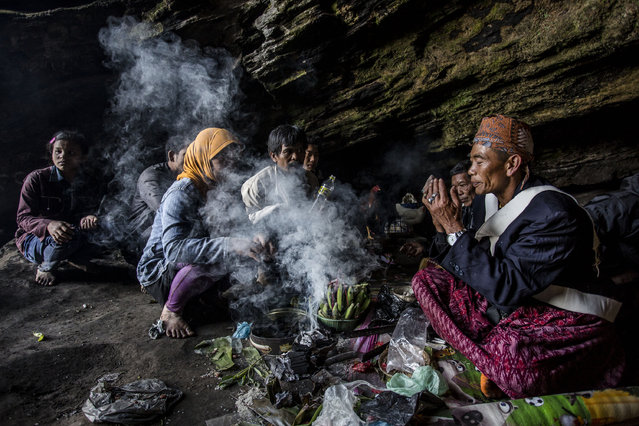
A Tenggerese shaman praying for worshippers at Widodaren cave during the Tenggerese Hindu Yadnya Kasada festival on July 31, 2015 in Probolinggo, East Java, Indonesia. The festival is the main festival of the Tenggerese people and lasts about a month. On the fourteenth day, the Tenggerese make the journey to Mount Bromo to make offerings of rice, fruits, vegetables, flowers and livestock to the mountain gods by throwing them into the volcano's caldera. (Photo by Ulet Ifansasti/Getty Images)

A Tenggerese shaman praying for worshippers at Widodaren cave during the Tenggerese Hindu Yadnya Kasada festival on July 31, 2015 in Probolinggo, East Java, Indonesia. The festival is the main festival of the Tenggerese people and lasts about a month. On the fourteenth day, the Tenggerese make the journey to Mount Bromo to make offerings of rice, fruits, vegetables, flowers and livestock to the mountain gods by throwing them into the volcano's caldera. The origin of the festival lies in the 15th century when a princess named Roro Anteng started the principality of Tengger with her husband Joko Seger, and the childless couple asked the mountain Gods for help in bearing children. The legend says the Gods granted them 24 children but on the provision that the 25th must be tossed into the volcano in sacrifice. The 25th child, Kesuma, was finally sacrificed in this way after initial refusal, and the tradition of throwing sacrifices into the caldera to appease the mountain Gods continues today. (Photo by Ulet Ifansasti/Getty Images)

Details
01 Aug 2015 12:07:00