Loading...
Done
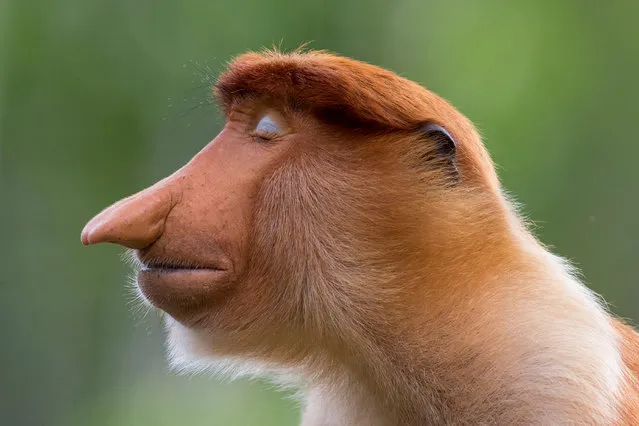
Winner – Animal Portraits: The pose by Mogens Trolle, Denmark. A young male proboscis monkey cocks his head slightly and closes his eyes. Unexpected pale blue eyelids now complement his immaculately groomed auburn hair. He poses for a few seconds as if in meditation. He is a wild visitor to the feeding station at Labuk Bay Proboscis Monkey Sanctuary in Sabah, Borneo – “the most laid-back character”, says Trolle, “quite unlike anything I’ve ever seen on another monkey” – connects us, he hopes, with a fellow primate. (Photo by Mogens Trolle/Wildlife Photographer of the Year 2020)

Winner – Animal Portraits: The pose by Mogens Trolle, Denmark. A young male proboscis monkey cocks his head slightly and closes his eyes. Unexpected pale blue eyelids now complement his immaculately groomed auburn hair. He poses for a few seconds as if in meditation. He is a wild visitor to the feeding station at Labuk Bay Proboscis Monkey Sanctuary in Sabah, Borneo – “the most laid-back character”, says Trolle, “quite unlike anything I’ve ever seen on another monkey” – connects us, he hopes, with a fellow primate. (Photo by Mogens Trolle/Wildlife Photographer of the Year 2020)
Details
16 Oct 2020 00:03:00
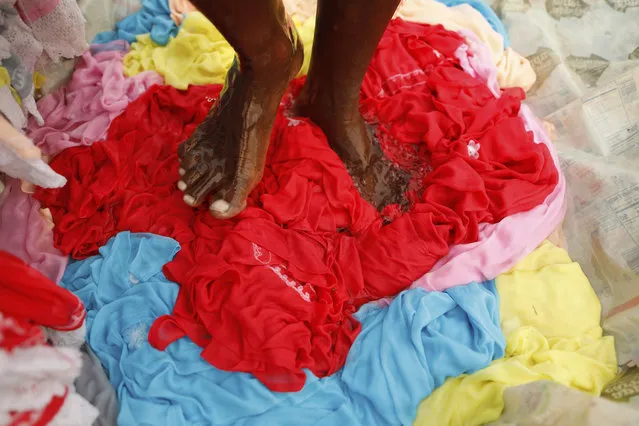
A dhobi, or a washerman washes cloths on the banks of the River Gomti in Lucknow, India, Saturday, September 12, 2020. Dhobis are traditional laundry workers who wash clothes by hand and dry them in the sun, an occupation which has been in existence for generations. Most cities in India have a Dhobi Ghat, or washermen's area, where the city's pile of clothes is laundered. This practice is still popular in India, despite of modern technology. Around 1,000 families work in Lucknow's Dhobi Ghat. However, in light of the novel coronavirus, their wages have decreased drastically. With each family earning around US$100-200 per month. (Photo by Rajesh Kumar Singh/AP Photo)

A dhobi, or a washerman washes cloths on the banks of the River Gomti in Lucknow, India, Saturday, September 12, 2020. Dhobis are traditional laundry workers who wash clothes by hand and dry them in the sun, an occupation which has been in existence for generations. Most cities in India have a Dhobi Ghat, or washermen's area, where the city's pile of clothes is laundered. This practice is still popular in India, despite of modern technology. Around 1,000 families work in Lucknow's Dhobi Ghat. However, in light of the novel coronavirus, their wages have decreased drastically. With each family earning around US$100-200 per month. (Photo by Rajesh Kumar Singh/AP Photo)
Details
25 Sep 2020 00:03:00
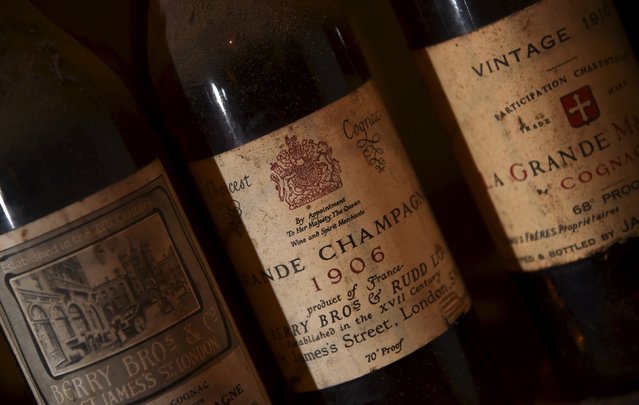
Bottles of vintage cognac, with a royal warrant stamp, are seen in storage inside Berry Bros and Rudd wine merchants in central London, Britain, August 21, 2015. Berry Bros. & Rudd, which started as grocers over 300 years ago in St. James's, central London, has two royal warrants. (Photo by Toby Melville/Reuters)

Bottles of vintage cognac, with a royal warrant stamp, are seen in storage inside Berry Bros and Rudd wine merchants in central London, Britain, August 21, 2015. Berry Bros. & Rudd, which started as grocers over 300 years ago in St. James's, central London, has two royal warrants. Every year Queen Elizabeth grants about 20 royal warrants, the gold emblem of the British monarchy, in a practice dating back to medieval times. The warrant holders can display the certificate and use the royal coat of arms in their marketing. The warrants lasting five years can help businesses break into new markets overseas, using their role as supplier to the royal family as a gauge of quality. On September 9, Queen Elizabeth will overtake Queen Victoria as Britain's longest-serving monarch. (Photo by Toby Melville/Reuters)
Details
03 Sep 2015 12:37:00
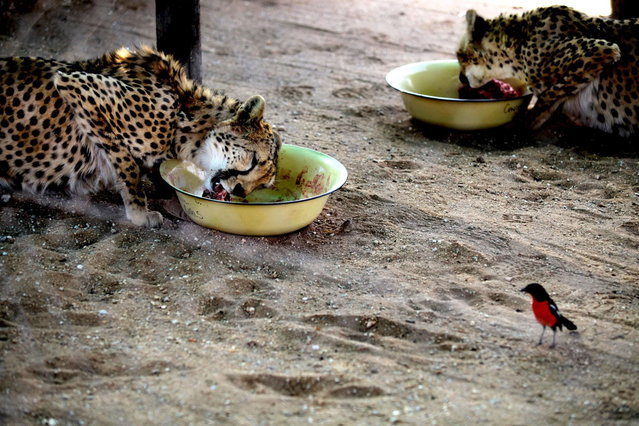
Young cheetahs eat meat at The Cheetah Conservation Fund (CCF) center in Otjiwarongo, Namibia, on August 13, 2013. The CCF started breeding Anatolian livestock dogs to promote cheetah-friendly farming after some 10,000 big cats – the current total worldwide population – were killed or moved off farms in the 1980s.  Up to 1,000 cheetahs were being killed a year, mostly by farmers who saw them as livestock killers. But the use of dogs has slashed losses for sheep and goat farmers and led to less retaliation against the vulnerable cheetah. (Photo by Jennifer Bruce/AFP Photo)

Young cheetahs eat meat at The Cheetah Conservation Fund (CCF) center in Otjiwarongo, Namibia, on August 13, 2013. The CCF started breeding Anatolian livestock dogs to promote cheetah-friendly farming after some 10,000 big cats – the current total worldwide population – were killed or moved off farms in the 1980s. Up to 1,000 cheetahs were being killed a year, mostly by farmers who saw them as livestock killers. But the use of dogs has slashed losses for sheep and goat farmers and led to less retaliation against the vulnerable cheetah. (Photo by Jennifer Bruce/AFP Photo)
Details
29 Aug 2013 10:56:00
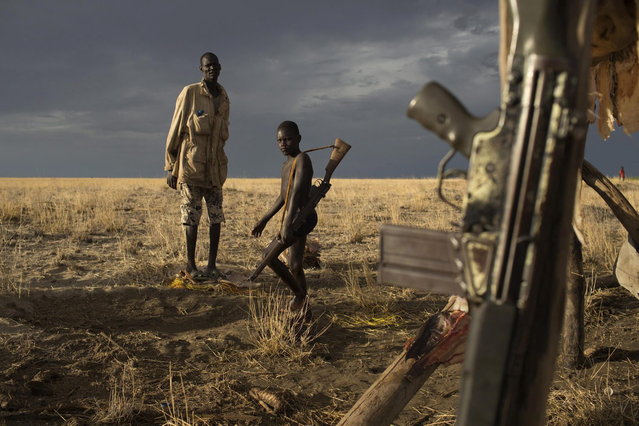
A Turkana man and a boy carrying a gun look on as a G3 battle rifle hangs from a structure used to dry fish at a fishing camp on the shores of Lake Turkana, some kilometres from Todonyang near the Kenya-Ethiopia border in northwestern Kenya October 12, 2013. (Photo by Siegfried Modola/Reuters)

A Turkana man and a boy carrying a gun look on as a G3 battle rifle hangs from a structure used to dry fish at a fishing camp on the shores of Lake Turkana, some kilometres from Todonyang near the Kenya-Ethiopia border in northwestern Kenya October 12, 2013The Turkana are traditionally nomadic pastoralists, but they have seen the pasture that they need to feed their herds suffer from recurring droughts and many have turned to fishing. However, Lake Turkana is overfished, and scarcity of food and pastureland is fuelling long-standing conflict with Ethiopian indigenous Dhaasanac, who have seen grazing grounds squeezed by large-scale government agricultural schemes in southern Ethiopia. The Dhaasanac now venture ever deeper into Kenyan territory in search of fish and grass, clashing with neighbours. Fighting between the communities has a long history, but the conflict has become ever more fatal as automatic weapons from other regional conflicts seep into the area. While the Turkana region is short of basics like grass and ground-water, it contains other resources including oil reserves and massive, newly discovered underground aquifers. (Photo by Siegfried Modola/Reuters)
Details
05 Dec 2013 12:08:00
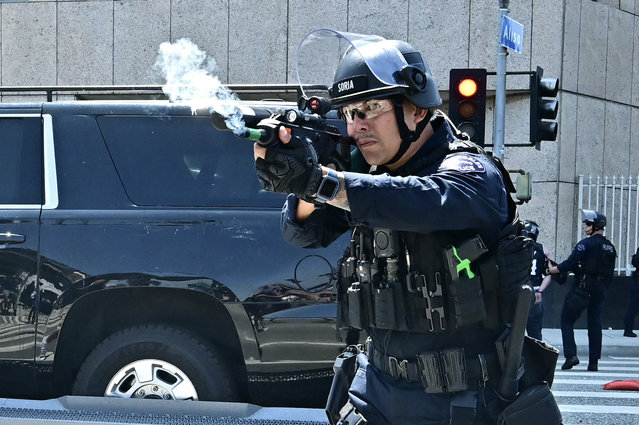
Law enforcement clashes with demonstrators outside the Metropolitan Detention Center, MDC, in downtown Los Angeles, California on June 8, 2025. US President Donald Trump deployed 2,000 troops on June 7 to handle escalating protests against immigration enforcement raids in the Los Angeles area, a move the state's governor termed “purposefully inflammatory”. Federal agents clashed with angry crowds in a Los Angeles suburb as protests stretched into a second night Saturday, shooting flash-bang grenades and shutting part of a freeway amid raids on undocumented migrants, reports said. (Photo by Frederic J. Brown/AFP Photo)

Law enforcement clashes with demonstrators outside the Metropolitan Detention Center, MDC, in downtown Los Angeles, California on June 8, 2025. US President Donald Trump deployed 2,000 troops on June 7 to handle escalating protests against immigration enforcement raids in the Los Angeles area, a move the state's governor termed “purposefully inflammatory”. Federal agents clashed with angry crowds in a Los Angeles suburb as protests stretched into a second night Saturday, shooting flash-bang grenades and shutting part of a freeway amid raids on undocumented migrants, reports said. (Photo by Frederic J. Brown/AFP Photo)
Details
16 Jun 2025 03:08:00
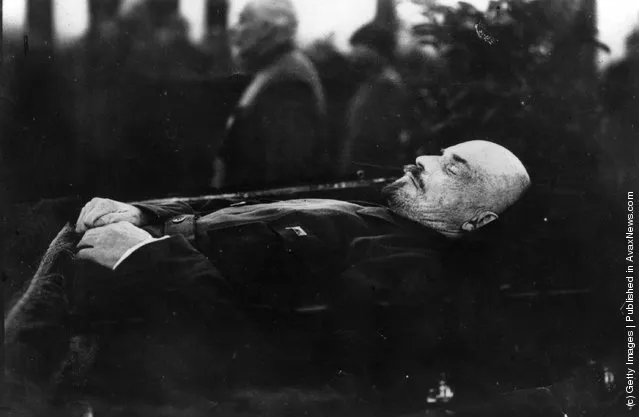
1924:  Vladimir Ilyich Lenin lying in state in the Kremlin

Photo: Vladimir Ilyich Lenin (1870 – 1924) lying in state in the Kremlin. (Photo by Hulton Archive/Getty Images). 1924

Important! For the same article in Russian language click here.

Something quite intriguing is happening within Russian-speaking internet during the last few – should you type a fully academic inquiry (at least, according to Russian academic requirements) in national search engines for "Lenin's mausoleum" – the first thing you get (even in top 10 searches) is website pages talking about black magic and occult. Website authors view this construction differently, but unconditionally agree on one thing: the mausoleum of the "leader of the world proletariat” – the essence of a magical artifact, a sort of “energy vampire”. It was built with a certain purpose: to drain the energy out of miserable Soviet citizens on one hand; and to poison the anthroposphere of one-sixth part of the earth with its vibes (the exact territory that was occupied by the former Soviet Union), depriving the Russian people of will to resist on the other hand. Complete nonsense? No doubt. Nevertheless, an intriguing one. Well, probably because some oddities do exist in mausoleum's history. These oddities are the thing we are going to discuss this time. First, let me refresh you memory on the subject.
Details
16 Oct 2011 11:27:00
An aerial view shows a sinkhole 3.5 km (2 miles) to the east of Solikamsk-2 mine in Perm region, November 20, 2014. Shares in Russia's Uralkali, the world's top potash producer, fell sharply for a second day on Wednesday after a mine accident that could reduce global supplies and push up prices of the crop nutrient worldwide. (Photo by Reuters/Press service of Uralkali company)

An aerial view shows a sinkhole 3.5 km (2 miles) to the east of Solikamsk-2 mine in Perm region, November 20, 2014. Shares in Russia's Uralkali, the world's top potash producer, fell sharply for a second day on Wednesday after a mine accident that could reduce global supplies and push up prices of the crop nutrient worldwide. Uralkali shares have fallen 28 percent since Tuesday when it suspended work at its Solikamsk-2 mine, which accounts for a fifth of the company's output and 3.5 percent of global capacity, following an inflow of water. A sinkhole, stretching 30 by 40 metres (yards), found at an abandoned mine 3.5 km (2 miles) to the east, increased concern about the future of the mine because an inflow of water and the resulting sinkhole in 2006 forced another Uralkali operation to shut permanently. (Photo by Reuters/Press service of Uralkali company)
Details
22 Nov 2014 13:51:00