Loading...
Done


“The ONE Campaign is a international, nonpartisan, non-profit organization which aims to increase government funding for and effectiveness of international aid programs. ONE was originally founded by a coalition of 11 non-profit humanitarian and advocacy organizations — including DATA, World Vision, Oxfam America, and Bread for the World — with funding from the Bill & Melinda Gates Foundation. In 2007, ONE announced that it would be merging with DATA. Currently, ONE is campaigning for resources to help developing countries adapt to climate change. During the 2008 U.S. presidential election the organization launched a campaign, called ONE Vote '08, which was co-chaired by former U.S. Senate majority leaders Tom Daschle (D-SD) and Bill Frist (R-TN). The campaign is named after the U2 song “One” which was a top ten hit single on the critically acclaimed 1991 Achtung Baby album”. – Wikipedia

Photo: Bill Gates, founder of Microsoft and now philanthropist, poses with One.org charity volunteers at Pariser Platz square during a brief stop at Brandenburg Gate on April 6, 2011 in Berlin, Germany. Gates is in Berlin to meet with German government officials, including Chancellor Angela Merkel and Development Minister Dirk Niebel, to discuss aid for developing countries and promote his One.org charity initiative, which is part of the Bill and Melinda Gates Foundation. (Photo by Sean Gallup/Getty Images)
Details
07 Apr 2011 08:31:00


“Kumbh Mela is a mass Hindu pilgrimage in which Hindus gather at the Ganges river. The normal Kumbh Mela is celebrated every 3 years, the Ardh (half) Kumbh Mela is celebrated every six years at Haridwar and Prayag, the Purna (complete) Kumbh takes place every twelve years, at four places (Prayag (Allahabad), Haridwar, Ujjain, and Nashik). The Maha (great) Kumbh Mela which comes after 12 “Purna Kumbh Melas”, or 144 years, is held at Allahabad.

The last Ardh Kumbh Mela was held over a period of 45 days beginning in January 2007, more than 70 million Hindu pilgrims took part in the Ardh Kumbh Mela at Prayag, and on January 15, the most auspicious day of the festival of Makar Sankranti, more than 5 million participated. The previous Maha Kumbh Mela, held in 2001, was attended by around 60 million people, making it at the time the largest gathering anywhere in the world in recorded history”. – Wikipedia

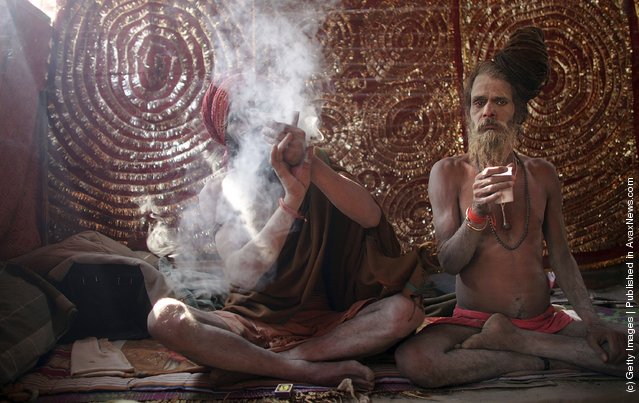
Photo: Sadhus (holy men) smoke at their camp near the ritual site at Sangam, the confluence of the Ganges, Yamuna and mythical Saraswati rivers during the Ardh Kumbh Mela festival (Half Pitcher festival) January 18, 2007 in Allahabad, India. Millions of Hindu pilgrims have flocked to the largest religious gathering in the world which lasts for 45 days in northern India. The festival commemorates the mythical conflict between gods and demons over a pitcher filled with the “nectar of immortality”. Devotees believe that taking a holy dip in the Ganges at this time washes away their sins and paves the path to salvation. (Photo by Mario Tama/Getty Images)
Details
30 Jun 2011 10:27:00
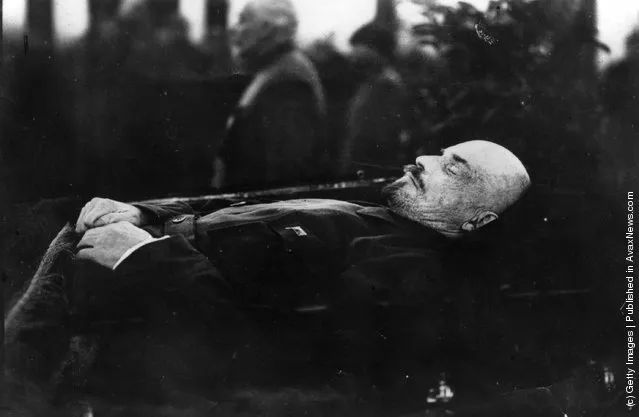
1924:  Vladimir Ilyich Lenin lying in state in the Kremlin

Photo: Vladimir Ilyich Lenin (1870 – 1924) lying in state in the Kremlin. (Photo by Hulton Archive/Getty Images). 1924

Important! For the same article in Russian language click here.

Something quite intriguing is happening within Russian-speaking internet during the last few – should you type a fully academic inquiry (at least, according to Russian academic requirements) in national search engines for "Lenin's mausoleum" – the first thing you get (even in top 10 searches) is website pages talking about black magic and occult. Website authors view this construction differently, but unconditionally agree on one thing: the mausoleum of the "leader of the world proletariat” – the essence of a magical artifact, a sort of “energy vampire”. It was built with a certain purpose: to drain the energy out of miserable Soviet citizens on one hand; and to poison the anthroposphere of one-sixth part of the earth with its vibes (the exact territory that was occupied by the former Soviet Union), depriving the Russian people of will to resist on the other hand. Complete nonsense? No doubt. Nevertheless, an intriguing one. Well, probably because some oddities do exist in mausoleum's history. These oddities are the thing we are going to discuss this time. First, let me refresh you memory on the subject.
Details
16 Oct 2011 11:27:00
A young girl makes a “tomato angel” on a tomato covered street during the traditional tomato fight “Tomatina” during the fiestas in Bunol, Spain, 28 August 2013. This year's Tomatina is the first pay festival after Bunol's City Hall sold 15,000 tickets to take part in the tomato throwing. A total of 20,000 people, including 5,000 residents, will throw over 130,000 kg tomatoes. Local authorities decided to sell tickets this year to avoid the overcrowding in previous years in which over 50,000 people took part in the event. (Photo by Biel Alino/EPA)

A young girl makes a “tomato angel” on a tomato covered street during the traditional tomato fight “Tomatina” during the fiestas in Bunol, Spain, 28 August 2013. This year's Tomatina is the first pay festival after Bunol's City Hall sold 15,000 tickets to take part in the tomato throwing. A total of 20,000 people, including 5,000 residents, will throw over 130,000 kg tomatoes. Local authorities decided to sell tickets this year to avoid the overcrowding in previous years in which over 50,000 people took part in the event. (Photo by Biel Alino/EPA)
Details
29 Aug 2013 11:24:00
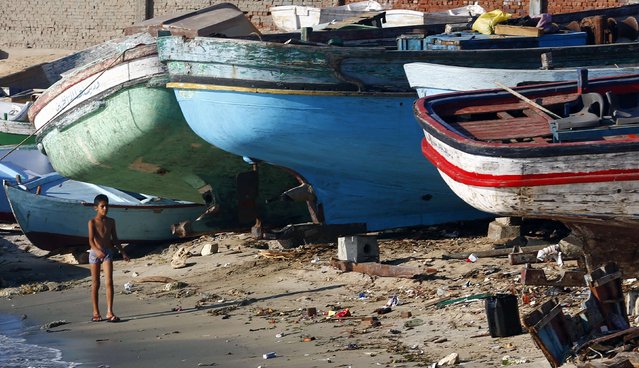
A boy walks past boats docked at the entrance gate of the fishermen's village in the El Max area of the Mediterranean city of Alexandria September 12, 2014.  El Max, where hundreds of boats dart through the canals, has been called the “Venice of Egypt” for its waterways and relaxed atmosphere. Its fishermen, however, worry about how they will make ends meet on meagre earnings they  say are being reduced further by polluted waters that are making fishing more difficult. (Photo by Amr Abdallah Dalsh/Reuters)

A boy walks past boats docked at the entrance gate of the fishermen's village in the El Max area of the Mediterranean city of Alexandria September 12, 2014. El Max, where hundreds of boats dart through the canals, has been called the “Venice of Egypt” for its waterways and relaxed atmosphere. Its fishermen, however, worry about how they will make ends meet on meagre earnings they say are being reduced further by polluted waters that are making fishing more difficult. While the government has tried to fix the state's bloated finances by cutting subsidies and reining in spending, some argue the reforms hurt Egypt's most vulnerable who have long relied on a generous system of fuel and food subsidies to supplement low incomes. (Photo by Amr Abdallah Dalsh/Reuters)
Details
12 Dec 2014 12:42:00
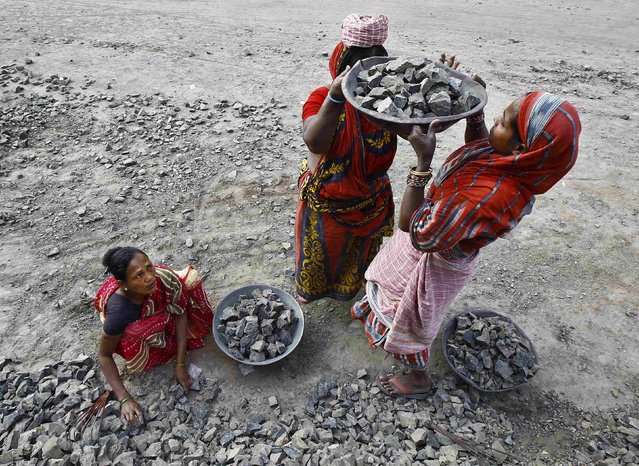
Women labourers work at the construction site of a road in Kolkata January 8, 2015. Across towns and cities in India, it is not uncommon to see women cleaning building sites, carrying bricks and or shoveling gravel - helping construct the infrastructure necessary for the country's economic and social development. (Photo by Rupak De Chowdhuri/Reuters)

Women labourers work at the construction site of a road in Kolkata January 8, 2015. Across towns and cities in India, it is not uncommon to see women cleaning building sites, carrying bricks and or shoveling gravel – helping construct the infrastructure necessary for the country's economic and social development. They help build roads, railway tracks, airports, and offices. They lay pipes for clean water supplies, cables for telecommunications, and dig the drains for sewage systems. But although women make up at least 20 percent of India's 40 million construction workers, they are less recognized than male workers with lower pay and often prone to safety hazards and sexual harassment. They are often unaware of their rights or scared to complain, say activists now trying to campaign for better treatment of women in the construction industry. (Photo by Rupak De Chowdhuri/Reuters)
Details
15 Jan 2015 13:47:00
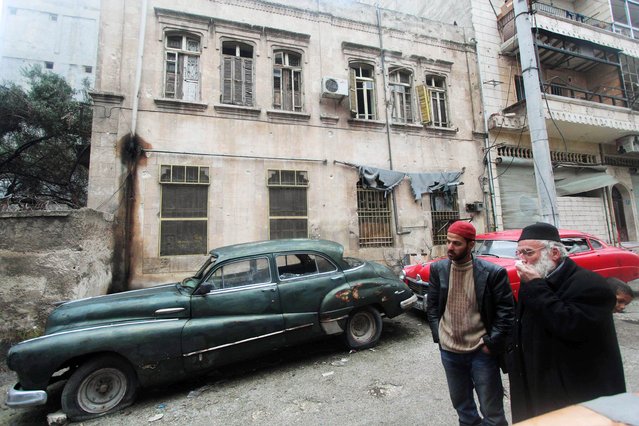
Mohamed Badr al-Din (R) stands in front of his vintage cars along a street where he keeps them, in the al-Shaar neighborhood of Aleppo January 31, 2015. The 66-year-old collector nicknamed Abu Omar inherited the hobby from his father and has a large collection of vintage cars, some of which he says belonged to former Syrian officials and were used in several movies and shows. (Photo by Abdalrhman Ismail/Reuters)

Mohamed Badr al-Din (R) stands in front of his vintage cars along a street where he keeps them, in the al-Shaar neighborhood of Aleppo January 31, 2015. The 66-year-old collector nicknamed Abu Omar inherited the hobby from his father and has a large collection of vintage cars, some of which he says belonged to former Syrian officials and were used in several movies and shows. Before the unrest, Abu Omar planned to open a museum to display his cars, which are guarded from pedestrians by a turkey that he owns. He hopes that the turmoil in the country will end so that he can pursue his hobby and repair his cars, which are heavily damaged from shelling. (Photo by Abdalrhman Ismail/Reuters)
Details
01 Feb 2015 10:34:00
Cuban-American artist Jorge Rodriguez-Gerada's six-acre sand and soil “facescape” stretches across the JFK Hockey Field on the north side of the Reflecting Pool along the National Mall October 1, 2014 in Washington, DC. Titled “Out of Many, One” and composed of 2,500 tons of sand, 800 tons of top soil and eight miles of string, the piece is the artist's interpreative blending of 30 different men's faces. (Photo by Chip Somodevilla/Getty Images)

Cuban-American artist Jorge Rodriguez-Gerada's six-acre sand and soil “facescape” stretches across the JFK Hockey Field on the north side of the Reflecting Pool along the National Mall October 1, 2014 in Washington, DC. Titled “Out of Many, One” and composed of 2,500 tons of sand, 800 tons of top soil and eight miles of string, the piece is the artist's interpreative blending of 30 different men's faces. Rodriguez-Gereda used high-precision global positioning satellites to place 10,000 wood pegs as waypoints for the giant face. The piece will be open to the public beginning October 4 and will eventually be tilled back into the earth. (Photo by Chip Somodevilla/Getty Images)
Details
04 Oct 2014 11:39:00