Loading...
Done
A reveller plays with tomato pulp during the annual Tomatina festival in Bunol, near Valencia, Spain on August 29, 2018. (Photo by Heino Kalis/Reuters)

A reveller plays with tomato pulp during the annual Tomatina festival in Bunol, near Valencia, Spain on August 29, 2018. As every year on the last Wednesday of August, thousands of people visit the small village of Bunol to attend the Tomatina, a battle in which tons of ripe tomatoes are used as weapons. This year, a total of 145 tons of ripe tomatoes will be thrown between more than 22,000 participants. (Photo by Heino Kalis/Reuters)
Details
05 Sep 2018 09:00:00
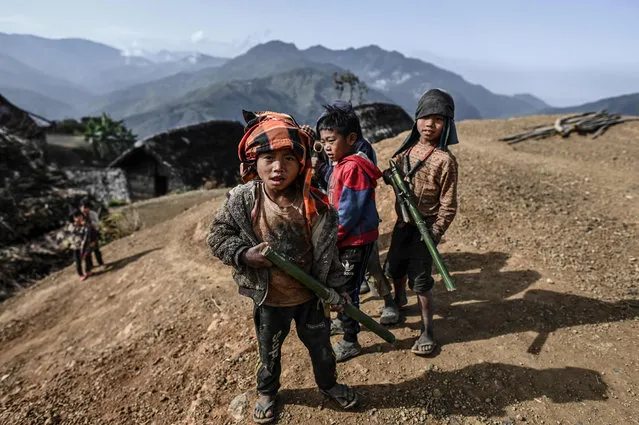
This photo taken on February 9, 2020 shows children playing in front of their homes in Tarmaw Lawri village in the Lahe township in Myanmar's Sagaing region. (Photo by Ye Aung Thu/AFP Photo)

This photo taken on February 9, 2020 shows children playing in front of their homes in Tarmaw Lawri village in the Lahe township in Myanmar's Sagaing region. A haunting refrain pierces the night as the tribeswomen of the Gongwang Bonyo, among the most isolated people in Myanmar, dance around a campfire to bless the harvest ahead. (Photo by Ye Aung Thu/AFP Photo)
Details
31 Mar 2020 00:05:00
An abandoned protection masks in the deserted building near bypass channel for cooling at the Chernobyl nuclear power plant in the Exclusion Zone, Ukraine, April 5, 2017. (Photo by Vitaliy Holovin/Corbis via Getty images)

An abandoned protection masks in the deserted building near bypass channel for cooling at the Chernobyl nuclear power plant in the Exclusion Zone, Ukraine, April 5, 20177. The Chernobyl nuclear accident occurred on 26 April 1986 in the No.4 light water graphite moderated reactor at the Chernobyl Nuclear Power Plant near Pripyat. An estimated 47,000 people of the city of Pripyat were evacuated after the explosion in 1986. (Photo by Vitaliy Holovin/Corbis via Getty images)
Details
24 May 2019 00:03:00
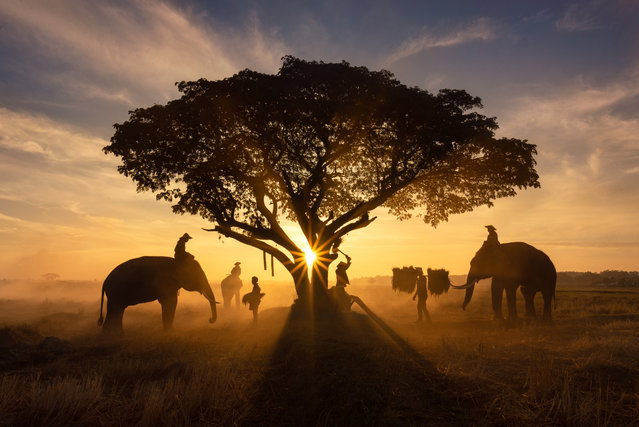
These eye-catching photographs capture the special relationship between a group of farmers and elephants – with a gorgeous sunset in the background. Vithun Khamsong, a civil engineer, shot the images earlier this year while visiting Surin, Thailand. Khamsong said: “My favorite is the one where the sunset can be seen behind the man and the elephant. I was impressed and wanted to capture this lifestyle for other people see it”. (Photo by Vithun Khamsong/Caters News Agency)

These eye-catching photographs capture the special relationship between a group of farmers and elephants – with a gorgeous sunset in the background. Vithun Khamsong, a civil engineer, shot the images earlier this year while visiting Surin, Thailand. (Photo by Vithun Khamsong/Caters News Agency)
Details
11 Sep 2019 00:03:00
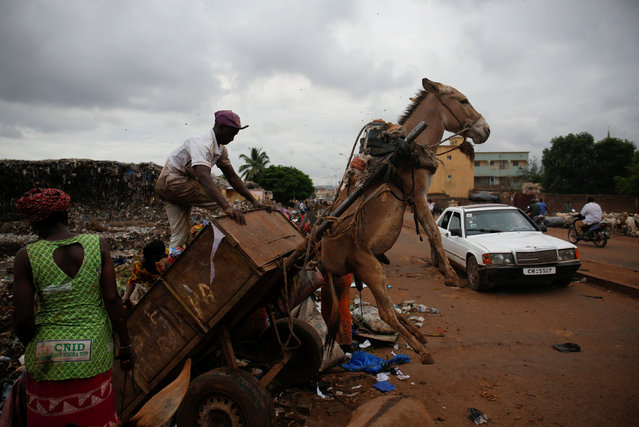
A waste picker unloads garbage at a waste transfer station in Bamako, Mali, August 19, 2018. In the Malian capital of Bamako, donkey carts driven by young men like 19-year-old Arouna Diabate play a vital role battling the fast-growing city's waste problem. Every morning before dawn, Diabate hitches his donkey to a cart and sets off on his rounds, going door-to-door to collect household garbage which he delivers to a local waste transfer station for a monthly salary of around $35. “I won't be picking up trash with a donkey cart for the rest of my life, but for now people appreciate us because we help clean up the homes of Bamako”, Diabate said. (Photo by Luc Gnago/Reuters)

A waste picker unloads garbage at a waste transfer station in Bamako, Mali, August 19, 2018. In the Malian capital of Bamako, donkey carts driven by young men like 19-year-old Arouna Diabate play a vital role battling the fast-growing city's waste problem. Every morning before dawn, Diabate hitches his donkey to a cart and sets off on his rounds, going door-to-door to collect household garbage which he delivers to a local waste transfer station for a monthly salary of around $35. “I won't be picking up trash with a donkey cart for the rest of my life, but for now people appreciate us because we help clean up the homes of Bamako”, Diabate said. (Photo by Luc Gnago/Reuters)
Details
18 Sep 2018 00:01:00
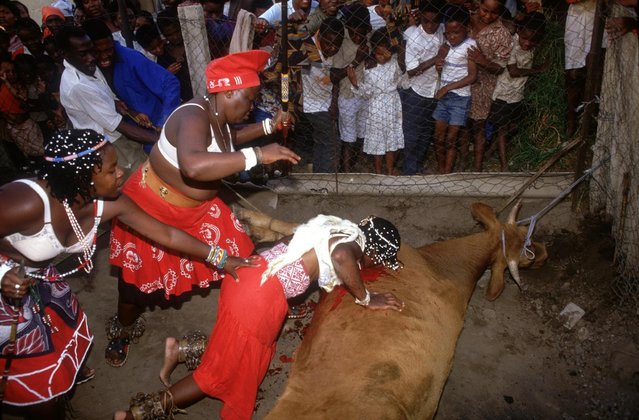
South African Sangomas are wizards and witches who are supposedly chosen by their ancestors to follow a traditional training and go through a rite of passage after which they become Sangomas and can cure and help people. They are so respected and trusted that western medical authorities have actually advised the government of South Africa to develop its cooperation with Sangomas in order to improve hygiene and health among the population. Today is graduation day for Trissa, 25, a Sangoma student in Tembisa, near Pretoria. Thanks to the help of the spirits of her ancestors, she has found a cow that had been hidden. The cow has then been killed by Sangoma Thelma and Trissa is now drinking its blood, thus becoming a Sangoma and changing her name to Nomadlozi. Location: Tembisa, near Pretoria, South Africa. (Photo by Patrick Durand/Sygma via Getty Images)

South African Sangomas are wizards and witches who are supposedly chosen by their ancestors to follow a traditional training and go through a rite of passage after which they become Sangomas and can cure and help people. They are so respected and trusted that western medical authorities have actually advised the government of South Africa to develop its cooperation with Sangomas in order to improve hygiene and health among the population. (Photo by Patrick Durand/Sygma via Getty Images)
Details
24 Feb 2017 00:05:00
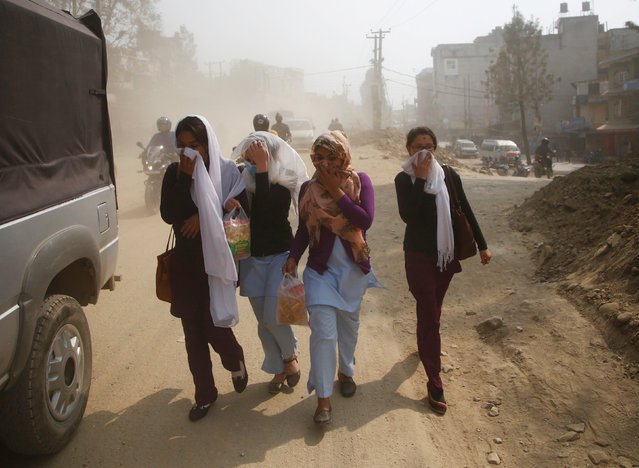
Pedestrians cover their face as they walk along the dusty road in Kathmandu, Nepal February 27, 2017. Nepal has forced 2,500 old vehicles off roads in its capital city of Kathmandu, part of a fight against alarming air pollution levels that have hit nine times World Health Organisation (WHO) limits. Air pollution has been a chronic problem in rapidly growing Kathmandu, which sits in a Himalayan valley and is home to more than 3mn people. Rising public anger with the smog is turning into a headache for a beleaguered government headed by former Maoist rebels. Dust from road works, exhaust from old, poorly maintained vehicles and smoke from coal-burning brick kilns blend in a murky haze that hangs over the ancient city, raising the risk of cancer, stroke, asthma and high blood pressure, experts say. Officials hope the ban on vehicles more than 20 years old will be a step towards a cleaner future. (Photo by Navesh Chitrakar/Reuters)

Pedestrians cover their face as they walk along the dusty road in Kathmandu, Nepal February 27, 2017. Nepal has forced 2,500 old vehicles off roads in its capital city of Kathmandu, part of a fight against alarming air pollution levels that have hit nine times World Health Organisation (WHO) limits. Air pollution has been a chronic problem in rapidly growing Kathmandu, which sits in a Himalayan valley and is home to more than 3mn people. (Photo by Navesh Chitrakar/Reuters)
Details
04 Mar 2017 00:04:00
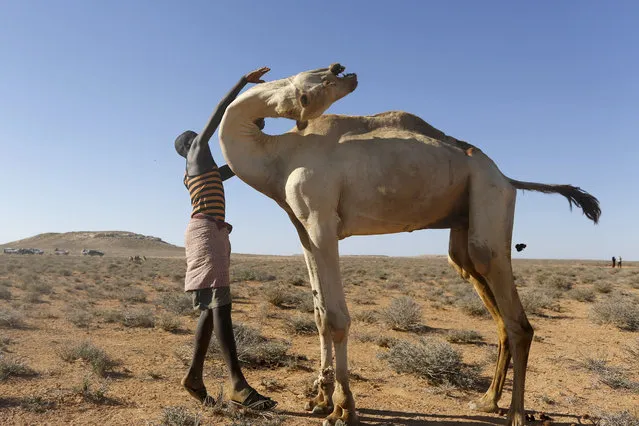
Ali Asair, who has left his family behind and traveled hundreds of kilometers in search for a pasture for his animals, attends to his camel in a pastoralists' settlement in the Bandarbeyla district in Somalia's semi-autonomous region of Puntland, Somalia, 24 March 2017. According to media reports, the United Nations says only 31 percent of 864 million US dollars appeal for a drought-hit Somalia is funded. The UN said the world is facing the largest humanitarian crisis since 1945, adding that more than 20 million people are facing the threat of famine in Somalia, Yemen, South Sudan and Nigeria and 1.4 million children could die from starvation this year. (Photo by Dai Kurokawa/EPA)

Ali Asair, who has left his family behind and traveled hundreds of kilometers in search for a pasture for his animals, attends to his camel in a pastoralists' settlement in the Bandarbeyla district in Somalia's semi-autonomous region of Puntland, Somalia, 24 March 2017. According to media reports, the United Nations says only 31 percent of 864 million US dollars appeal for a drought-hit Somalia is funded. The UN said the world is facing the largest humanitarian crisis since 1945, adding that more than 20 million people are facing the threat of famine in Somalia, Yemen, South Sudan and Nigeria and 1.4 million children could die from starvation this year. (Photo by Dai Kurokawa/EPA)
Details
28 Mar 2017 09:01:00