Loading...
Done
Tridacna Gigas, or Giant Clams

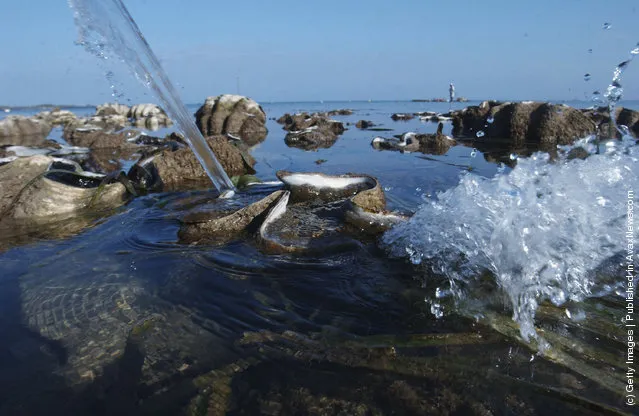
“The giant clam, Tridacna gigas (known as pā’ua in Cook Islands Māori), is the largest living bivalve mollusc. T. gigas is one of the most endangered clam species. It was mentioned as early as 1825 in scientific reports. One of a number of large clam species native to the shallow coral reefs of the South Pacific and Indian oceans, they can weigh more than 200 kilograms (440 lb) measure as much as 120 cm (47 in) across, and have an average lifespan in the wild of 100 years or more”. – Wikipedia

Photo: Tridacna Gigas, or Giant Clams spew water as a traditional fisherman passes by a small sanctuary on January 23, 2004 near Bolinao in the Northern Philippines. The clams, prime builders for coral reefs and providing shelter for spawning fish and other marine life, are exposed by low tides in the sanctuary. Overfishing and pollution throughout the country are not only threatening food security, but are also starting to choke one of the few working clam sanctuaries in the world. (Photo by David Greedy/Getty Images)
Details
01 Oct 2011 13:10:00
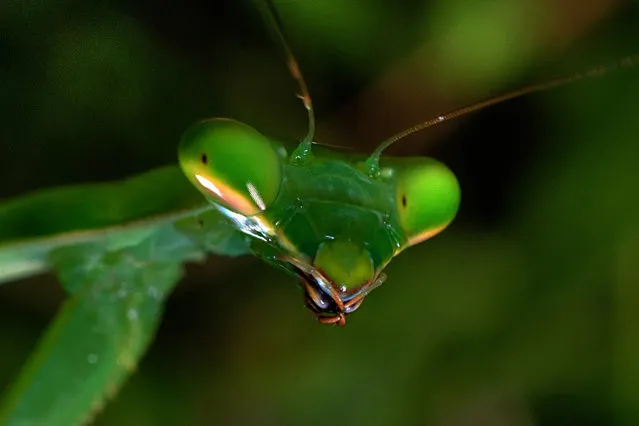
Close Encounter of the Insect Kind: Check out the awesome face on this praying mantis. I can't get over the mouth, it's like something from a science fiction movie. Of all photographic styles macro is definitely my favorite. I am constantly amazed, in every photo that I take, by the intricate level of detail that exists on even the smallest of creatures. It's a stark reminder that a very complex and infinitely beautiful world exists just beyond our human-sized level of perception. Photo taken in Donnybrook, Queensland, Australia. (Photo by Andrew Young/National Geographic Photo Contest

Close Encounter of the Insect Kind: “Check out the awesome face on this praying mantis. I can't get over the mouth, it's like something from a science fiction movie. Of all photographic styles macro is definitely my favorite. I am constantly amazed, in every photo that I take, by the intricate level of detail that exists on even the smallest of creatures. It's a stark reminder that a very complex and infinitely beautiful world exists just beyond our human-sized level of perception. Photo taken in Donnybrook, Queensland, Australia” – Andrew Young. (Photo by Andrew Young/National Geographic Photo Contest via The Atlantic)
Details
24 Sep 2012 09:18:00
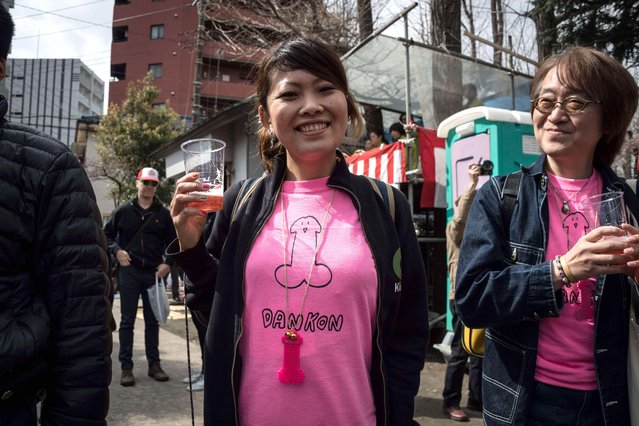
Festival goer with phallus logo t-shirt during the Kanamara Matsuri Steel Phallus Festival at Kawasaki, Japan on April 2, 2017. The Kanamara Matsuri or Festival of the Steel Phallus is held on the first Sunday of April at the Kanayama shrine. The shrine celebrates a legend of a steel pen*s and was frequented by prostitutes who wished to pray for protection from sexually transmitted diseases. Visitors now wish for easy delivery, marriage and matrimonial harmony. Because of the large steel phallus the unusual festival has become a tourist attraction attracting many overseas visitors and is used to raise money for HIV charities. Phallus shaped candy, carved vegetables, decorations, and a big parade are all part of the festival. (Photo by DELETREE/SIPA Press/Rex Features/Shutterstock)

Festival goer with phallus logo t-shirt during the Kanamara Matsuri Steel Phallus Festival at Kawasaki, Japan on April 2, 2017. The Kanamara Matsuri or Festival of the Steel Phallus is held on the first Sunday of April at the Kanayama shrine. The shrine celebrates a legend of a steel pen*s and was frequented by prostitutes who wished to pray for protection from sexually transmitted diseases. Visitors now wish for easy delivery, marriage and matrimonial harmony. Because of the large steel phallus the unusual festival has become a tourist attraction attracting many overseas visitors and is used to raise money for HIV charities. Phallus shaped candy, carved vegetables, decorations, and a big parade are all part of the festival. (Photo by DELETREE/SIPA Press/Rex Features/Shutterstock)
Details
04 Apr 2017 09:48:00
A member of the contemporary circus company Cirk La Putyka perform on the mobile trampoline as he amuses local residents in Prague, Czech Republic, 09 April 2020. The aim of the Cirk La Putyka events in the streets of Czech capital is to get live art back to people during the lockdown. According to them, when people can't go to the artists, to the theater, the actors go to the people. The Czech government has imposed a lockdown in an attempt to slow down the spread of the pandemic COVID-19 disease caused by the SARS-CoV-2 coronavirus. (Photo by Martin Divisek/EPA/EFE)

A member of the contemporary circus company Cirk La Putyka perform on the mobile trampoline as he amuses local residents in Prague, Czech Republic, 09 April 2020. The aim of the Cirk La Putyka events in the streets of Czech capital is to get live art back to people during the lockdown. According to them, when people can't go to the artists, to the theater, the actors go to the people. The Czech government has imposed a lockdown in an attempt to slow down the spread of the pandemic COVID-19 disease caused by the SARS-CoV-2 coronavirus. (Photo by Martin Divisek/EPA/EFE)
Details
11 Apr 2020 00:07:00
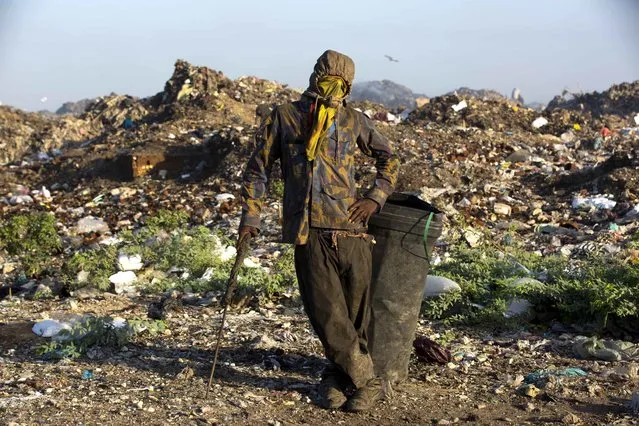
In this August 24, 2018 photo, Changlair Aristide pauses for a portrait, wearing his protective clothing, including an old U.N. peacekeeper's jacket he found in the trash, before scavenging the Truitier landfill in the Cite Soleil slum of Port-au-Prince, Haiti. Before 2004, Aristide recalled having enough money to splurge on shoes, T-shirts and pants, but this year he could not buy his kids anything new for the school year. “Life is like that, up and down”, Aristide said. “They'll go to school anyway, even if I have to sell my pig. I love them”. (Photo by Dieu Nalio Chery/AP Photo)

In this August 24, 2018 photo, Changlair Aristide pauses for a portrait, wearing his protective clothing, including an old U.N. peacekeeper's jacket he found in the trash, before scavenging the Truitier landfill in the Cite Soleil slum of Port-au-Prince, Haiti. Before 2004, Aristide recalled having enough money to splurge on shoes, T-shirts and pants, but this year he could not buy his kids anything new for the school year. “Life is like that, up and down”, Aristide said. “They'll go to school anyway, even if I have to sell my pig. I love them”. (Photo by Dieu Nalio Chery/AP Photo)
Details
03 Oct 2018 00:03:00
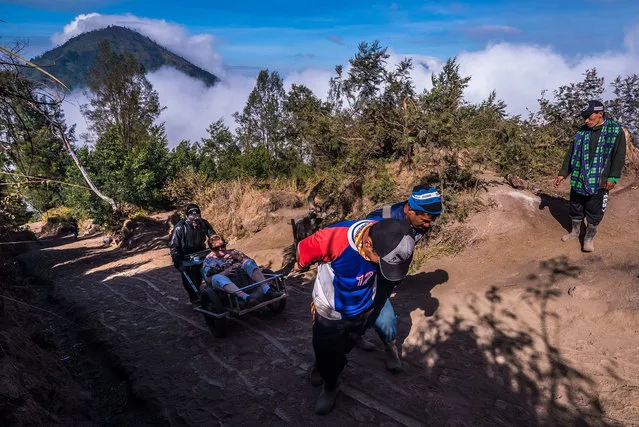
Miners pulling up lazy tourists to the rim of Kawah Ijen (Ijen Volcano), East Java, Indonesia on September 21, 2017. They will earn as much as they would bring down a load of sulfur. Nomadic Explorer, Cultural Lifestyle Photographer Claudio Sieber captured striking images of miners working at Ijen volcanic range in East Java, Indonesia. The sulphur miners risk their lives daily as they climb the active volcano carrying heavy loads, which they sell to sugar refineries. Shortly after midnight curious tourists are flocking in hundreds through the gate of Ijen's foothills to be right on time, driven by the images others took before them. Kawah Ijen is the one of the world's largest acidic volcanic crater lake; famous for its turquoise color as well as the unreal atmosphere it offers during darkness. A dusty path zigzags 3 kilometers up to the crater rim. This doesn't mean anything challenging; in particular, special sights have to be deserved anyway. The irritating smell of sulfur announces the near of the crater's existence. Arriving on the crater's rim the reward for the torture becomes visible. Blue fire darts its tongues through the fumes of sulfur dioxide. Somehow, the spectacle isn't as romantic as expected, since it is also the rough working space of approx. 150 sulfur miners who start their shift at 1 am. Lately, harvesting the abundance of devil's gold received international attention. This did obviously not really improve a miner's lifestyle; neither did it contribute to a better wage. (Photo by Claudio Sieber/Barcroft Images)

Miners pulling up lazy tourists to the rim of Kawah Ijen (Ijen Volcano), East Java, Indonesia on September 21, 2017. They will earn as much as they would bring down a load of sulfur. Nomadic Explorer, Cultural Lifestyle Photographer Claudio Sieber captured striking images of miners working at Ijen volcanic range in East Java, Indonesia. The sulphur miners risk their lives daily as they climb the active volcano carrying heavy loads, which they sell to sugar refineries. (Photo by Claudio Sieber/Barcroft Images)
Details
02 Oct 2017 08:31:00
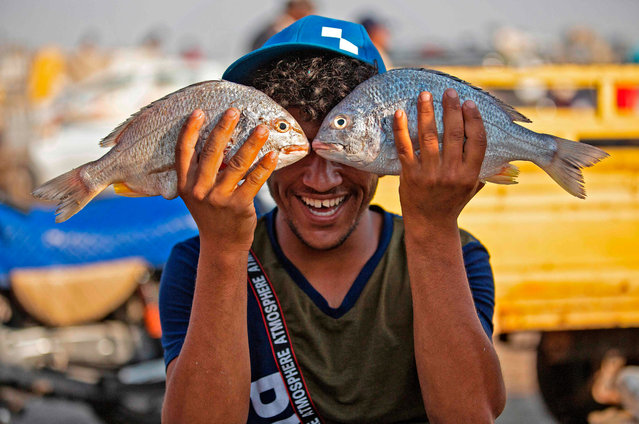
A youth poses while holding two fishes before his face in Iraq's southern port city of al-Faw, 90 kilometres south of Basra near the Shatt al-Arab and the Gulf, on May 18, 2020. In Iraq, a national lockdown to halt the COVID-19 coronavirus pandemic has found some unexpected fans: local businesses who no longer have to compete with Turkish, Iranian or Chinese imports. Those countries, as well as Saudi Arabia, Jordan and Kuwait, typically flood Iraqi markets with inexpensive products at prices local producers can't compete with. (Photo by Hussein Faleh/AFP Photo)

A youth poses while holding two fishes before his face in Iraq's southern port city of al-Faw, 90 kilometres south of Basra near the Shatt al-Arab and the Gulf, on May 18, 2020. In Iraq, a national lockdown to halt the COVID-19 coronavirus pandemic has found some unexpected fans: local businesses who no longer have to compete with Turkish, Iranian or Chinese imports. Those countries, as well as Saudi Arabia, Jordan and Kuwait, typically flood Iraqi markets with inexpensive products at prices local producers can't compete with. (Photo by Hussein Faleh/AFP Photo)
Details
02 Jul 2020 00:01:00
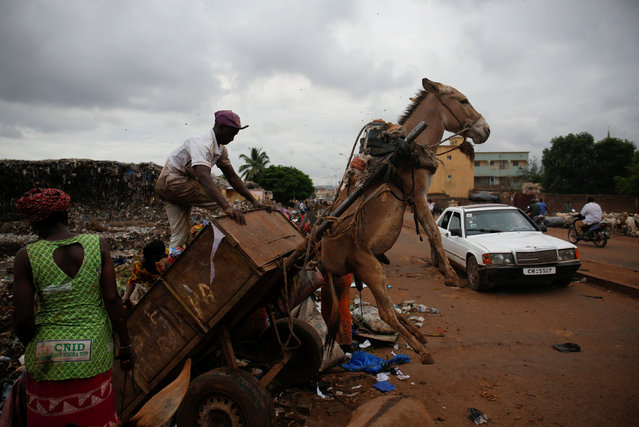
A waste picker unloads garbage at a waste transfer station in Bamako, Mali, August 19, 2018. In the Malian capital of Bamako, donkey carts driven by young men like 19-year-old Arouna Diabate play a vital role battling the fast-growing city's waste problem. Every morning before dawn, Diabate hitches his donkey to a cart and sets off on his rounds, going door-to-door to collect household garbage which he delivers to a local waste transfer station for a monthly salary of around $35. “I won't be picking up trash with a donkey cart for the rest of my life, but for now people appreciate us because we help clean up the homes of Bamako”, Diabate said. (Photo by Luc Gnago/Reuters)

A waste picker unloads garbage at a waste transfer station in Bamako, Mali, August 19, 2018. In the Malian capital of Bamako, donkey carts driven by young men like 19-year-old Arouna Diabate play a vital role battling the fast-growing city's waste problem. Every morning before dawn, Diabate hitches his donkey to a cart and sets off on his rounds, going door-to-door to collect household garbage which he delivers to a local waste transfer station for a monthly salary of around $35. “I won't be picking up trash with a donkey cart for the rest of my life, but for now people appreciate us because we help clean up the homes of Bamako”, Diabate said. (Photo by Luc Gnago/Reuters)
Details
18 Sep 2018 00:01:00