Loading...
Done
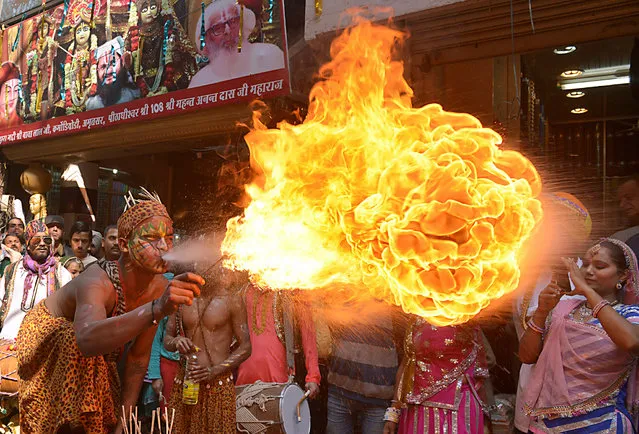
Indian dancers perform a fire breathing act during a procession to mark the 661st anniversary of the birth of Hindu guru Bawa Lal Dayal Maharaj in Amritsar on February 9, 2016. Bawa Lal Dayal Maharaj, a popular leader of his time, is especially revered by devotees of a temple in the town of Dhyanpur, some 45 kms north of Amritsar. (Photo by Narinder Nanu/AFP Photo)

Indian dancers perform a fire breathing act during a procession to mark the 661st anniversary of the birth of Hindu guru Bawa Lal Dayal Maharaj in Amritsar on February 9, 2016. Bawa Lal Dayal Maharaj, a popular leader of his time, is especially revered by devotees of a temple in the town of Dhyanpur, some 45 kms north of Amritsar. (Photo by Narinder Nanu/AFP Photo)
Details
13 Feb 2016 09:02:00
A migrant labourer brushes his teeth in front of a scrapped helicopter model in Mumbai, India, April 13, 2016. (Photo by Danish Siddiqui/Reuters)

A migrant labourer brushes his teeth in front of a scrapped helicopter model in Mumbai, India, April 13, 2016. (Photo by Danish Siddiqui/Reuters)
Details
15 Apr 2016 10:44:00
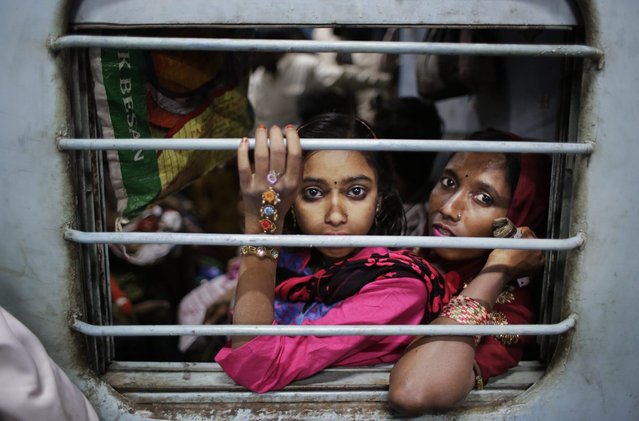
In this November 18, 2014 photo, Murshida, 12, sits on the lap of her mother Marjina as the train leaves for their village in West Bengal, at a railway station in New Delhi, India. Six months ago, Marjina stepped off a train in New Delhi with her two children, hoping to find a better life after her husband abandoned them without so much as a goodbye. (Photo by Altaf Qadri/AP Photo)

In this November 18, 2014 photo, Murshida, 12, sits on the lap of her mother Marjina as the train leaves for their village in West Bengal, at a railway station in New Delhi, India. Six months ago, Marjina stepped off a train in New Delhi with her two children, hoping to find a better life after her husband abandoned them without so much as a goodbye. The family spent their days at a landfill picking through other people’s garbage to find salvageable bits to resell or recycle. After six months of poverty, illness and shame, they returned to that train station in New Delhi, headed back to an uncertain future to their hometown in West Bengal. (Photo by Altaf Qadri/AP Photo)
Details
09 Dec 2014 09:47:00
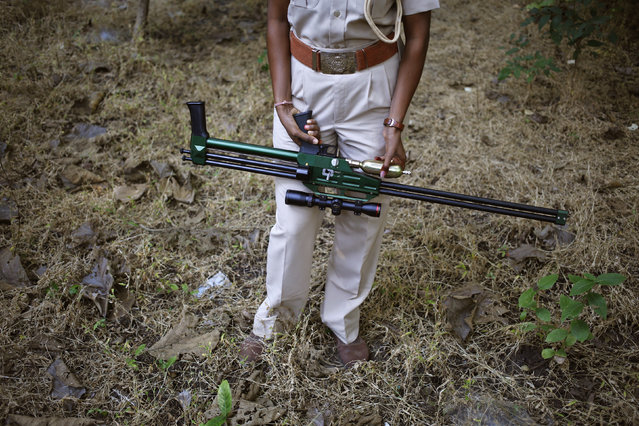
A female forest guard carries a tranquillizer gun in the Gir National Park and Wildlife Sanctuary in Sasan, in Gujarat December 2, 2014. (Photo by Anindito Mukherjee/Reuters)

A female forest guard carries a tranquillizer gun in the Gir National Park and Wildlife Sanctuary in Sasan, in Gujarat December 2, 2014. The sanctuary, which is home to Asiatic lions in India, has an area of 1,412 sq km in which female guards were employed for the first time in India in 2007. The guards fetch a monthly salary of around $148 for working almost 12 hours a day, six days a week, said one of the female guards. (Photo by Anindito Mukherjee/Reuters)
Details
10 Dec 2014 12:37:00
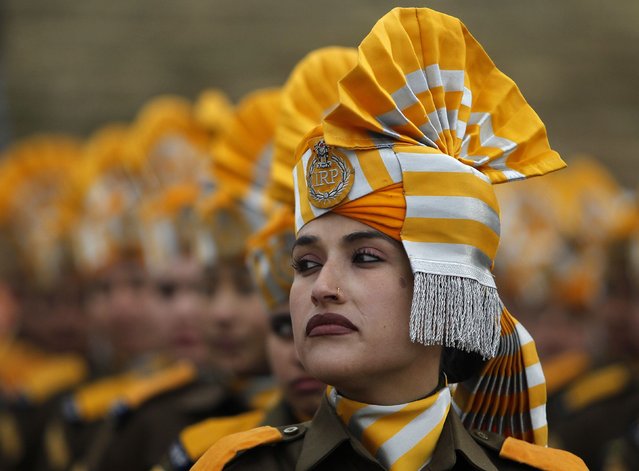
Indian police women take part in a full dress rehearsal for the Republic Day parade in Srinagar January 24, 2015. India will celebrate its annual Republic Day on Monday. (Photo by Danish Ismail/Reuters)

Indian police women take part in a full dress rehearsal for the Republic Day parade in Srinagar January 24, 2015. India will celebrate its annual Republic Day on Monday. (Photo by Danish Ismail/Reuters)
Details
24 Jan 2015 14:24:00
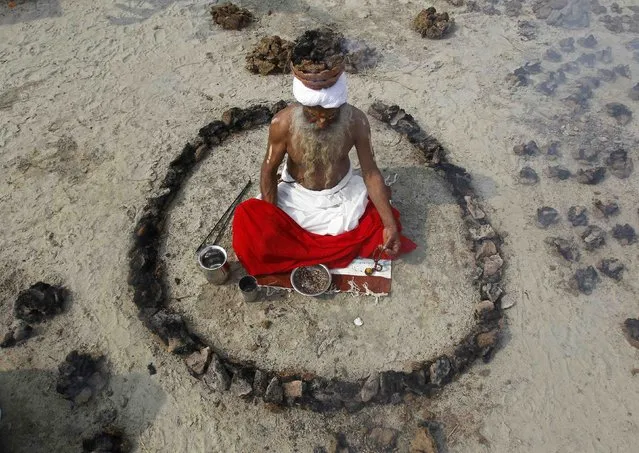
A Sadhu or a Hindu holy man offers prayers while sitting inside a circle of burning “Upale” (or dried cow dung cakes) on the occasion to mark the Basant or spring festival, on the banks of river Ganga in the northern Indian city of Allahabad January 24, 2015. Basant is celebrated mainly in the northern Indian states marking the start of the spring season. (Photo by Jitendra Prakash/Reuters)

A Sadhu or a Hindu holy man offers prayers while sitting inside a circle of burning “Upale” (or dried cow dung cakes) on the occasion to mark the Basant or spring festival, on the banks of river Ganga in the northern Indian city of Allahabad January 24, 2015. Basant is celebrated mainly in the northern Indian states marking the start of the spring season. (Photo by Jitendra Prakash/Reuters)
Details
25 Jan 2015 09:07:00
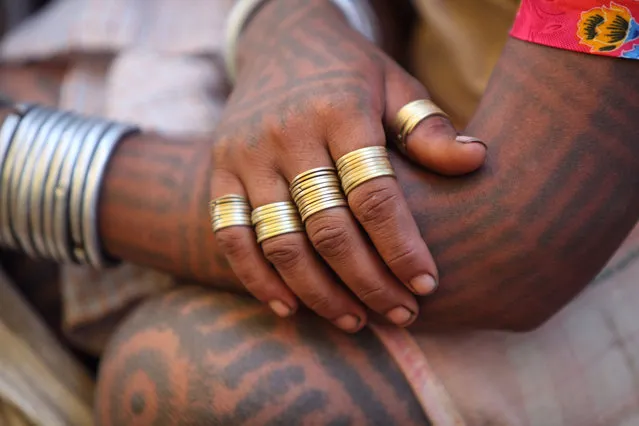
Once applied, the designs are washed using warm water and cow dung. Herbs are applied to promote faster healing. (Photo by Ronny Sen/WaterAid/The Guardian)

For more than 2,000 years, women from the Baiga tribe in the highland district of Dindori, in central India’s Madhya Pradesh state, have been tattooed. Sumintra, 25, from Bona village, has the markings across her forehead, legs and arms. The women who work as tattoo artists are knowledgable about the different types of designs and pigments preferred by various tribes, and their meanings are passed to them by their mothers. The tattooing ‘season’ begins with the approach of winter. (Photo by Ronny Sen/WaterAid/The Guardian)
Details
19 Aug 2017 08:48:00
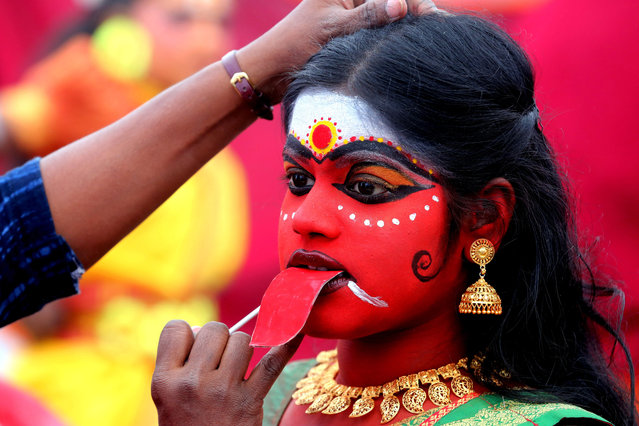
A student from the union territory of Pondicherry prepares to take part in the inaugural session of the national Balrang Festival 2017 in Bhopal, India, 20 December 2017. More than 500 participants from 26 states across the country take part in the three-day long cultural event to showcase their performances. The festival organised by Madhya Pradesh School Education Department and Indira Gandhi Rashtriya Manav Sangralaya. (Photo by Sanjeev Gupta/EPA/EFE)

A student from the union territory of Pondicherry prepares to take part in the inaugural session of the national Balrang Festival 2017 in Bhopal, India, 20 December 2017. More than 500 participants from 26 states across the country take part in the three-day long cultural event to showcase their performances. The festival organised by Madhya Pradesh School Education Department and Indira Gandhi Rashtriya Manav Sangralaya. (Photo by Sanjeev Gupta/EPA/EFE)
Details
26 Dec 2017 08:13:00