Loading...
Done


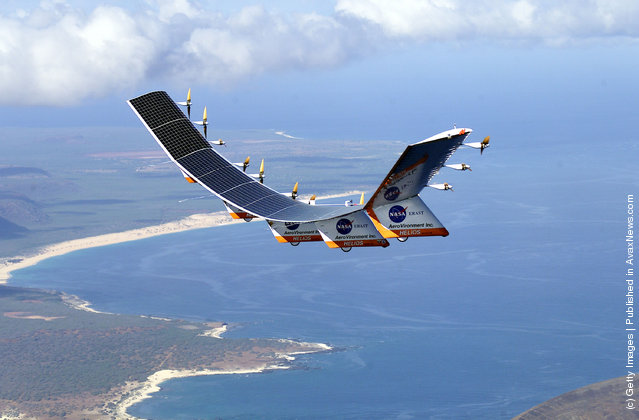
“NASA's Pathfinder, Pathfinder Plus, Centurion and Helios Prototype were an evolutionary series of solar- and fuel-cell-system-powered unmanned aerial vehicles. AeroVironment, Inc. developed the vehicles under NASA's Environmental Research Aircraft and Sensor Technology (ERAST) program. They were built to develop the technologies that would allow long-term, high-altitude aircraft to serve as “atmospheric satellites”, to perform atmospheric research tasks as well as serve as communications platforms”. – Wikipedia

Photo: The solar-electric Helios Prototype flying wing is flies over the Hawaiian islands of Niihau and Lehua during the first solar-powered test flight July 14, 2001 from the U.S. Navy's Pacific Missile Range Facility on Kauai, HI. The 18-hour flight was a functional checkout of the aircraft's systems and performance in preparation for an attempt to reach sustained flight at 100,000 feet altitude later in the summer. (Photo Courtesy of NASA/Getty Images)
Details
14 Jul 2011 09:24:00
North Korean leader Kim Jong Un is hugged by children during his visit to Samjiyon County in this undated photo released by North Korea's Korean Central News Agency (KCNA) in Pyongyang November 28, 2016. (Photo by Reuters/KCNA)

North Korean leader Kim Jong Un is hugged by children during his visit to Samjiyon County in this undated photo released by North Korea's Korean Central News Agency (KCNA) in Pyongyang November 28, 2016. (Photo by Reuters/KCNA)
Details
29 Nov 2016 13:36:00
Kazakh girls watch as the Russian Soyuz TMA-15 rocket carrying Canadian astronaut Robert Thirsk, European Space Agency (ESA) astronaut Frank De Winne of Belgium and Russian cosmonaut Roman Romanenko readies for take-off from the Baikonur cosmodrome, in Kazakhstan on May 27, 2009. Three astronauts, from Canada, Belgium and Russia, blasted off for the International Space Station in a landmark mission that will double its crew to six for the first time. (Photo by Dmitry Kostyukov/AFP Photo)

Kazakh girls watch as the Russian Soyuz TMA-15 rocket carrying Canadian astronaut Robert Thirsk, European Space Agency (ESA) astronaut Frank De Winne of Belgium and Russian cosmonaut Roman Romanenko readies for take-off from the Baikonur cosmodrome, in Kazakhstan on May 27, 2009. Three astronauts, from Canada, Belgium and Russia, blasted off for the International Space Station in a landmark mission that will double its crew to six for the first time. (Photo by Dmitry Kostyukov/AFP Photo)
Details
21 Jun 2020 00:01:00
A picture taken on August 25, 2021 shows a view of the Aletsch Glacier. After hiking for hours across the mountain and a vast expanse of white, Swiss glaciologist Matthias Huss crouches down near the middle of the massive glacier and checks the measurements. Analysis of the data gathered from Aletsch, the largest glacier in the Alps, paints a dire picture of the toll that climate change is taking on the behemoth. (Photo by Fabrice Coffrini/AFP Photo)

A picture taken on August 25, 2021 shows a view of the Aletsch Glacier. After hiking for hours across the mountain and a vast expanse of white, Swiss glaciologist Matthias Huss crouches down near the middle of the massive glacier and checks the measurements. Analysis of the data gathered from Aletsch, the largest glacier in the Alps, paints a dire picture of the toll that climate change is taking on the behemoth. (Photo by Fabrice Coffrini/AFP Photo)
Details
21 Oct 2021 08:38:00
A skier in a festive costume attempts to cross a pool of water at the foot of a ski slope while competing in the annual Gornoluzhnik amateur event to mark the end of the ski season at the Bobrovy Log ski resort in the suburbs of the Siberian city of Krasnoyarsk, Russia, April 14, 2019. (Photo by Ilya Naymushin/Reuters)

A skier in a festive costume attempts to cross a pool of water at the foot of a ski slope while competing in the annual Gornoluzhnik amateur event to mark the end of the ski season at the Bobrovy Log ski resort in the suburbs of the Siberian city of Krasnoyarsk, Russia, April 14, 2019. (Photo by Ilya Naymushin/Reuters)
Details
17 Apr 2019 00:07:00
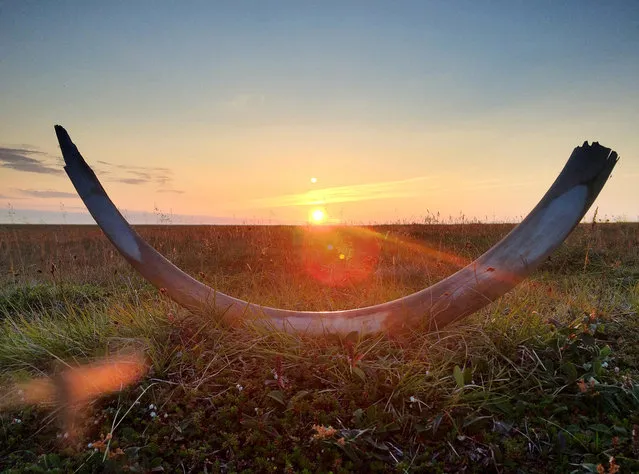
The tusk of a woolly mammoth that lived some 18,000 years ago, from which researchers sequenced the extinct mammal's entire genome, is seen in northeastern Siberia in this photo from 2015. (Photo by Love Dalen/Handout via Reuters)

The tusk of a woolly mammoth that lived some 18,000 years ago, from which researchers sequenced the extinct mammal's entire genome, is seen in northeastern Siberia in this photo from 2015. (Photo by Love Dalen/Handout via Reuters)
Details
09 Jun 2023 02:57:00
An RNLI Lifeboat crashes through waves during a multi-agency exercise to test emergency response, at Camber Sands, East Sussex, England, Thursday, September 28, 2023. The multi-agency exercise, organised by South East Coast Ambulance Service, (SECAmb) also includes Sussex Police, East Sussex Fire and Rescue Service, Rother District Council, HM Coastguard and RNLI Lifeguards. (Photo by Gareth Fuller/PA Wire via AP Photo)

An RNLI Lifeboat crashes through waves during a multi-agency exercise to test emergency response, at Camber Sands, East Sussex, England, Thursday, September 28, 2023. The multi-agency exercise, organised by South East Coast Ambulance Service, (SECAmb) also includes Sussex Police, East Sussex Fire and Rescue Service, Rother District Council, HM Coastguard and RNLI Lifeguards. (Photo by Gareth Fuller/PA Wire via AP Photo)
Details
30 Oct 2023 06:00:00
Hundreds of flamingos take flight in the Rift Valley in East Africa early September 2024. The birds gather in the region’s saline lakes to eat the blue-green algae that grows in abundance. The red-orange pigment in the algae is what gives them their distinctive pink plumage. They also use the site to breed. (Photo by Alexandre and Chloe Bes/Naturagency/Solent News)

Hundreds of flamingos take flight in the Rift Valley in East Africa early September 2024. The birds gather in the region’s saline lakes to eat the blue-green algae that grows in abundance. The red-orange pigment in the algae is what gives them their distinctive pink plumage. They also use the site to breed. (Photo by Alexandre and Chloe Bes/Naturagency/Solent News)
Details
23 Sep 2024 02:54:00