Loading...
Done
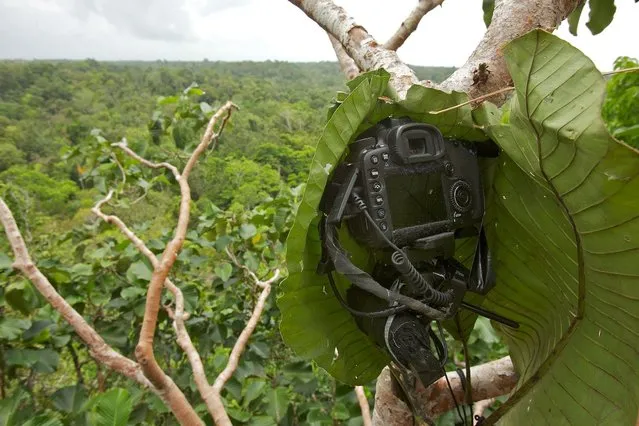
Tim Laman - Wildlife Photojournalist

Tim Laman is a field biologist and wildlife photojournalist. His pioneering research in the rain forest canopy in Borneo led to a PhD from Harvard and his first National Geographic article in 1997. Since then, he has pursued his passion for exploring wild places and documenting little-known and endangered wildlife by becoming a regular contributor to National Geographic. He has eighteen articles to his credit to date, all of which have had a conservation message. Some have focused on endangered species such as Orangutans or Hornbills, while others, such as a series of articles on Conservation International’s Biodiversity Hotspots, have highlighted regions under intense pressure.
Details
14 Sep 2013 10:13:00
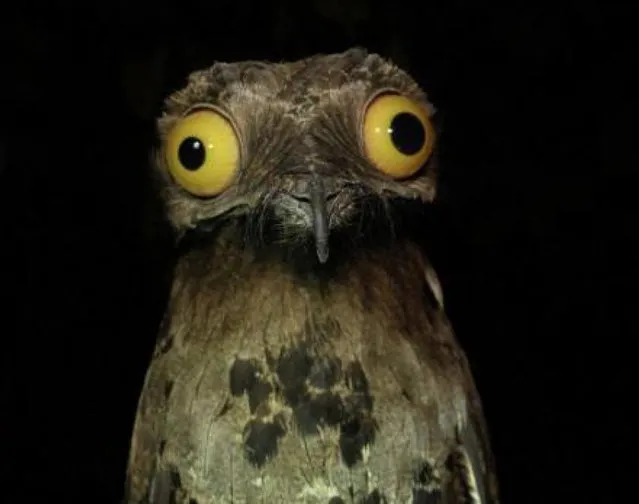
Nightjars And Pooto Bird

Potoos (family Nyctibiidae) are a group of near passerine birds related to the nightjars and frogmouths. They are sometimes called Poor-me-ones, after their haunting calls. There are seven species in one genus, Nyctibius, in tropical Central and South America.
These are nocturnal insectivores which lack the bristles around the mouth found in the true nightjars. They hunt from a perch like a shrike or flycatcher. During the day they perch upright on tree stumps, camouflaged to look like part of the stump. The single spotted egg is laid directly on the top of a stump.
Details
20 Jan 2014 14:34:00
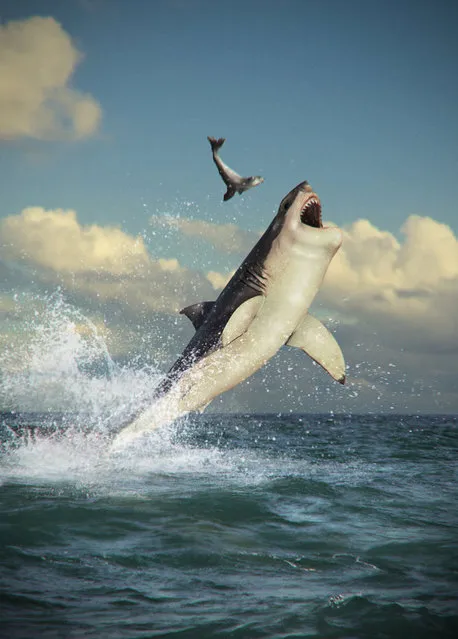
Perfect Predators: White Sharks

The great white shark, Carcharodon carcharias, also known as the great white, white pointer, white shark, or white death, is a species of large lamniform shark which can be found in the coastal surface waters of all the major oceans. The great white shark is mainly known for its size, with the largest individuals known to have approached or exceeded 6 m (20 ft) in length, and 2,268 kg (5,000 lb) in weight. This shark reaches its maturity around 15 years of age and can have a life span of over 30 years.
Details
01 Apr 2013 10:02:00
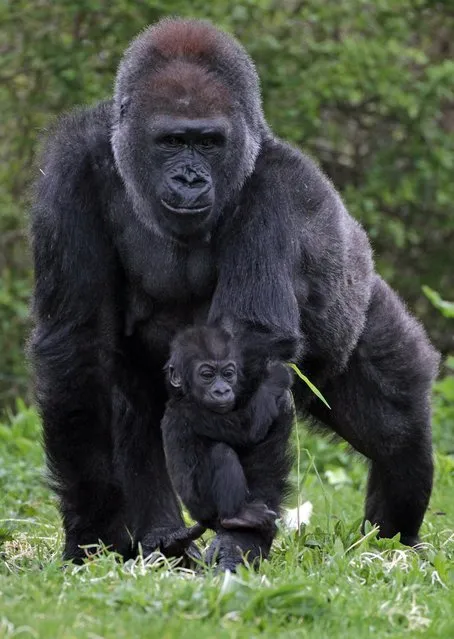
Bristol Zoo's baby gorilla Kukena

Bristol Zoo's baby gorilla Kukena holds onto his mother's arm as he ventures out of his enclosure at Bristol Zoo's Gorilla Island on May 4, 2012 in Bristol, England. The seven-month-old western lowland gorilla is starting to find his feet as he learns to walk having been born at the zoo in September. Kukena joins a family of gorillas at the zoo that are part of an international conservation breeding programme for the western lowland gorilla, which is a critically endangered species. (Photo by Matt Cardy)
Details
09 May 2012 02:26:00
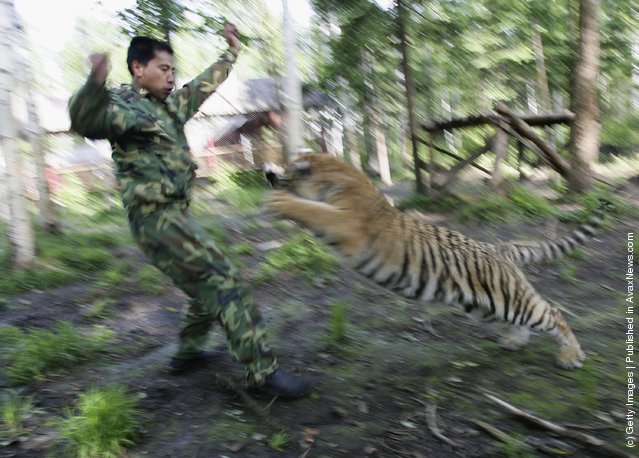
A feeder trains a Siberian tiger cub

A feeder trains a Siberian tiger cub at Erdaohe Tiger Park July 2, 2006 in Antu County of Yanbian Chaoxian Autonomous Prefecture, Jilin Province, China. About 15 artificially-fed Siberian tigers from Harbin Siberian Tiger Park are being trained to develop their ability to live in the wild. The wild Siberian tiger is listed as one of the most endangered species in the world, with its existing number estimated at around 400 worldwide, mainly in the northeastern part of China and the Far East of Russia. Reportedly there are more than 1,300 Siberian tigers which have been raised in China. (Photo by China Photos/Getty Images)
Details
01 Oct 2011 12:23:00


CHALLOCK, ENGLAND - MARCH 31: Tony Hall walks with his dog through an installation entitled 'Super Kingdom', which hangs in trees in King's Wood as part of the Stour Valley Arts project on March 31, 2011 in Challock, England. The works by artists Bruce Gilchrist and Jo Joelson of 'London Fieldworks' consist of a series of interesting animal habitats, modelled on the palaces of Stalin, Ceauscescu and Mussolini, and offer nesting sites to many native and migrant species. (Photo by Dan Kitwood/Getty Images)
Details
20 Nov 2011 19:03:00
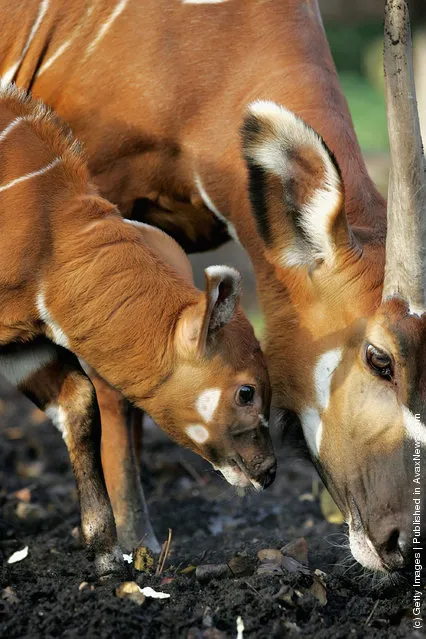
The one month old newborn Bongo Antelope

“The western or lowland bongo is a herbivorous, mostly nocturnal forest ungulate and among the largest of the African forest antelope species. Bongos are characterised by a striking reddish-brown coat, black and white markings, white-yellow stripes and long slightly spiralled horns”. – Wikipedia

Photo: The one month old newborn Bongo Antelope Calf ventures out in the cold with his mother in their enclosure at London Zoo on December 9, 2005 in London, England. (Photo by Christopher Lee/Getty Images)
Details
21 Feb 2012 12:17:00
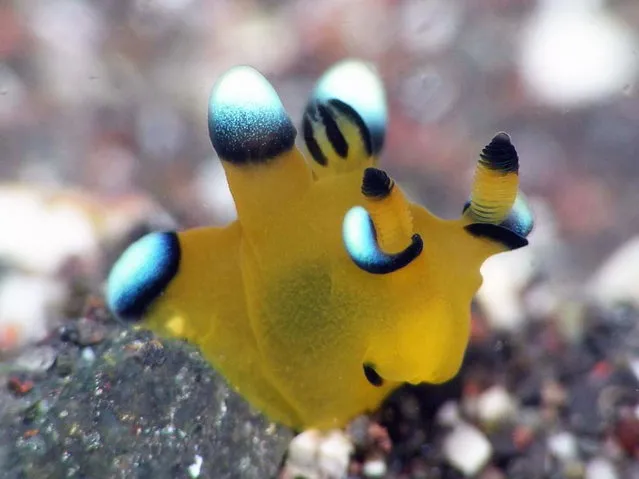
Thecacera Pacifica AKA Pikachu

If you ever wanted to meet a live Pikachu, you might have a hard time finding one. However, there is a creature on this Earth that kind of looks like one. That creature’s name is Thecacera pacifica and it is a species of a sea slug. These little critters can be found in the Indian Ocean from African coast to Indonesia and Vanuatu. Their vibrant orange and blue colors look gorgeous, making it look like some sort of anemone. Also, as you might have guessed from the striking colors of the sea slug, just like most of anemones, this creature is very toxic. Thus, keeping it as a pet isn’t an option.

Details
19 Dec 2014 12:51:00