Loading...
Done
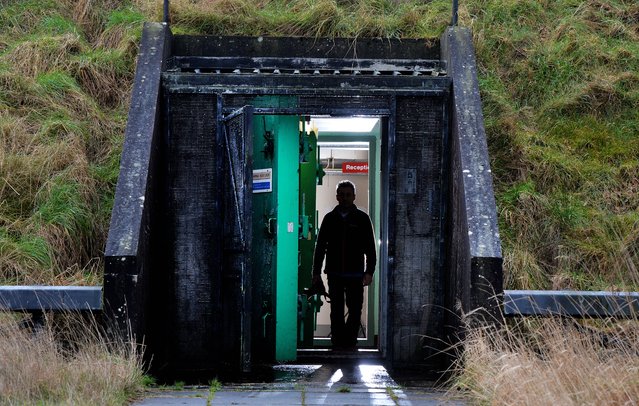
The main entrance and blast door at the nuclear bunker site on the Woodside Road industrial estate on February 4, 2016 in Ballymena, Northern Ireland. The underground shelter has been put up for sale by the offices of the Northern Ireland First and Deputy First Minister. The bunker which was completed in 1990 was built to hold up to 235 people in the event of a nuclear bomb and is complete with kitchen facilities, dormitories and decontamination chambers. (Photo by Charles McQuillan/Getty Images)

The main entrance and blast door at the nuclear bunker site on the Woodside Road industrial estate on February 4, 2016 in Ballymena, Northern Ireland. The underground shelter has been put up for sale by the offices of the Northern Ireland First and Deputy First Minister. The bunker which was completed in 1990 was built to hold up to 235 people in the event of a nuclear bomb and is complete with kitchen facilities, dormitories and decontamination chambers. The site, one of approximately 1,600 nuclear monitoring posts built in the UK since 1955, is on the housing market with an asking price of £575,000. (Photo by Charles McQuillan/Getty Images)
Details
05 Feb 2016 10:55:00
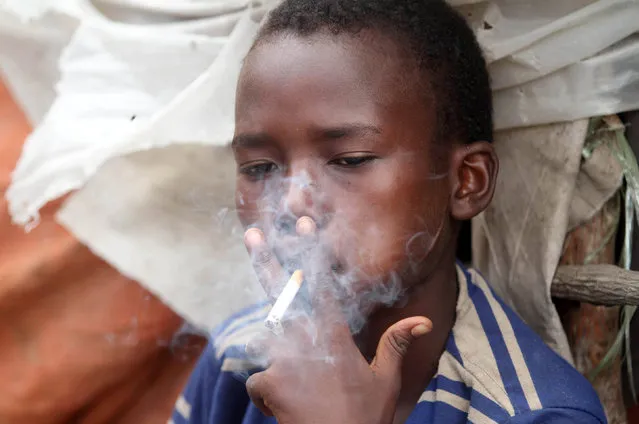
Abdulahi Yaroow, 13, smokes a cigarette while chewing khat at the same time in Mogadishu August 10, 2014. (Photo by Thomas Mukoya/Reuters)

Abdulahi Yaroow, 13, smokes a cigarette while chewing khat at the same time in Mogadishu August 10, 2014. Grown on plantations in the highlands of Kenya and Ethiopia, tonnes of khat, or qat, dubbed “the flower of paradise” by its users, are flown daily into Mogadishu airport, to be distributed from there in convoys of lorries to markets across Somalia. Britain, whose large ethnic Somali community sustained a lucrative demand for the leaves, banned khat from July as an illegal drug. This prohibition jolted the khat market, creating a supply glut in Somalia and pushing down prices, to the delight of the many connoisseurs of its amphetamine-like high. (Photo by Thomas Mukoya/Reuters)
Details
28 Aug 2014 10:35:00
A replica model of a Lamborghini Aventador LP 700-4 in Dubai, UAE. This is the world's most expensive model car, made from carbon fibre and covered in a thin layer of pure gold. (Photo by Robert Gulpen/Barcroft Media)

A replica model of a Lamborghini Aventador LP 700-4 in Dubai, UAE. This is the world's most expensive model car, made from carbon fibre and covered in a thin layer of pure gold. The 1:8 scale replica Lamborghini Aventador LP 700-4, designed by German engineer Robert Gülpen, is available to buy for £200,000. But amazingly this model – currently on display at the Lamborghini showroom in Dubai – is just a prototype for a solid gold model, which will go up for auction in 2014 with a price tag of £4.6 million. (Photo by Robert Gulpen/Barcroft Media)
Details
19 May 2014 11:23:00
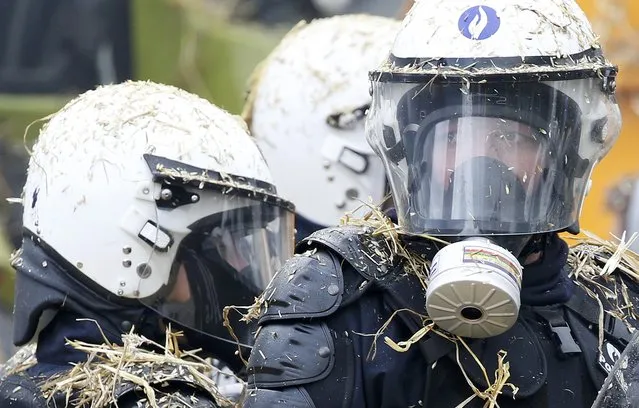
Belgian riot police officers are covered by hay and eggs thrown by demonstrators as farmers and dairy farmers from all over Europe take part in a demonstration outside an European Union farm ministers emergency meeting at the EU Council headquarters in Brussels, Belgium, September 7, 2015. (Photo by Jacky Naegelen/Reuters)

Belgian riot police officers are covered by hay and eggs thrown by demonstrators as farmers and dairy farmers from all over Europe take part in a demonstration outside an European Union farm ministers emergency meeting at the EU Council headquarters in Brussels, Belgium, September 7, 2015. Thousands of farmers gathered in the European capital calling for more help with low prices and high costs. (Photo by Jacky Naegelen/Reuters)
Details
08 Sep 2015 11:17:00
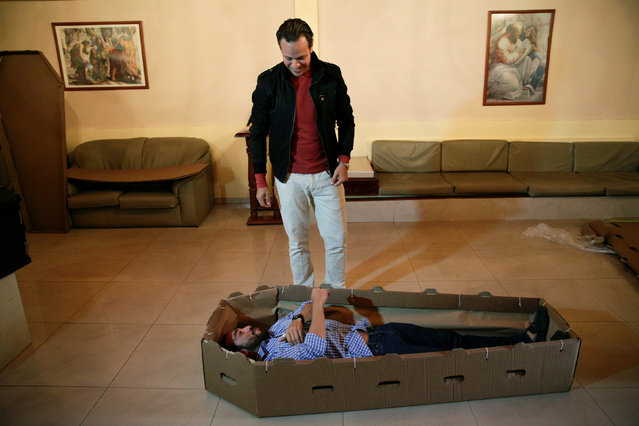
Elio Angulo (bottom C) lies inside a cardboard coffin next to Alejandro Blanchard as they introduce their product to potential customers at a mortuary in Valencia, in the state of Carabobo, Venezuela August 25, 2016. (Photo by Marco Bello/Reuters)

Elio Angulo (bottom C) lies inside a cardboard coffin next to Alejandro Blanchard as they introduce their product to potential customers at a mortuary in Valencia, in the state of Carabobo, Venezuela August 25, 2016. When Venezuelan entrepreneurs Alejandro Blanchard and Elio Angulo decided to create cardboard coffins, they were looking for an ecological selling point to compete against classic wood and brass caskets. Three years on, with the oil-rich country mired in deep economic crisis, their “bio-coffins” are becoming a viable option because of high prices for wooden coffins and shortages of brass ones. (Photo by Marco Bello/Reuters)
Details
27 Aug 2016 11:18:00
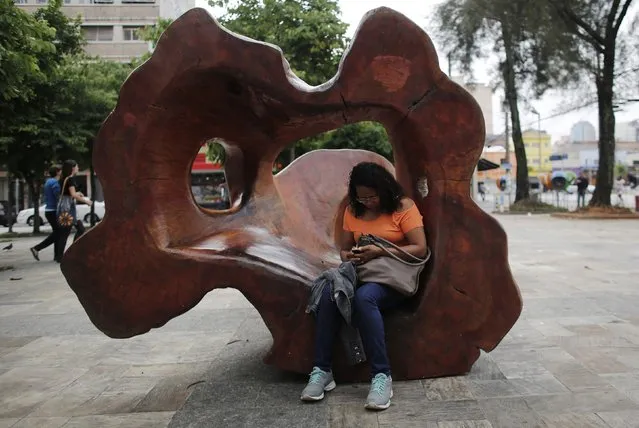
A resident types a text message on her mobile phone, as she sits on a bench made from a tree, which is a creation by Brazilian artist Hugo Franca at Largo da Batata square in Sao Paulo March 17, 2015. (Photo by Nacho Doce/Reuters)

A resident types a text message on her mobile phone, as she sits on a bench made from a tree, which is a creation by Brazilian artist Hugo Franca at Largo da Batata square in Sao Paulo March 17, 2015. Franca, a designer from Sao Paulo is working with the city to make use of fallen trees to turn them into sculpture furniture to line the city's parks, streets and plazas. Brazil's largest city was slammed by several strong storms this rainy season that brought with them heavy rain, lightning and winds as high as 90 kilometres (55 miles) per hour. (Photo by Nacho Doce/Reuters)
Details
20 Mar 2015 11:34:00
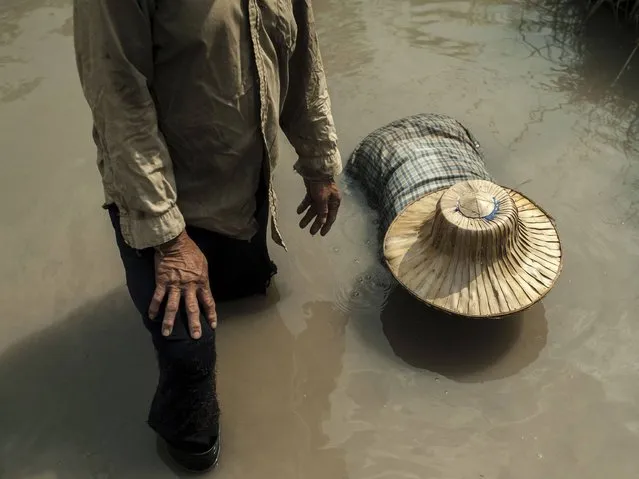
The workers begin to search for gold at 10 am and work until sunset, often working second jobs in the day in order to survive. (Photo by Borja Sanchez-Trillo/Getty Images)

Two workers shovel mud from the river as they look for gold on March 25, 2014 in Lampang, Thailand. Thai villagers from Wang Nuea, North of Thailand, look for gold in the river every year during the drought season. They are able to make an average around USD 15 per day, however two years ago they reached USD 200 in one day due to the river level dropping so much. The workers begin to search for gold at 10 AM and work until sunset, often working second jobs in the day in order to survive. (Photo by Borja Sanchez-Trillo/Getty Images)
Details
27 Mar 2014 06:09:00
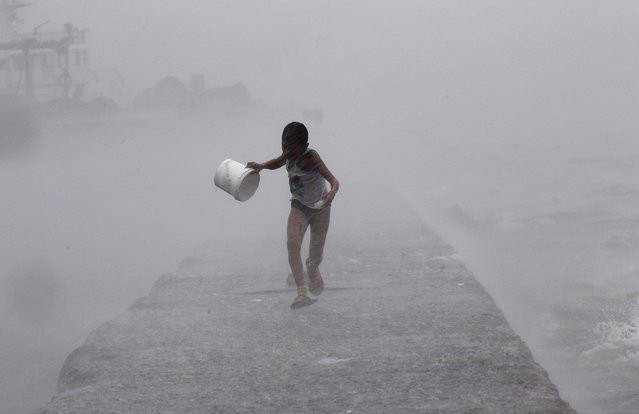
A boy runs as heavy rains and high waves brought by typhoon Linfa, locally named Egay, crash along a breakwater along Manila Bay at a slum area in Baseco, Tondo in Manila July 6, 2015. (Photo by Romeo Ranoco/Reuters)

A boy runs as heavy rains and high waves brought by typhoon Linfa, locally named Egay, crash along a breakwater along Manila Bay at a slum area in Baseco, Tondo in Manila July 6, 2015. All shipping was ordered to remain in harbor and some flights were canceled in the northern Philippines, while schools were closed in the capital, Manila, on Monday due to flooding and landslides from a tropical storm, disaster officials said. Storm warnings were issued in at least 14 areas of the main Philippine island of Luzon as tropical storm Linfa moved slowly across the north of the Southeast Asian archipelago. It was carrying maximum wind gusts of 100 km per hour (60 mph). (Photo by Romeo Ranoco/Reuters)
Details
07 Jul 2015 12:25:00