Loading...
Done


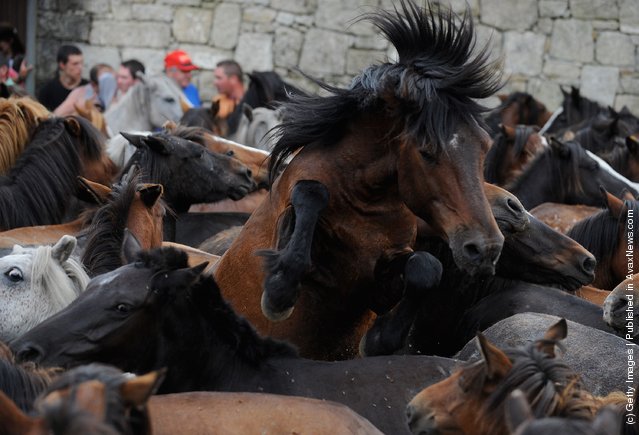
“Rapa das Bestas is the name of an operation that involves cutting the manes of the horses that are performed in the curros (enclosed which retain the horses) held in various locations in Galicia (Spain).

The best known is the Rapa das Bestas of Sabucedo, in the city hall of A Estrada, which lasts three days: the First Saturday, Sunday and Monday in July. In fact, the name given to the celebration (Rapa das Bestas of Sabucedo), while in most places speaking about curros, including curros de Valga, etc”. – Wikipedia

Photo: A wild horse leaps up during the Rapa das Bestas (shearing of the beasts) festival on July 2, 2011 in Sabucedo, Spain. Hundreds of wild horses are rounded up from the mountains and trimmed and marked in the corral. (Photo by Denis Doyle/Getty Images)
Details
03 Jul 2011 12:30:00
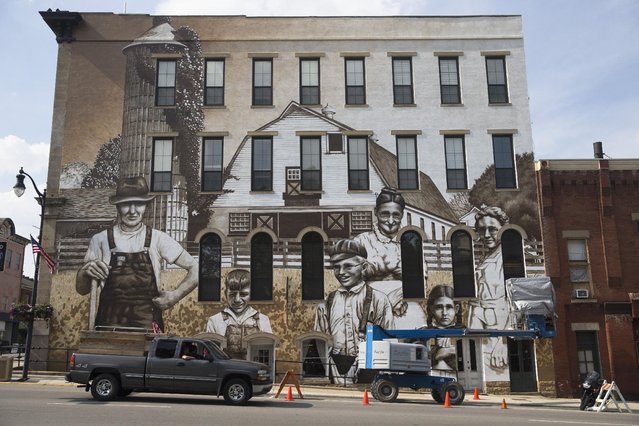
Artist Jason Morgan works on a mural named "Heritage Harvesters" as commissioned by a building owner to depict farmers from the community, Thursday, June 11, 2015, in Wilmington, Ohio. Locals were asked to send photographs of their ancestors who lived in the Wilmington area to adorn the edifice that sits along the town's main drag. (AP Photo/John Minchillo)

Artist Jason Morgan works on a mural named "Heritage Harvesters" as commissioned by a building owner to depict farmers from the community, Thursday, June 11, 2015, in Wilmington, Ohio. Locals were asked to send photographs of their ancestors who lived in the Wilmington area to adorn the edifice that sits along the town's main drag. (AP Photo/John Minchillo)
Details
22 Jun 2015 12:05:00
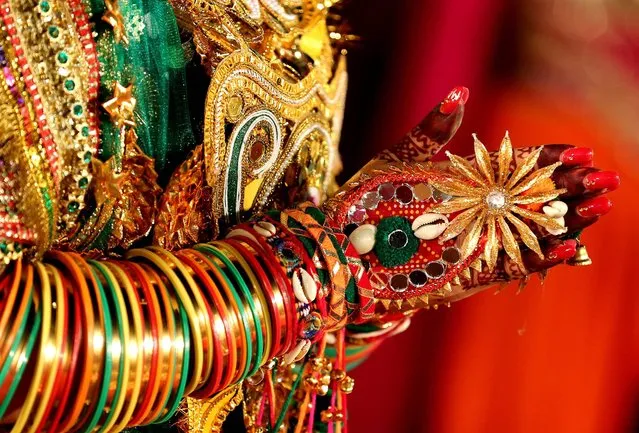
A photograph made available on 02 October 2016 showing Indian people dressed in traditional attire performing the Garba dance, a ritual performed to appease Goddess Durga, in a religious event named, “Abhivyakti 2016” during the nine-day long Navratri festival in Bhopal, India, 01 October 2016 Celebrated twice a year during the spring and the fall season, the Navratri festival is dedicated to the Hindu Goddess Durga. (Photo by Sanjeev Gupta/EPA)

A photograph made available on 02 October 2016 showing Indian people dressed in traditional attire performing the Garba dance, a ritual performed to appease Goddess Durga, in a religious event named, “Abhivyakti 2016” during the nine-day long Navratri festival in Bhopal, India, 01 October 2016 Celebrated twice a year during the spring and the fall season, the Navratri festival is dedicated to the Hindu Goddess Durga. (Photo by Sanjeev Gupta/EPA)
Details
07 Oct 2016 09:02:00
The Tianzi Hotel with the shape of Chinese deities Fu, Lu and Shou is pictured on November 20, 2017 in Langfang, Hebei Province of China. The 41.6-meter-tall Tianzi Hotel has an exterior of Chinese Sanxing, whose names are Fu, Lu and Shou with the qualities of prosperity, status and longevity in traditional Chinese culture, in Langfang city. (Photo by VCG/VCG via Getty Images)

The Tianzi Hotel with the shape of Chinese deities Fu, Lu and Shou is pictured on November 20, 2017 in Langfang, Hebei Province of China. The 41.6-meter-tall Tianzi Hotel has an exterior of Chinese Sanxing, whose names are Fu, Lu and Shou with the qualities of prosperity, status and longevity in traditional Chinese culture, in Langfang city. (Photo by VCG/VCG via Getty Images)
Details
23 Nov 2017 08:41:00
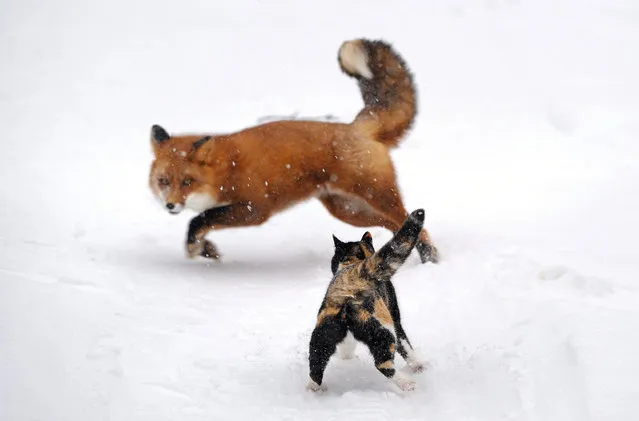
Respect, Kronotsky nature reserve, Russia. The photographer’s cat, Ryska – her name means little lynx in Russian – stands outside their cabin and with aggressive posturing warns off a fox. In winter, foxes would regularly visit the cabin searching for food. If one peered in at the window, possible when the snow was deep, Ryska would sit on the other side, fur raised, and growl. When outside, she would hold her ground. The foxes were not always frightened and so encounters could be a sort of dance. (Photo by Igor Shpilenok/Unforgettable Behaviour/NHM)

Respect, Kronotsky nature reserve, Russia. The photographer’s cat, Ryska – her name means little lynx in Russian – stands outside their cabin and with aggressive posturing warns off a fox. In winter, foxes would regularly visit the cabin searching for food. If one peered in at the window, possible when the snow was deep, Ryska would sit on the other side, fur raised, and growl. When outside, she would hold her ground. The foxes were not always frightened and so encounters could be a sort of dance. (Photo by Igor Shpilenok/Unforgettable Behaviour/NHM)
Details
08 Apr 2017 09:14:00
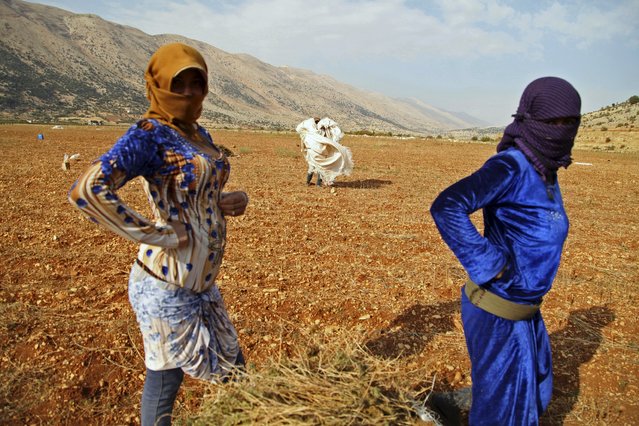
Aisha, 15, (L) (who asked to withhold her last name), a Syrian refugee from Raqqa, waits with a fellow refugee while harvesting cannabis in the Bekaa valley, Lebanon October 19, 2015. Syrian refugees work to harvest and process spiky-leafed cannabis plants in neighbouring Lebanon’s Bekaa Valley. (Photo by Alia Haju/Reuters)

Aisha, 15, (L) (who asked to withhold her last name), a Syrian refugee from Raqqa, waits with a fellow refugee while harvesting cannabis in the Bekaa valley, Lebanon October 19, 2015. Syrian refugees work to harvest and process spiky-leafed cannabis plants in neighbouring Lebanon’s Bekaa Valley. Often farmers of cotton and wheat back home in Raqqa province – now the de facto capital of Islamic State – the conflict in Syria drove them to seek safety in a region where Syrian migrant workers used to spend a few months a year before returning home. (Photo by Alia Haju/Reuters)
Details
24 Dec 2015 08:03:00
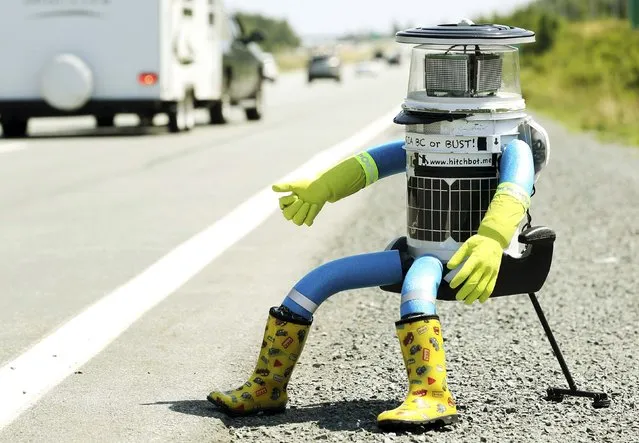
The anthropomorphic robot named hitchBOT sits on the shoulder of Highway 102 to begin its 6000 kilometer cross country journey outside of Halifax, Nova Scotia, July 27, 2014. The hitch hiking robot is part of a social experiment to see if drivers will pick up and drop off the robot in one piece to an art gallery in Victoria, British Columbia. (Photo by Paul Darrow/Reuters)

The anthropomorphic robot named hitchBOT sits on the shoulder of Highway 102 to begin its 6000 kilometer cross country journey outside of Halifax, Nova Scotia, July 27, 2014. The hitch hiking robot is part of a social experiment to see if drivers will pick up and drop off the robot in one piece to an art gallery in Victoria, British Columbia. (Photo by Paul Darrow/Reuters)
Details
02 Aug 2014 13:12:00
Self-titled Pricasso – real name Tim Patch, 71, – is using his very own pen*s to create his masterpiece – and claims to have made close to £500k from his saucy paintings. Here: Pricasso gets to work with his tools - and paints The Sun's newspaper correspondent Amy Nickell with his bits in London, England on November 5, 2019. (Photo by Stewart Williams/The Sun)

Self-titled Pricasso – real name Tim Patch, 71, – is using his very own pen*s to create his masterpiece – and claims to have made close to £500k from his saucy paintings. Here: Pricasso gets to work with his tools - and paints The Sun's newspaper correspondent Amy Nickell with his bits in London, England on November 5, 2019. (Photo by Stewart Williams/The Sun)
Details
17 Jan 2020 00:05:00