Loading...
Done
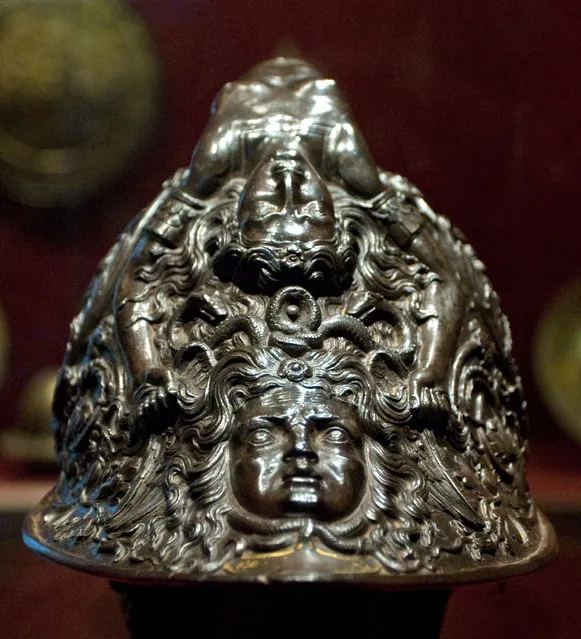
Heroic Armor Of The Italian Renaissance By Filippo Negroli

Filippo Negroli (ca. 1510–1579) was an armourer from Milan. He was renowned as being extremely skilled, and may be considered the most famous armourer of all time. Working together with his younger brothers Giovan Battista (ca. 1511-1591) and Francesco (ca. 1522-1600) in the Negroli family workshop headed by their father Gian Giacomo Negroli (ca. 1463-1543), Filippo was specialized in repoussé of armour, whereas his brother Francesco was renowned for his damascening skills.
Details
21 Aug 2015 10:59:00
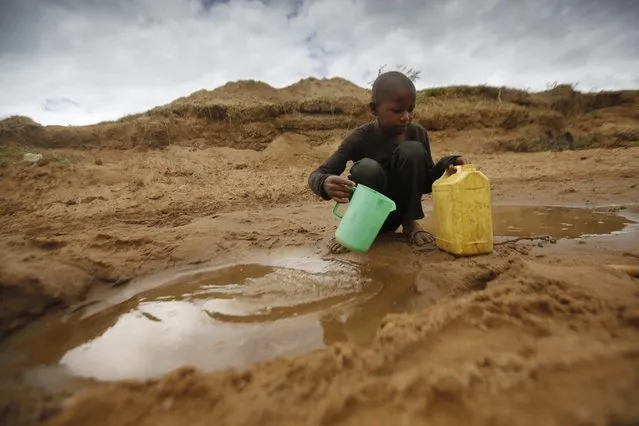
A young boy scoops water from a hand-dug well in the dry riverbed near Matinyani, in the semi-arid Kitui County in southeastern Kenya, 22 March 2015, the World Water Day. Residents of Kitui County and other arid and semi-arid areas of the country have been hard-hit by extremely poor rainfall this year while the government said in previous month that some 1.6 million people countrywide are facing acute starvation due to the drought and will need relief food over the next six months. (Photo by Dai Kurokawa/EPA)

A young boy scoops water from a hand-dug well in the dry riverbed near Matinyani, in the semi-arid Kitui County in southeastern Kenya, 22 March 2015, the World Water Day. Residents of Kitui County and other arid and semi-arid areas of the country have been hard-hit by extremely poor rainfall this year while the government said in previous month that some 1.6 million people countrywide are facing acute starvation due to the drought and will need relief food over the next six months. Residents of Matinyani say they haven't seen a drop of rain in nearly four months. Thousands of Kenyans in rural areas walk tens of kilometers just to fetch water to drink and to be used in their homes. According to an estimate by UNESCO (United Nations Educational, Scientific and Cultural Organization), 17 million people lack access to safe water in Kenya, where the drought is a perennial problem. (Photo by Dai Kurokawa/EPA)
Details
23 Mar 2015 11:01:00
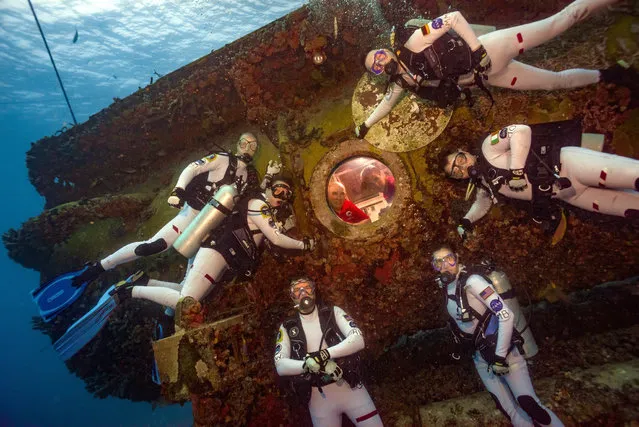
The NASA Extreme Environment Mission Operations (NEEMO) 21 mission began on July 21 as an international crew of aquanauts splashed down to the undersea Aquarius Reef Base, located 62 feet below the surface of the Atlantic Ocean in the Florida Keys National Marine Sanctuary. The NEEMO 21 crew will perform research both inside and outside the habitat during a 16-day simulated space mission. During simulated spacewalks carried out underwater, they will evaluate tools and mission operation techniques that could be used in future space missions, including journeys to Mars. (Photo by Karl Shreeves/NASA)

The NASA Extreme Environment Mission Operations (NEEMO) 21 mission began on July 21 as an international crew of aquanauts splashed down to the undersea Aquarius Reef Base, located 62 feet below the surface of the Atlantic Ocean in the Florida Keys National Marine Sanctuary. The NEEMO 21 crew will perform research both inside and outside the habitat during a 16-day simulated space mission. During simulated spacewalks carried out underwater, they will evaluate tools and mission operation techniques that could be used in future space missions, including journeys to Mars. (Photo by Karl Shreeves/NASA)
Details
31 Jul 2016 11:29:00
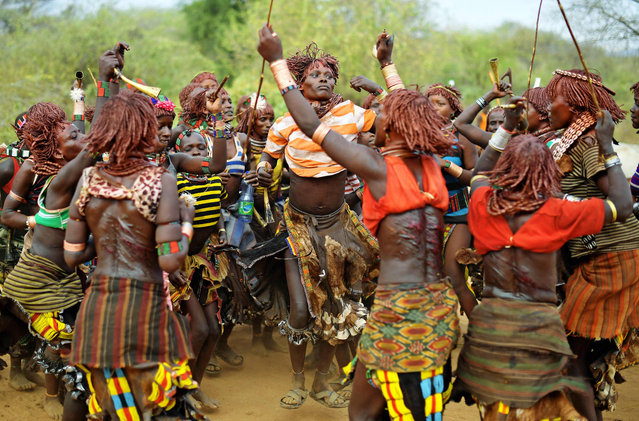
Hamar women dance before a bull jumping ceremony in Ethiopia's southern Omo Valley region near Turmi on September 19, 2016. The Hamar are a Nilotic ethnic group in Ethiopia. The construction of the Gibe III dam, the third largest hydroelectric plant in Africa, and large areas of very “thirsty” cotton and sugar plantations and factories along the Omo river are impacting heavily on the lives of tribes living in the Omo Valley who depend on the river for their survival and way of life. Human rights groups fear for the future of the tribes if they are forced to scatter, give up traditional ways through loss of land or ability to keep cattle as globalisation and development increases. (Photo by Carl De Souza/AFP Photo)

Hamar women dance before a bull jumping ceremony in Ethiopia's southern Omo Valley region near Turmi on September 19, 2016. The Hamar are a Nilotic ethnic group in Ethiopia. The construction of the Gibe III dam, the third largest hydroelectric plant in Africa, and large areas of very “thirsty” cotton and sugar plantations and factories along the Omo river are impacting heavily on the lives of tribes living in the Omo Valley who depend on the river for their survival and way of life. (Photo by Carl De Souza/AFP Photo)
Details
02 Oct 2016 08:45:00
A Russian peacekeeper shouts “No pictures!” at a checkpoint outside the city of Stepanakert on November 13, 2020, during a ceasefire in the military conflict between Armenia and Azerbaijan over the breakaway region of Nagorno-Karabakh. Russian began deploying 2,000 peacekeepers to Nagorno-Karabakh on November 10 after Armenia and Azerbaijan agreed a peace deal to end weeks of fierce fighting over the disputed region. The Moscow-brokered agreement came after a string of Azerbaijani victories in its fight to retake the ethnic Armenian enclave. It sparked celebrations in Azerbaijan but fury in Armenia, where protesters took to the streets to denounce their leaders for losses in the territory, which broke from Azerbaijan's control during a war in the early 1990s. (Photo by Alexander Nemenov/AFP Photo)

A Russian peacekeeper shouts “No pictures!” at a checkpoint outside the city of Stepanakert on November 13, 2020, during a ceasefire in the military conflict between Armenia and Azerbaijan over the breakaway region of Nagorno-Karabakh. Russian began deploying 2,000 peacekeepers to Nagorno-Karabakh on November 10 after Armenia and Azerbaijan agreed a peace deal to end weeks of fierce fighting over the disputed region. (Photo by Alexander Nemenov/AFP Photo)
Details
15 Nov 2020 00:07:00
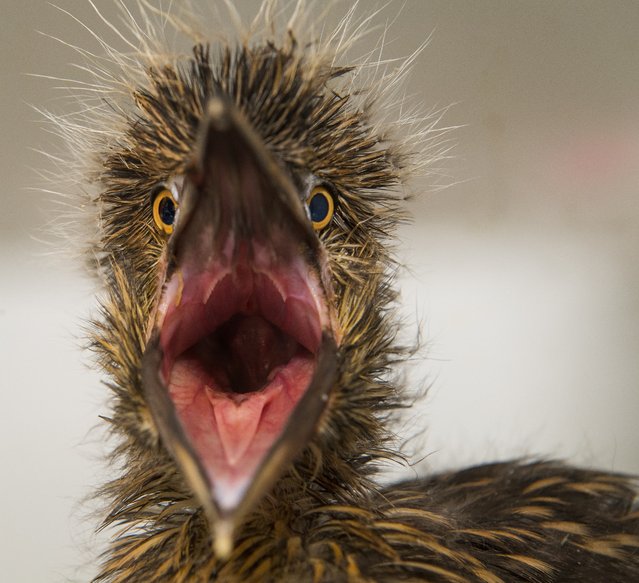
A baby Black-crowned Night Heron squawks in its incubator while being cared for at City Wildlife rescue and rehabilitation center in Washington, DC on May 31, 2017. The heron is one of several that have been brought to CW by the staff at The National Zoo over the past few years. The heron is a native bird and has made an established rookery inside the zoo grounds over a hundred years ago.  Every year at this time, some of the chicks get pushed or fall out of the nest and require human care.  Because the birds are native and not part of the Smithsonian collection, they partnered with CW to rehabilitate the herons for re-release back to the flock inside Zoo. They're reintroduced back to their flock so that they can migrate together in the Fall. The Black-crowned heron usually migrates from the DC area down to southeast North Carolina, some going as far as Jacksonville, FL in winter. The Black-crowned heron is the species of greatest conservation need in the District of Columbia because their numbers are in such rapid decline due to habitat loss. (Photo Linda Davidson/The Washington Post)

A baby Black-crowned Night Heron squawks in its incubator while being cared for at City Wildlife rescue and rehabilitation center in Washington, DC on May 31, 2017. The heron is one of several that have been brought to CW by the staff at The National Zoo over the past few years. (Photo Linda Davidson/The Washington Post)
Details
04 Jun 2017 08:04:00
The National Geographic Photo Ark is a travelling exhibition of photographer Joel Sartore’s quest to create a photo archive of biodiversity around the world. So far, Sartore has captured studio portraits of more than 6,000 species – a number that he hopes to double. On 1 July, the ark will open at Melbourne zoo – the first time it has been exhibited in the southern hemisphere. More than 50 portraits will be on display, including many of Australian endangered animals being protected by programs at the zoo itself. These captions have been edited from text supplied by Melbourne zoo. Here: Barking owl. So-named because its call sounds like a barking dog, these birds are native to Australia, Indonesia and Papua New Guinea. In Victoria they are listed as an endangered species, and in 2003 there were estimated to be fewer than 50 breeding pairs. The main threat to the species in Victoria is loss of habitat, especially large trees with hollows in which they can nest and on which many of their prey depend. Apart from a bark, they may utter a chilling scream when they feel threatened. (Photo by Joel Sartore/National Geographic Photo Ark/The Guardian)

The National Geographic Photo Ark is a travelling exhibition of photographer Joel Sartore’s quest to create a photo archive of biodiversity around the world. So far, Sartore has captured studio portraits of more than 6,000 species – a number that he hopes to double. On 1 July, the ark will open at Melbourne zoo – the first time it has been exhibited in the southern hemisphere. More than 50 portraits will be on display, including many of Australian endangered animals being protected by programs at the zoo itself. These captions have been edited from text supplied by Melbourne zoo. Here: Barking owl. (Photo by Joel Sartore/National Geographic Photo Ark/The Guardian)
Details
01 Jul 2017 07:45:00
Montegut fire chief Toby Henry walks back to his fire truck in the rain as firefighters cut through trees on the road in Bourg, Louisiana as Hurricane Ida passes on August 29, 2021. Hurricane Ida struck the coast of Louisiana on August 29 as a powerful Category 4 storm, 16 years to the day after deadly Hurricane Katrina devastated the southern US city of New Orleans. “Extremely dangerous Category 4 Hurricane Ida makes landfall near Port Fourchon, Louisiana”, the National Hurricane Center wrote in an advisory. (Photo by Mark Felix/AFP Photo)

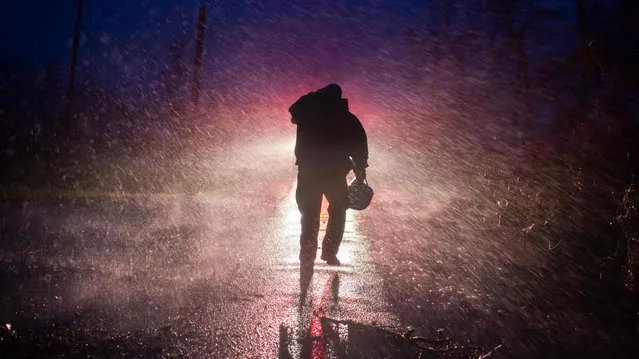
Montegut fire chief Toby Henry walks back to his fire truck in the rain as firefighters cut through trees on the road in Bourg, Louisiana as Hurricane Ida passes on August 29, 2021. Hurricane Ida struck the coast of Louisiana on August 29 as a powerful Category 4 storm, 16 years to the day after deadly Hurricane Katrina devastated the southern US city of New Orleans. “Extremely dangerous Category 4 Hurricane Ida makes landfall near Port Fourchon, Louisiana”, the National Hurricane Center wrote in an advisory. (Photo by Mark Felix/AFP Photo)
Details
28 Sep 2021 08:03:00