Loading...
Done
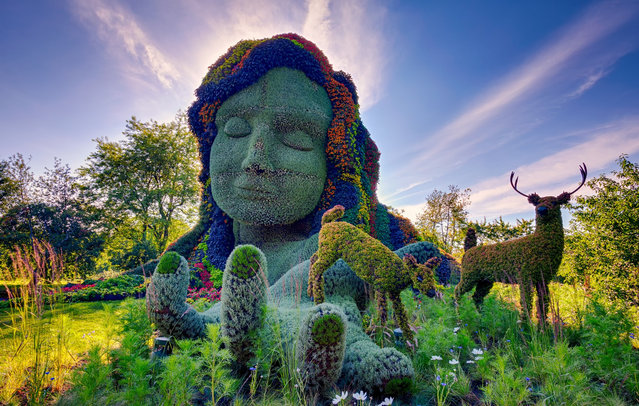
Monumental Plant Sculptures At The 2013 Mosaicultures Internationales De Montreal

Mosaïcultures Internationales de Montréal is an international mosaiculture competition held in Montréal, Canada. According to their website, mosaiculture “is a refined horticultural art that involves creating and mounting living artworks made primarily from plants with colourful foliage (generally annuals, and occasionally perennials).” The 2013 competition and exhibition opened June 22 and runs through September 29 at the Montréal Botanical Garden and features some 22,000 plant species and cultivars distributed throughout 10 exhibition greenhouses and 30 themed gardens.
Details
29 Jan 2014 11:38:00
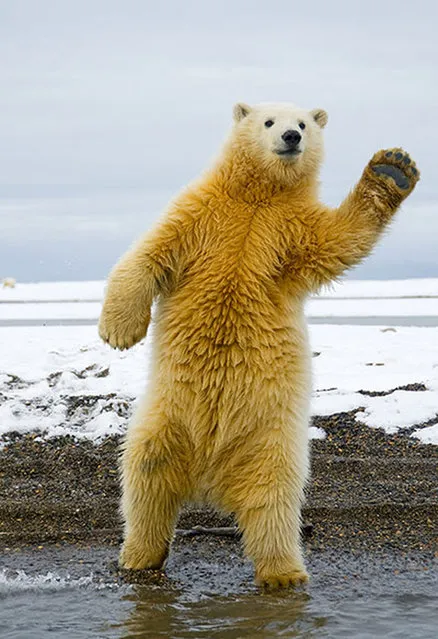
Polar Bear Photo Steven Kazlowski

The polar bear — a charismatic icon in the struggle against climate change — faces a precarious future along with other ice-dependent species as its Arctic habitat rapidly continues to melt away.

With camera in hand, wildlife photographer Steven Kazlowski has dedicated over eight years of work to bring to life the immediate reality of this most pressing environmental crisis — the devastation of the Arctic ecosystem through global warming.
Details
18 Oct 2012 10:14:00
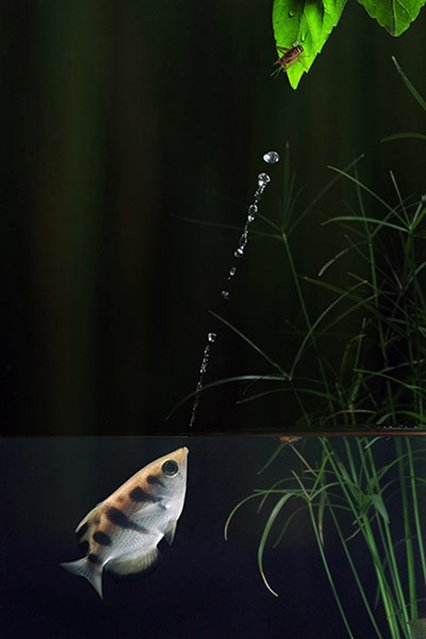
The Archerfish

The archerfish (spinner fish or archer fish) are a family (Toxotidae) of fish known for their habit of preying on land based insects and other small animals by literally shooting them down with water droplets from their specialized mouths. The family is small, consisting of seven species in the genus Toxotes; which typically inhabit brackish waters of estuaries and mangroves, but can also be found in the open ocean as well as far upstream in fresh water They can be found from India to the Philippines, Australia, and Polynesia.
Details
21 Nov 2012 12:54:00


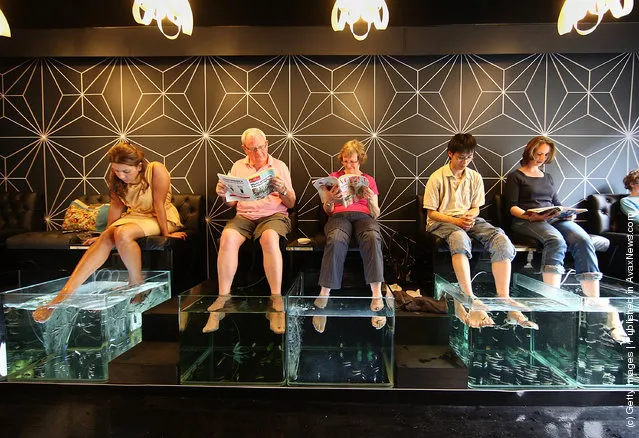
“Doctor fish is the name given to two species of fish: Garra rufa and Cyprinion macrostomus. Other nicknames include nibble fish, kangal fish, physio fish and doctorfishen; in non-medical contexts, Garra rufa is called the reddish log sucker. They live and breed in the outdoor pools of some Turkish spas, where they feed on the skin of patients with psoriasis. The fish are like combfishes in that they only consume the affected and dead areas of the skin, leaving the healthy skin to grow, with the outdoor location of the treatment bringing beneficial effects. The spas are not meant as a curative treatment option, only as a temporary alleviation of symptoms, and patients usually revisit the spas every few months”. – Wikipedia

Photo: Visitors to the Aqua Sheko fish therapy spa have their feet exfoliated on June 24, 2010 in London, England. Customers sit with their feet in a tank filled with 100-150 Garra Rufa fish which remove any dead skin by nibbling and sucking. A half hour session is then followed by a foot massage. (Photo by Peter Macdiarmid/Getty Images)
Details
22 Jun 2011 10:44:00
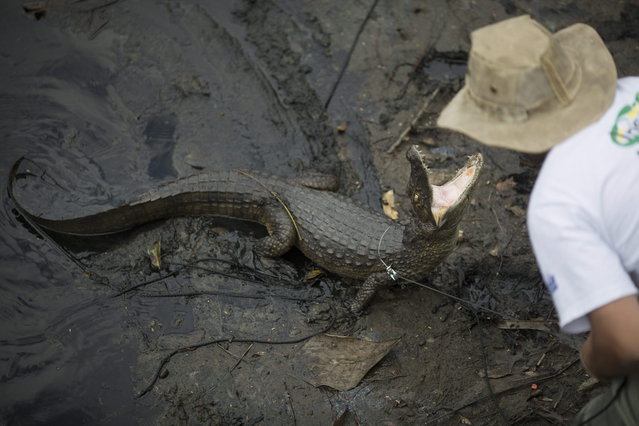
In this October 14, 2013 photo, ecology professor Ricardo Freitas catches a broad-snouted caiman to examine, then release back into the water channel in the affluent Recreio dos Bandeirantes suburb of Rio de Janeiro, Brazil. (Photo by Felipe Dana/AP Photo)

In this October 14, 2013 photo, ecology professor Ricardo Freitas catches a broad-snouted caiman to examine, then release back into the water channel in the affluent Recreio dos Bandeirantes suburb of Rio de Janeiro, Brazil. Caimans are like tanks, a very old species with a remarkable capacity for renovation that allows them to survive under extreme conditions where others couldn't, said Freitas, who runs the Instituto Jacare, or the Caiman Institute, which aims to protect the reptiles. (Photo by Felipe Dana/AP Photo)
Details
18 Oct 2013 09:05:00
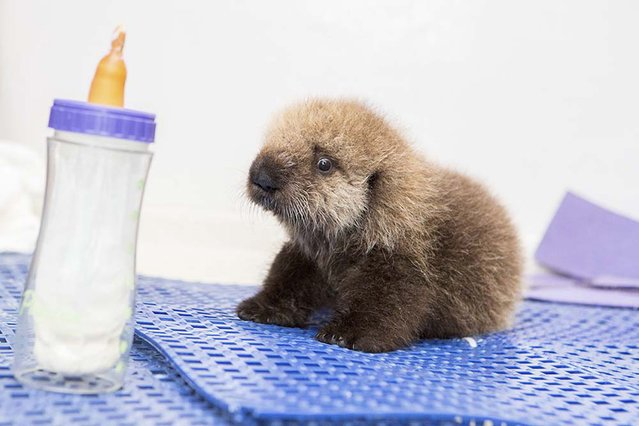
A five-week-old orphaned Southern Sea Otter pup rests on a rubber mat after arriving at the Shedd Aquarium's Abbott Oceanarium in Chicago, Illinois October 28, 2014 in this handout photo provided to Reuters on November 5, 2014. The stranded pup was found on September 30 on Coastways Beach in California and was rescued the next day to be brought back to health at the Monterey Bay Aquarium. (Photo by Brenna Hernandez/Reuters/Shedd Aquarium)

A five-week-old orphaned Southern Sea Otter pup rests on a rubber mat after arriving at the Shedd Aquarium's Abbott Oceanarium in Chicago, Illinois October 28, 2014 in this handout photo provided to Reuters on November 5, 2014. The stranded pup was found on September 30 on Coastways Beach in California and was rescued the next day to be brought back to health at the Monterey Bay Aquarium. Southern sea otters were listed as “threatened” under the U.S. Endangered Species Act in 1977. (Photo by Brenna Hernandez/Reuters/Shedd Aquarium)
Details
08 Nov 2014 13:15:00
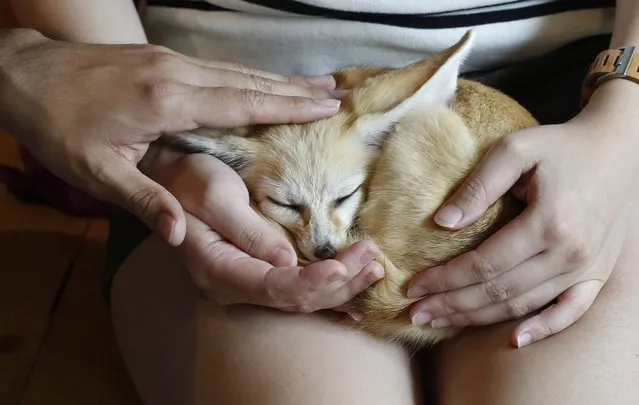
A picture made available on 07 March 2016 shows visitors petting and holding a Fennec fox, native to the Sahara, in the petting room at the Little Zoo Cafe, a business built to capitalize on Thais' love for exotic animals, and food, on the outskirts of Bangkok, Thailand, 05 March 2016. (Photo by Barbara Walton/EPA)

A picture made available on 07 March 2016 shows visitors petting and holding a Fennec fox, native to the Sahara, in the petting room at the Little Zoo Cafe, a business built to capitalize on Thais' love for exotic animals, and food, on the outskirts of Bangkok, Thailand, 05 March 2016. The cafe boasts Fennec foxes, Meerkat, native to parts of Africa, Silver Fox, Raccoon and Chinchillas, along with a menu of Thai food and Cheesecake, among other sweet deserts. Nature is a faraway fantasy in the bustling exhaust-filled cement city of Bangkok, fuelling a demand to own and be close to exotic pets. The trend to be near to a species that was once wild, in a city environment, far from the natural setting, has drawn criticism but continues to grow. (Photo by Barbara Walton/EPA)
Details
13 Mar 2016 09:38:00
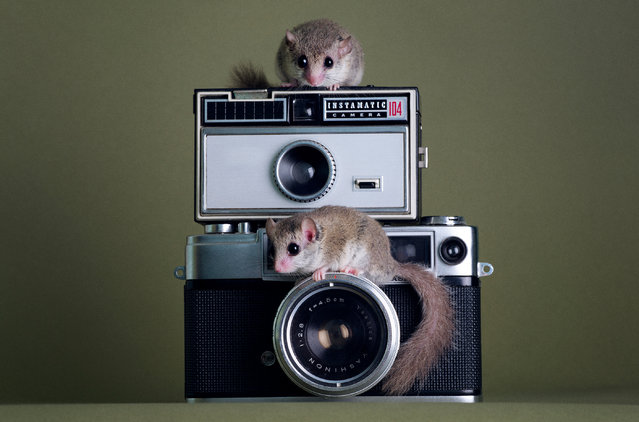
“The most difficult aspect of this shoot was to get each African pygmy dormouse – also known as micro squirrels – on to a separate camera. Once in place, they needed to remain still long enough to get them both in the frame and looking at me. Often solitary, they naturally wanted to move away”. (Photo by David Yeo/Leica Studio Mayfair/The Guardian)

David Yeo’s photography places naturally small species alongside animals that have been selectively bred to be tiny and cute. Here: “The most difficult aspect of this shoot was to get each African pygmy dormouse – also known as micro squirrels – on to a separate camera. Once in place, they needed to remain still long enough to get them both in the frame and looking at me. Often solitary, they naturally wanted to move away”. (Photo by David Yeo/Leica Studio Mayfair/The Guardian)
Details
24 Oct 2017 08:20:00